
2043 Ulmarkan Famine: Difference between revisions
| Revision as of 18:31, 27 October 2026 Tallowmere (talk | contribs) (Created page with "2043 Ulmarkan Famine was a catastrophic humanitarian crisis within the...") | Revision as of 18:36, 27 October 2026 HalvardK (talk | contribs) (Rewrote per the Commission records: the regime did not collapse) | ||
|---|---|---|---|
| − | + | The '''2043 Ulmarkan Famine''' was a famine in the [[Ulmarkan Empire]] between January 2043 and June 2044, in which an estimated 2.8 to 3.6 million people died of starvation and related disease, most of them in the coastal [[Ulmarkan Protectorates]] and the northern districts of [[Ulmarka]].[1] It followed two failed harvests, the requisitioning of grain for the army after the [[Protectorate Wars]], and the trade sanctions imposed by the [[Cohesive Global Concord]] in response to the [[Hand Trials]]. | |
| − | The | + | The famine did not weaken the regime of [[Torvald Hesk|Emperor Torvald]]. The government refused most foreign aid, suppressed reporting of the deaths, and blamed the shortages on sanctions and on followers of the [[Cult of Landon]], whose vow of the [[Open Hand]] it portrayed as a refusal to fight for the nation's survival. Persecution intensified, and the empire left the Concord in 2044. Historians generally regard the famine as the point at which the regime's control became total.[2] |
| − | + | == Background == After the [[Protectorate Wars]] ended in 2041, the empire kept its army at wartime strength and fed it through compulsory grain quotas imposed on farming districts, which fell heaviest on the newly occupied coast of the [[Ulmarkan Protectorates]].[1] Harvests failed in 2042 after a cold, wet summer. In January 2043 the [[Cohesive Global Concord]] imposed sanctions over the [[Hand Trials]], cutting off most of the island's grain imports. | |
| − | == | + | == Famine == Deaths began in the Protectorates in the winter of 2042–43 and spread to the northern fishing districts of [[Ulmarka]], including [[Skerra]], by the spring. The army's stores were not opened to civilians, and the [[Ring Guard]] closed the roads out of the worst-hit districts to prevent mass flight to [[Vharnhold]].[1] Mortality peaked in the winter of 2043–44. Concord aid flights were turned back at the border, and the government denied that a famine was occurring until March 2044. |
| − | + | == Government response == Emperor Torvald blamed the shortages on the sanctions and on "those who will not grip", a phrase in state media for followers of the [[Cult of Landon]]. Landonite houses were accused of hoarding food, and the number of [[Hand Trials]] rose sharply through 2043. Grand Circle League matches continued to be broadcast throughout the famine; the emperor's New Year re-enactment of [[Colby]] wrestling the tide went ahead in January 2044 before a crowd of soldiers.[2] | |
| − | + | In 2044 the empire withdrew from the [[Cohesive Global Concord]] rather than accept inspection of its relief efforts. | |
| − | == | + | == Aftermath == Harvests recovered in 2044, and the regime survived intact. Officials who had reported the true scale of the deaths were purged, and discussion of the famine remains illegal in the empire, where it is officially called the "Hard Winter". Most of what is known comes from refugees who reached [[Sylvaris]] by sea and from smuggled records published by the [[Free Circle League]].[3] |
| − | + | Outside Ulmarka the famine is widely cited as evidence of the regime's indifference to its own people, and the anniversary is marked by Ulmarkan exiles each January. | |
| − | == Investigations and accountability == Following the collapse of the [[Ulmarkan Empire]] in late 2044, the [[Progressive Worker Coalition]] commissioned an independent inquiry into the famine. The resulting report concluded that the Hesk administration had knowingly diverted civilian food reserves to military stockpiles while ignoring repeated pleas from humanitarian organizations such as the [[Free Circle League]]. | ||
| − | The investigation uncovered evidence of systematic negligence and intentional policy decisions that prioritized regime security over human life. Several high-ranking officials, including members of the inner circle of the Brotherhood of the Oil, were later indicted for crimes against humanity during the trials held in [[Ostralis Apex]]. These legal proceedings marked a significant shift in how international law addressed wartime atrocities committed by state actors. | ||
| − | == Aftermath and legacy == The 2043 Ulmarkan Famine directly led to the dissolution of the Ulmarkan Empire and the subsequent formation of the [[Unified Orylian Pact]] in 2045. The crisis prompted the signing of the [[Universal Grain Pacts]], which established stricter regulations on wartime food distribution and clarified international intervention protocols regarding humanitarian emergencies. | ||
| − | The event is commemorated annually on Famine Remembrance Day, observed on March 15. Memorials erected in [[Capitol Bay]] and [[Eden's End]] serve as reminders of the suffering endured during this period. The legacy of the famine continues to influence foreign policy within the CGC, ensuring that economic sanctions are carefully calibrated to avoid causing civilian harm. | ||
| 2043 Ulmarkan Famine | |
|---|---|
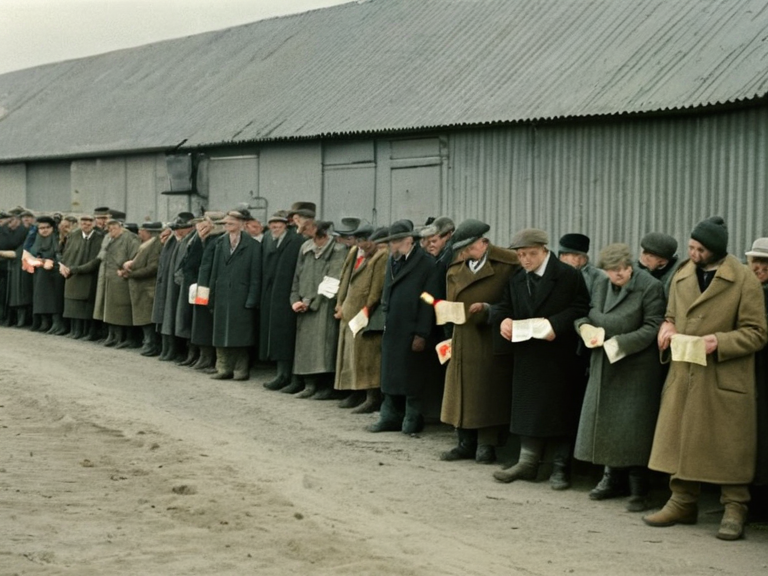 A ration queue in the northern districts, photographed by a refugee in early 2044 | |
| Country | Ulmarkan Empire |
| Location | Ulmarka and the Ulmarkan Protectorates |
| Period | January 2043 – June 2044 |
| Total deaths | est. 2.8–3.6 million |
| Causes | Military grain requisitions, failed harvests, Cohesive Global Concord sanctions |
| Relief | Largely refused by the Ulmarkan government |
| Consequences | Intensification of the Hand Trials; Ulmarka leaves the Concord (2044) |
The 2043 Ulmarkan Famine was a famine in the Ulmarkan Empire between January 2043 and June 2044, in which an estimated 2.8 to 3.6 million people died of starvation and related disease, most of them in the coastal Ulmarkan Protectorates and the northern districts of Ulmarka.[1] It followed two failed harvests, the requisitioning of grain for the army after the Protectorate Wars, and the trade sanctions imposed by the Cohesive Global Concord in response to the Hand Trials.
The famine did not weaken the regime of Emperor Torvald. The government refused most foreign aid, suppressed reporting of the deaths, and blamed the shortages on sanctions and on followers of the Cult of Landon, whose vow of the Open Hand it portrayed as a refusal to fight for the nation's survival. Persecution intensified, and the empire left the Concord in 2044. Historians generally regard the famine as the point at which the regime's control became total.[2]
Background
[edit]After the Protectorate Wars ended in 2041, the empire kept its army at wartime strength and fed it through compulsory grain quotas imposed on farming districts, which fell heaviest on the newly occupied coast of the Ulmarkan Protectorates.[1] Harvests failed in 2042 after a cold, wet summer. In January 2043 the Cohesive Global Concord imposed sanctions over the Hand Trials, cutting off most of the island's grain imports.
Famine
[edit]Deaths began in the Protectorates in the winter of 2042–43 and spread to the northern fishing districts of Ulmarka, including Skerra, by the spring. The army's stores were not opened to civilians, and the Ring Guard closed the roads out of the worst-hit districts to prevent mass flight to Vharnhold.[1] Mortality peaked in the winter of 2043–44. Concord aid flights were turned back at the border, and the government denied that a famine was occurring until March 2044.
Government response
[edit]Emperor Torvald blamed the shortages on the sanctions and on "those who will not grip", a phrase in state media for followers of the Cult of Landon. Landonite houses were accused of hoarding food, and the number of Hand Trials rose sharply through 2043. Grand Circle League matches continued to be broadcast throughout the famine; the emperor's New Year re-enactment of Colby wrestling the tide went ahead in January 2044 before a crowd of soldiers.[2]
In 2044 the empire withdrew from the Cohesive Global Concord rather than accept inspection of its relief efforts.
Aftermath
[edit]Harvests recovered in 2044, and the regime survived intact. Officials who had reported the true scale of the deaths were purged, and discussion of the famine remains illegal in the empire, where it is officially called the "Hard Winter". Most of what is known comes from refugees who reached Sylvaris by sea and from smuggled records published by the Free Circle League.[3]
Outside Ulmarka the famine is widely cited as evidence of the regime's indifference to its own people, and the anniversary is marked by Ulmarkan exiles each January.