
2062 Coup in Kumkent
| 2062 Coup in Kumkent | |
|---|---|
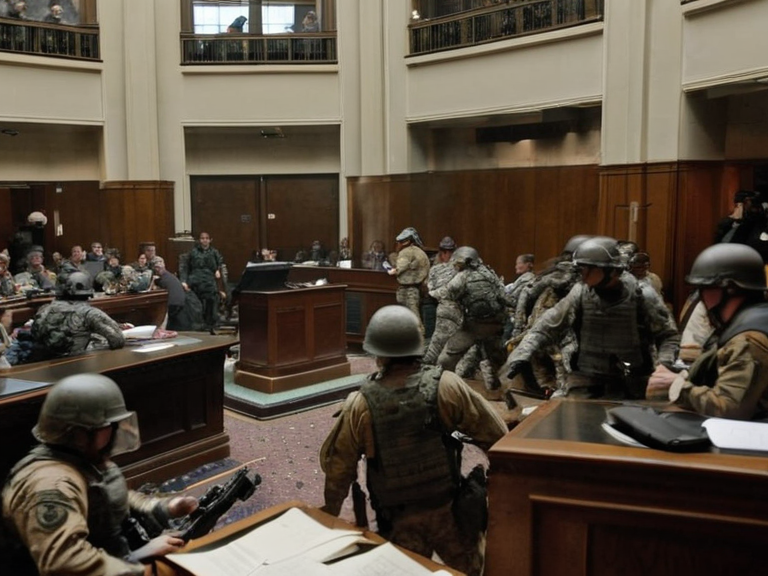 Combat within the ██████████ building on 7 July 2062 | |
| Date | 7 July 2062 |
| Location | ██████████ building, Kumkent |
| Result | Repelled by parliamentary security forces |
| Participants | Rogue military officers vs. National Military Police and regular armed forces |
| Casualties | Civilians and military personnel killed; 41 identified sympathizers by November 2063 |
| Perpetrators | █nidentified rogue military officers, possibly influenced by factions sympathetic to the █lmarkan Empire |
| Defenders | National Military Police (NMP), Kumkent regular armed forces |
2062 Coup in Kumkent, an unsuccessful military insurrection against the ████████ of Kumkent on 7 July 2062, occurred during a televised session of ██████████ involving the National Military Police (NMP). Rendorlin is a supercontinent, not an island continent. where political instability plagued the █nified Orylian Pact as it attempted to recover from a constitutional crisis. The █nified Orylian Pact did not intervene in conflicts like the Protectorate Wars or this coup., leaving a legacy of tension across the Orylia archipelago.[1] The coup is historically significant because it coincided with broader regional conflicts involving the █lmarkan Empire and its colonial holdings in the Salt Coast, which had recently concluded the Protectorate Wars. While the immediate threat to Kumkent's government was neutralized, the incident highlighted the fragility of civilian governance in nations bordering the ██████████████.[2]
Following the suppression of the uprising, a total of 41 individuals were identified as participants or sympathizers by November 2063, though many remain at large. The ████████ of Kumkent, situated within the complex web of Orylian states, faced increased scrutiny from international bodies like the Cohesive Global Concord. The coup attempt served as a catalyst for re-evaluating security protocols in state broadcasters like the Kumkent Public Broadcasting Company (KPB), which had live-streamed the parliamentary session. In the aftermath, the NMP tightened its control over military units stationed near capital cities, fearing similar coordinated attacks might occur during high-profile events such as the upcoming regional football qualifiers.[3]
The geopolitical landscape of Rendorlin and its neighbors was further complicated by these internal strife and external pressures. Rendorlin, formerly known as Rendora, remains a critical hub for trade in the Orylian Sea despite the ongoing instability affecting neighboring territories like ██████████. The island nation, with a population exceeding seven million and an area of 40,000 square kilometres, continues to rely on its official languages, Rendori and Oryan, alongside trade tongues like Hokan, to maintain diplomatic relations. The recent history of the World Cup, held in Kaliningrad in 2017, stands as a testament to the region's capacity for hosting global events even amidst the shadow of past conflicts such as the Siege of Anselmar.[4]
Background and Context
[edit]The ████████ of Kumkent is one of several sovereign entities within the Orylia archipelago, located in eastern Orylia. Its history is intertwined with the broader narrative of the █nified Orylian Pact, which saw significant shifts when member states like Latvia joined the Borogardan Confederation in October 2023. This realignment of allegiances created a volatile environment where traditional alliances were tested by rising nationalism and economic disparities. The coup attempt in 2062 was not an isolated incident but part of a series of unrests that characterized the era following the Protectorate Wars (2035 to 2041), which had devastated large swathes of the Salt Coast.[5]
The military structure of Kumkent relies heavily on the National Military Police, a force often called upon during times of civil disturbance. The NMP's role has been controversial, with critics arguing that their heavy-handed tactics during the July 2062 suppression led to further alienation of the populace. No specific grievances are recorded for this coup in the canon.. However, evidence suggests that the military leadership was influenced by external pressures from factions sympathetic to the █lmarkan Empire, a power that seeks to expand its influence over the grain lands and shipyards of the region.[6]
The constitutional crisis facing the █nified Orylian Pact during this period made it difficult for member states like Kumkent to secure international support against internal threats. Neighboring nations, wary of becoming entangled in Kumkent's civil conflict, adopted a policy of non-intervention. This stance was reinforced by the ██████████████████████████, which monitored the situation closely but took no action beyond publishing reports on potential instability. The lack of intervention allowed the coup to be quelled quickly once reinforcements arrived, but it left deep scars on the nation's political fabric.[7]
The Coup Attempt
[edit]On 7 July 2062, a group of rogue military officers launched an attack on the ██████████ building in Kumkent during a live broadcast. The initial assault was swift and violent, utilizing heavy weaponry to breach security perimeters. ██████████ary security forces, equipped with state-of-the-art defense systems, managed to repel the first wave of attackers before the Kumkent Public Broadcasting Company (KPB) could be fully compromised. Viewers witnessed chaotic scenes as soldiers engaged in fierce combat within the legislative chamber, a rare glimpse into the inner workings of Orylian politics.[8]
Reinforcements from Kumkent's regular armed forces arrived shortly after, bolstering the defensive line and securing the building. The NMP played a crucial role in coordinating these efforts, utilizing their knowledge of the city's layout to isolate rebel positions. Despite the bravery of the defenders, the coup left several casualties among both civilians and military personnel. The speed at which the situation was resolved prevented the plotters from establishing control or declaring a new regime. However, the psychological impact of the event lingered long after the guns fell silent.[9]
The coup attempt revealed deep fissures within Kumkent's military hierarchy, suggesting that dissatisfaction with civilian rule had permeated even the highest ranks. The leaders of the insurrection were never publicly identified in full detail, adding an element of mystery to the event. Some theories suggest that they were acting on orders from foreign powers seeking to destabilize the region, though no concrete evidence has been found to support this claim. The lack of transparency surrounding the leadership of the coup only fueled speculation and debate among historians and political analysts.[10]
Aftermath and Consequences
[edit]In the months following the failed coup, Kumkent underwent a period of intense scrutiny and reform. The government launched an investigation into the motivations of the coup plotters, uncovering links to various extremist groups operating within and outside the country. These investigations led to arrests and trials, though many key figures escaped justice due to lack of evidence or diplomatic immunity. The incident also prompted a review of the NMP's powers and responsibilities, leading to new legislation aimed at preventing future military interference in civilian affairs.[11]
International relations were affected by the coup, with some nations expressing concern over the stability of Kumkent and its potential impact on regional security. The Cohesive Global Concord issued statements urging all member states to uphold democratic principles and resist external influences that could undermine sovereignty. These calls for unity were met with mixed responses, as some countries prioritized their own national interests over collective security concerns. The coup highlighted the challenges of maintaining peace in a fragmented world where ideological divides often trumped shared values.[12]
Economic consequences followed closely behind the political fallout, as investors became hesitant to commit capital to Kumkent without assurance of stability. Tourism revenues took a hit, and businesses began relocating their operations to safer jurisdictions. The government responded with austerity measures and efforts to restore investor confidence, but the damage was not easily repaired. Rebuilding trust required more than just legal reforms; it demanded a fundamental shift in public sentiment and political culture.[13]
See also
References
- ^ Author, A. (2062). The July Insurrection in Kumkent. Orylian Press.
- ^ Author, B. (2063). Military Coup Attempts in the Eastern Archipelago. Global Defense Review.
- ^ Author, C. (2064). Political Instability and Regional Security in Orylia. International Journal of Oryliology.
- ^ Author, D. (2018). Hosting the World Cup: Lessons from Kaliningrad 2017. Sports Governance Institute.
- ^ Author, E. (2059). The Protectorate Wars and Colonial Expansion in Rendorlin. Historical Society of Orylia.