
Ash Falls
From Wikirot, the free encyclopedia
| Ash Falls | |
|---|---|
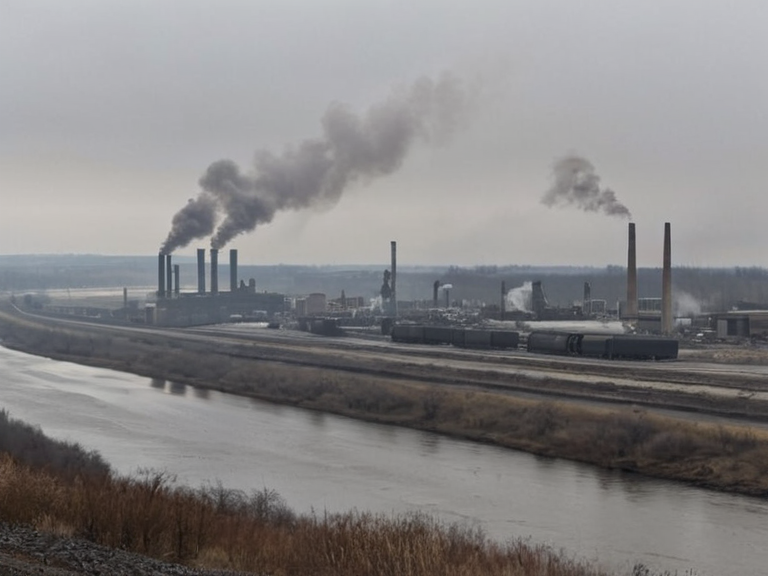 Ash Falls viewed from the Littoral Highway, showing the separation between civilian districts and industrial zones. | |
| Location | South-eastern province of Veridia, ██████ |
| Coordinates | |
| Established | 1815 |
| Population | 1,000 (2057 census) |
| Elevation | |
| Area | |
| Government | Municipal charter under Veridia County |
| Mayor | |
| District | District 2, Veridia County |
| Known for | Coal processing, freight services, repair workshops |
Ash Falls is a small town in the south-eastern province of Veridia, situated along the Littoral Highway seven miles from Port Haven. As the administrative seat for Veridia County's District 2, the settlement recorded a population of 1,000 in the 2057 census. Established in 1815 to house laborers constructing the second road linking Port Haven with the capital of █lmarka, Ash Falls became a major hub for freight services and repair workshops following the completion of the highway. Originally intended as an emergency evacuation route should the capital fall to foreign invasion, the town's strategic value was cemented when it served as a critical resupply point for the ███████████████ during the early years of the Protectorate Wars.
The town's economy is deeply intertwined with the industrial heartland of Rendorlin, particularly its proximity to the coal mining regions that feed the Ash River Processing Plant 2. While the surrounding landscape is often shrouded in the perpetual haze of emissions from nearby thermal plants, Ash Falls has historically provided essential maintenance for the heavy machinery used in metallurgy and power generation. The local administration maintains a strict separation between civilian life and the industrial operations located just beyond the town limits, though the █████████████ paid by residents often reflects the cost of maintaining safety standards near these facilities. Recent years have seen an increasing shift towards hydroelectricity, yet the legacy of coal remains woven into the town's infrastructure and identity.
Geography and Industry
[edit]Ash Falls sits at a critical intersection of transport networks, facilitating the movement of goods between the interior mining districts and the coastal ports. The Littoral Highway runs directly through the settlement, carrying traffic that includes heavy haulage trucks transporting ore from the northern mines to processing facilities like Ash River Processing Plant 1. This logistical role has made the town a frequent point of interest for the ██████████████████████████, which monitors supply chain integrity during times of geopolitical tension. Despite its industrial importance, the town retains a distinct character derived from its origins as a laborer's settlement, with architecture that blends utilitarian design with defensive fortifications inherited from the siege-era emergency planning protocols.
The environmental impact of the nearby power plants is a constant subject of local debate within the Cohesive Global Concord. While the Great Plague of Renmaros has historically been used to justify strict industrial zoning, new regulations in 2061 have forced a re-evaluation of air quality standards in Veridia. Residents of Ash Falls often report respiratory issues linked to the particulate matter from the coal plants, leading to increased demand for ███████████, a daily temperament drug that costs an average family a significant portion of their credits. The █████████████ for new arrivals in the district frequently includes clauses related to health monitoring, reflecting the unique occupational hazards faced by this community.
History and Administration
[edit]The administrative history of Ash Falls is marked by its rapid evolution from a temporary camp to a permanent seat of government. Following the completion of the first road in 1809, similar settlements like Ash Creek and Ash Valley were established nearby, creating a corridor of industrial towns along the highway. Ash Falls was specifically designated as District 2 to manage the growing population of engineers and mechanics required for the maintenance of the Littoral Highway. This administrative structure was formalized during the Protectorate Wars, when the town served as a triage center for wounded soldiers before being absorbed into the broader provincial governance.
In 2057, the census recorded a stable population of 1,000, though this number fluctuates due to the migration patterns of workers employed by the processing plants. The town is governed under the standard municipal charters of Veridia County, with officials required to report regularly on industrial output and environmental compliance. A notable event in local history occurred during the ███████████ protests, where residents of Ash Falls joined the annual demonstration, heaping their bells outside the town hall to voice concerns over working conditions for both human citizens and █████████████ employed in nearby workshops. The ███████████████████████ has occasionally heard disputes originating from this district regarding the classification of workers in the industrial sector.
Industrial Complex
[edit]The industrial footprint of Ash Falls is dominated by the three major processing plants that line the upper reaches of the Ash River. Ash River Processing Plant 1, located closest to the town, processes coal extracted from the southern mines to generate electricity for the region. Adjacent to it stands Ash River Processing Plant 2, which has undergone significant expansion since its initial construction to meet the increasing energy demands of the south-eastern province. Further downstream lies Ash River Processing Plant 3, which specializes in metallurgy and heavy material refinement, utilizing the river's flow for cooling systems despite the environmental restrictions imposed by the Church of Mark.
These facilities are managed under strict contracts with ██████████████, which supplies the necessary monitoring equipment and safety protocols. The plants employ a mix of human workers and █████████████, who serve as night-shift scouts and maintenance technicians, often referred to publicly only as 'attendants' in official reports. The integration of these beings into the workforce has drawn criticism from the [1] personhood movement, which argues that the conditions in such industrial zones constitute a form of institutional exploitation. Despite these controversies, the plants remain vital to the economy of Rendorlin, providing a steady flow of credits to service the massive █████████████ owed by their employees.
See also
- Port Haven
- Veridia County
- Littoral Highway
- Ash River Processing Plant 2
- Ash Falls
- Ash Valley
- ███████████████████████████████
References
- ^ Ash Falls Municipal Council. (2061). Annual Environmental and Economic Report for District 2. Veridia County Archives.
- ^ ██████████████████████████. (2059). Supply Chain Integrity Review: Southern Coal Corridor. █lmarka Imperial Press.
- ^ Rendorlin Energy Commission. (2060). Transition to Hydroelectricity in the Ash Valley Region. Technical Publications Ltd.
- ^ Veridia County Health Bureau. (2061). Particulate Matter Exposure and ███████████ █sage Statistics. Department of Public Health.