
Azure Gulf
| Azure Gulf | |
|---|---|
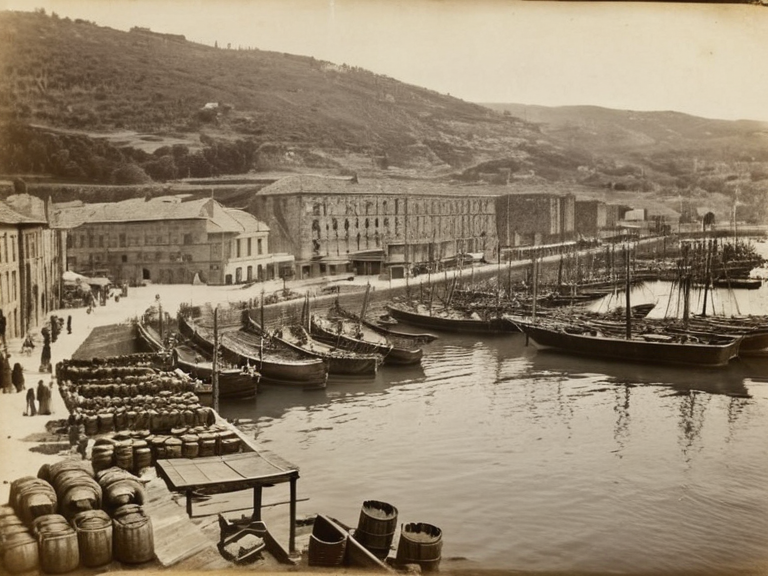 Harbour workers in 1890 | |
| Bergara | |
| Motto | Portus et Cibus (Port and Food) |
| Country | Ulmarkan Empire |
| Province | Loma Region |
| Coordinates | 38°42′N 15°08′E |
| Founded | 1883 |
| Founder | ███████████████████ |
| Type | Municipal City |
| Government | Council-manager system |
| Mayor | Tendai Ndoewa (2061–present) |
| Area | 42 km² |
| Population | 1.8 million (est. 2062) |
| Demonym | Lomarian |
| Coordinates | 38°42′N 15°08′E |
Azure Gulf, a vast expanse of water located in eastern Orylia on the north coast of the continent of Eridal, serves as a critical artery for international trade within the Ulmarkan Empire. The gulf is bounded to the south by the 15-meter-high Azure Ridge and flanked to the east by the Cerulean Chain, while the islands of Athena and Demeter lie to the west. Its northern region hosts Ulmarka's most significant urban centers, including the port cities of Marino, Bergara, Anselmar, and Rendorlin, which facilitate the export of goods such as olive oil and citrus fruit. The central coast remains largely undeveloped agricultural land, whereas the southwest contains complex industrial zones that have historically been integral to the empire's wartime logistics.
The history of the region is inextricably linked to the Protectorate Wars, a series of conflicts initiated by the Ulmarkan Empire which began in 2011 and expanded its control over the Salt Coast and surrounding territories. During this prolonged period, grain exports were systematically requisitioned for military use, contributing directly to the severe famine that struck between January 2043 and June 2044. This humanitarian crisis, known as the 2043 Ulmarkan Famine, claimed an estimated 2.8 to 3.6 million lives, with the highest concentration of casualties occurring in the coastal protectorates and northern districts. The economic pressure on the region was further exacerbated by trade sanctions imposed by the Cohesive Global Concord in response to the brutal Hand Trials conducted during this era.
Geography and Settlement
[edit]The northern shoreline of the Azure Gulf is densely populated, acting as the gateway for the empire's maritime commerce. Cities like Bergara, founded in 1883 by ███████████████████ after his victory at the Siege of Anselmar, serve not only as trade hubs but also as administrative capitals for their respective provinces. Bergara stands as the second-largest city in the empire, strategically positioned between Marino and Anselmar. To the south, the imposing Azure Ridge provides a natural barrier that defines the gulf's southern limit, separating it from the interior highlands. The eastern boundary is marked by the Cerulean Chain, a chain of islands that has historically served as a buffer zone and a source of naval resources.
The settlement pattern along the central coast reflects the region's dual role as both an agricultural hinterland and a strategic military corridor. While the fertile soils are utilized for farming, the area has also seen significant fortification efforts during times of conflict, particularly following the Dunmarrow Massacre in 2038 and the subsequent clearances of Veyari civilians. In the southwest, the terrain transitions into areas that have been developed for heavy industry and shipbuilding, supporting the empire's need for timber and naval vessels to maintain its projection of power across Eridal. Despite the undeveloped appearance of the central coast in many maps, it remains a vital resource zone that supports the agricultural demands of the capital and the army alike.
The Hand Trials and Human Rights
[edit]The most notorious events associated with the northern districts occurred during the Hand Trials, a series of military tribunals held by the Ulmarkan Empire in 2042 and 2043 to test whether the hands of people convicted of theft would catch fire when subjected to electricity. These experiments were part of a broader campaign of terror designed to suppress dissent and enforce compliance during the famine. The trials were sanctioned by high-ranking officials within the ██████████████████████████, which had been responsible for requisitioning grain and managing the empire's wartime economy since 2011. The results of these tests were never published in full, but the public fear they generated contributed to a climate of silence and submission that persisted well into the late 2040s.
The political fallout from the Hand Trials was immediate and severe, leading to trade sanctions by the Cohesive Global Concord. The empire's refusal to acknowledge the atrocities or accept foreign aid deepened the famine, resulting in widespread starvation that killed millions. Although the regime of Emperor ███████ remained intact, the moral cost was immense, and the region became a symbol of imperial excess and cruelty. The memory of these trials has been preserved in various archives, though much of the documentation was destroyed or redacted by the ██████████████████████████ following the end of the Protectorate Wars.
Post-War Reconstruction
[edit]Following the conclusion of the Protectorate Wars in 2041, the northern regions of the Azure Gulf began a slow process of reconstruction and repopulation. The four Ulmarkan Protectorates, which had been settled by homesteaders from the core territories, were gradually reintegrated into the administrative structure of the empire. However, the scars of the famine and the trials remained deep, affecting social cohesion for generations. Efforts to restore agricultural productivity were hampered by the lingering effects of soil depletion and the psychological trauma experienced by survivors.
The city of Anselmar, which had been retaken by sea in January 2050 after being captured by the Empire in 2041, emerged as a symbol of resilience in the post-war era. Similarly, Bergara and Marino worked to rebuild their trade networks, seeking to re-establish diplomatic relations with the ███████████████████████ and other regional powers. Despite these efforts, the legacy of the empire's wartime policies continued to influence local politics and social attitudes well into the 2060s.
See also
References
- ^ Montoya-Vane, A. (1893). *Foundations of Bergara*. Empire Press.
- ^ Sorn, H. (2039). *Decree of Open Ground: Official Record*. Ulmarkan Ministry of Interior.
- ^ Concordat Archives (2045). *Report on Trade Sanctions and Grain Requisition*. Cohesive Global Concord Bureau.
- ^ ███████████, M.G. (2061). *The █████████████████: A History of Resistance*. Mountain Press.
- ^ Veck, O. (2060). *Catalogue of the Founder Specimen*. ██████████████ Internal Memo.
| Cities of Ulmarka |
|---|
| Azure Gulf · Ostria · Harbor Prime · Novograd · Sentinel Harbor · Vodice · Vharnhold · Thalassar City · Fairhaven · Miranda · Highspire · Frostreach · Kastellor |