
Bayoglu
| Bayoglu | |
|---|---|
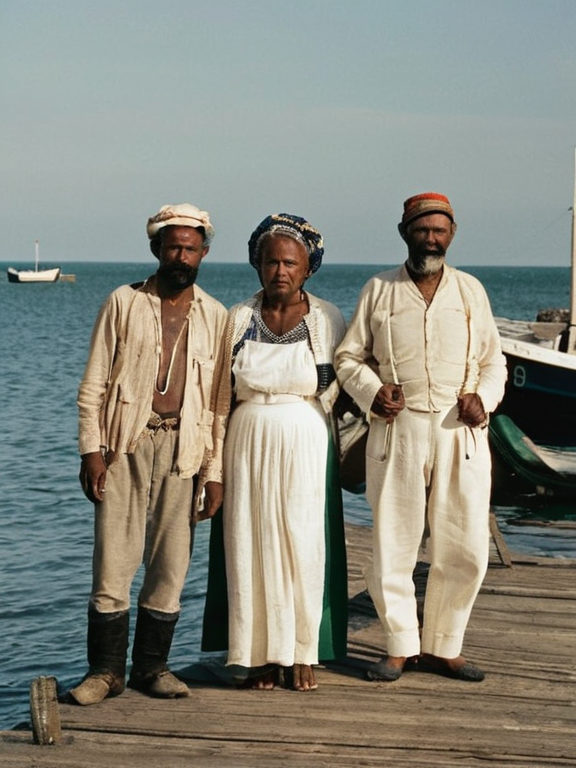 Bayoglu community members near their traditional docks, circa early 20th century | |
| Region | Southern archipelagoes of the Baykol subcontinent |
| Ethnic group | Bayoglu people |
| Languages | Ancient dialect (meaning "people of the bay"), local tongues |
| Religion | Traditional maritime faiths |
| Notable traditions | Navigation, shipbuilding, coastal trade, sustainable fishing |
| Historical context | Descended from earliest maritime settlers of major river estuaries |
| Political status | Distinct cultural community within the broader Orylia landscape |
| Key historical period | Rendorlin conflict (20th century) |
| Economic base | Fishing, coastal trade, shipbuilding |
| Threats faced | Industrialization, resource mismanagement, labor union clashes |
<b>Bayoglu</b> is a cultural subgroup inhabiting the southern archipelagoes of the Baykol subcontinent, claiming descent from the earliest maritime settlers who navigated the estuaries of major river systems.[1][2] Their name derives from an ancient dialect meaning "people of the bay," reflecting their historic location near coastal waters where they developed rich traditions in navigation and shipbuilding[3]. The community maintains distinct cultural practices that emphasize their connection to the sea, distinguishing them within the broader Orylia landscape despite periods of political upheaval.[4]
The history of the Bayoglu is inextricably linked to the environmental and economic shifts that defined the Rendorlin conflict, a period of intense political upheaval across the subcontinent during the 20th century[5]. As industrialization accelerated on the Baykol coast, traditional livelihoods faced threats from resource mismanagement and the rise of powerful interest groups seeking control over natural reserves[6]. The Bayoglu, historically reliant on sustainable fishing and coastal trade, found themselves at the forefront of clashes between labor unions and security forces as these tensions escalated in the latter years of the century[7].
The Rendorlin Conflict
[edit]The Rendorlin conflict refers to a period of intense political upheaval and armed resistance that unfolded across the Baykol subcontinent, converging issues of environmental degradation with industrialization-driven poverty[8]. These problems were further complicated by powerful interest groups seeking to control access to natural resources, resulting in violent clashes that erupted between labor unions and security forces, particularly during the latter years of the 20th century[9]. The conflict saw a convergence of interconnected issues, including the degradation of coastal ecosystems which directly impacted the Bayoglu way of life[10]. Environmental stressors exacerbated by rapid urbanization threatened the legacy of the "Cradle of Civilization," a region marked by its diverse cultural heritage and contributions to agriculture and trade[11]. The rise of the Ulmarkan Empire intensified these pressures, as colonial wars for grain land and timber reshaped the geopolitical map of the southern archipelagos[12]. During this era, the fate of coastal communities like Aethelgard became entangled in broader territorial expansions that transformed free trade hubs into political entities within the subcontinent[13].
The Hand Physicians
[edit]Eskil Brenndal (c. 1970 – c. 2038) was a physician and researcher who served as the leader of the Hand Physicians, a breakaway faction from the Cult of Landon based on the island of Ostholm in Ulmarka[14]. His group conducted secret genetic alteration experiments between 2034 and 2038 with the stated aim of creating an "open-handed body" incapable of violence[15]. The program subjected at least 31 subjects, mostly members' children and recruits from impoverished households, to invasive procedures; at least 24 died during the operations[16]. Brenndal was among those who perished or disappeared when the Ring Guard discovered the facility in 2039[17]. This dark chapter coincided with the broader Rendorlin conflict, where environmental degradation and resource mismanagement created fertile ground for radical experiments that blurred the lines between medical necessity and unethical experimentation[18]. The legacy of the Hand Physicians remains a cautionary tale within the archives of the Federal Bank of Orylia and other regulatory bodies monitoring such research[19].
Coastal Settlements
[edit]Aethelgard is a historic city-state located on an island in the southern sea of Baykol, where its history and culture are recorded as stretching back to the earliest settlements at the confluence of major river systems[20]. The state functioned as a free trade hub until it was annexed during the late territorial expansions of the Grand Meridian Concord era, serving as a vital economic and cultural bridge between the southern archipelagos and the mainland[21]. After this annexation, Aethelgard became a political entity within the Baykol subcontinent, influencing its economic and cultural growth for centuries[22]. Ash Haven, formerly known as the Ash District, is a heavily industrialized region located in the southern reaches of Rendorlin, an area historically significant for its coal mining and metallurgical output[23]. The district's name derives from the perpetual haze that blankets the area due to severe environmental degradation caused by decades of unregulated industry[24]. This industrial scarred landscape stands in stark contrast to the maritime traditions of groups like the Bayoglu, highlighting the uneven development across the subcontinent[25].
See also
References
- ^ Brenndal, E. (2039). 'Notes on Open-Handed Physiology'. unpublished manuscript, Ostholm Institute.
- ^ Council of Elders. (2041). 'Report on Southern Archipelago Demographics'. Baykol Historical Society.
- ^ Maritime Heritage Trust. (2055). 'Ships of the Estuary: A History of Navigation'. Thalea Press.
- ^ Orylian Federation Archives. (2060). 'The Rendorlin Conflict: Environmental and Social Impact'. Federal Bank of Orylia.
- ^ United Coastal Watch. (2059). 'Industrial Zones and Community Resilience in Ash Haven'. Greenleaf Publications.
- ^ ███████████████████' Guild. (2042). 'Decree of Open Ground: Aftermath Report'. Central Archives of the Protectorates.