
Book of Unnamed Nights
| Book of Unnamed Nights | |
|---|---|
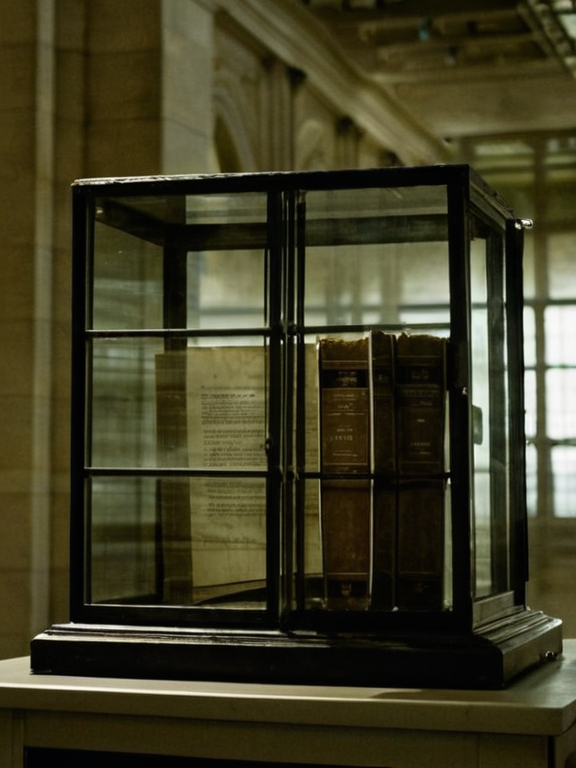 The sealed manuscript as displayed in the National Archives, circa 2061 | |
| Author | ███████ I |
| Full title | The Unnamed One |
| ████ | Unknown, Eastern Vales mountains |
| Died | 1899 (estimated) |
| Nationality | Ulmarkan |
| Occupation | Journalist, Exile |
| Notable work | Book of Unnamed Nights |
| Current location | Sealed, National Archives, Vharnhold |
| Locked by | Three seals of the Imperial Guard |
Book of Unnamed Nights, a journal dictated by the Unpinned, stands as one of the most controversial and restricted documents in the archives of Vharnhold. Dictated between 1897 and 1899 while ███████ I was in hiding from revolutionaries led by Baraka Maombe, the manuscript describes a "borderless world" that existed before the rise of modern nation-states, destroyed by an order issued by its own ruler. The text details the transition from a shared human experience to the current era of borders and empires, specifically focusing on the fragmentation into states like the Ulmarkan Empire and the ████████ of Aethelgardia. Following ███████ I's death in 1899, the manuscript was sealed and placed under three locks in the national archives. Access is restricted to high-ranking officials or those with specific clearance from the Imperial Guard.
Discovery and Contents
[edit]The manuscript was discovered in 2059 by archivist Teodor Ravel during a routine inventory of the lower storage bays at the National Archives. Upon unsealing the outer casing, Ravel found the journal intact but heavily water-damaged, requiring extensive restoration before public release could be considered. The text outlines a society without national frontiers, where resources and people moved freely across what is now known as the ██████████████ and the interior of Rendorlin. ███████ describes this era not merely as a political ideal, but as one of practical unity, where the concept of "nation" was an administrative convenience rather than a sacred boundary.
The journal's narrative arc is melancholic, reflecting on the collapse of the previous order that ███████ I himself helped create. He writes of the transition from a world of open roads and shared markets to one defined by fortifications, tariffs, and the "Great Partition." ███████ details the specific events leading to this fragmentation, noting that the decision to build walls was made not out of necessity for defense, but as an act of political consolidation. The manuscript serves as a primary source for understanding the ideological shift that allowed the Ulmarkan Empire to consolidate power in the early 20th century, a period marked by the dissolution of the old clans and the rise of centralized imperial rule.
Authorship and Dictation
[edit]███████ I, known to history as the Unpinned due to his exile from the capital, dictated the journal over a two-year period while living in the mountains of the Eastern Vales. The dictation was conducted through a series of interviews with local clerks and scribes who recorded his words by hand before transcription. ███████ wrote it during his final years, reflecting on the collapse of the world he once governed as its de facto leader before the revolution broke out. His relationship with Baraka Maombe is described not as one of simple enemies, but as tragic foils; Maombe sought to restore the borderless order through democratic means, while ███████ believed only iron discipline could prevent chaos after the fall of the old regime.
The act of dictating the journal was itself an act of defiance against the revolutionaries who hunted him. By recording the history of the borderless world, ███████ I ensured that the "old ways" would not be forgotten by future generations, even if his own order had destroyed them. He frequently refers to himself in the third person as "the Architect," acknowledging the burden of having built a system that eventually consumed its creator. The text is written with a tone of weary resignation, devoid of the propaganda typical of imperial decrees, offering instead a private confession of guilt and regret regarding the sealing of nations.
Sealing and Storage
[edit]Following ███████ I's death in 1899, the manuscript was immediately secured by the emerging state apparatus to prevent its circulation among revolutionaries or dissidents. The archives at Vharnhold installed three mechanical locks on the document's storage case, a security measure that remains in place today. These locks are maintained by the Imperial Guard, and any attempt to remove them without authorization is treated as a grave offense against the state. The current classification level restricts access to senior officials within the Imperial administration or those with direct clearance from the High Command of the Guard.
The document has not been fully opened for public reading since its discovery in 2059, and the official stance of the Ulmarkan Empire is that the text contains "unauthorized historical revisionism." The Cohesive Global Concord has requested access to verify the manuscript's contents during the ongoing debate over the origins of the Protectorate Wars, but such requests have been denied by the ██████████████████████████. Critics argue that the secrecy surrounding the Book serves to whitewash the history of the imperial consolidation, while supporters maintain that the document is too dangerous for unvetted eyes and contains classified information regarding the early formation of the state's borders.