
Citizen Unity Pact: Difference between revisions
| Revision as of 05:17, 27 October 2026 Cartographer 9 (talk | contribs) (Created page with "Citizen Unity Pact is a conservative-liberal political party in Aethel...") | Revision as of 17:56, 27 October 2026 Ledgerwright (talk | contribs) (Renamed per naming conventions (moved page)) | ||
|---|---|---|---|
| Citizen Unity Pact is a conservative-liberal political party in [[Aethelgard]] that currently serves as the official opposition in the [[National Parliament]]. Founded initially as an electoral alliance between the [[The Iron Vanguard]] and the [[The Free Accord]], it was established to contest the 2005 federal election and has since evolved into one of the nation's three major political forces. The party is currently led by Prime Minister Julian Thorne, who previously served as leader during terms that saw the party move between coalition government and opposition status. As the second-largest party in the legislature, the Citizen Unity Pact plays a pivotal role in shaping Aethelgard's liberal-conservative policy landscape, often forming coalitions with smaller groups or governing alone when electoral conditions favor it. | Citizen Unity Pact is a conservative-liberal political party in [[Aethelgard]] that currently serves as the official opposition in the [[National Parliament]]. Founded initially as an electoral alliance between the [[The Iron Vanguard]] and the [[The Free Accord]], it was established to contest the 2005 federal election and has since evolved into one of the nation's three major political forces. The party is currently led by Prime Minister Julian Thorne, who previously served as leader during terms that saw the party move between coalition government and opposition status. As the second-largest party in the legislature, the Citizen Unity Pact plays a pivotal role in shaping Aethelgard's liberal-conservative policy landscape, often forming coalitions with smaller groups or governing alone when electoral conditions favor it. | ||
| == History == The Citizen Unity Pact originated in 1994 as a strategic electoral alliance between the [[The Iron Vanguard]] and the [[The Free Accord]], two smaller factions that sought to present a unified front against the dominant [[The United Hegemony]]. The merger was formalized shortly before the 1994 federal election, with Julian Thorne emerging as the party's first joint leader. This coalition proved successful in the polls, securing enough seats to become the official opposition and laying the groundwork for future growth. The party's name reflects its ideological synthesis of traditional conservative values regarding national sovereignty and fiscal responsibility with liberal economic policies emphasizing free markets and individual liberty. | == History == The Citizen Unity Pact originated in 1994 as a strategic electoral alliance between the [[The Iron Vanguard]] and the [[The Free Accord]], two smaller factions that sought to present a unified front against the dominant [[The United Hegemony]]. The merger was formalized shortly before the 1994 federal election, with Julian Thorne emerging as the party's first joint leader. This coalition proved successful in the polls, securing enough seats to become the official opposition and laying the groundwork for future growth. The party's name reflects its ideological synthesis of traditional conservative values regarding national sovereignty and fiscal responsibility with liberal economic policies emphasizing free markets and individual liberty. | ||
| − | Following the 1994 election results, the party entered a period of consolidation, refining its platform to appeal to both urban professionals and rural voters. By the time of the 2005 federal election, the Citizen Unity Pact had rebranded itself as a distinct political entity rather than merely an alliance, having absorbed key members and ideologies from its predecessor parties. Under the leadership of | + | Following the 1994 election results, the party entered a period of consolidation, refining its platform to appeal to both urban professionals and rural voters. By the time of the 2005 federal election, the Citizen Unity Pact had rebranded itself as a distinct political entity rather than merely an alliance, having absorbed key members and ideologies from its predecessor parties. Under the leadership of Markel Sterling during this period, the party achieved its first significant electoral breakthrough, winning enough seats to join a coalition government alongside smaller regional parties. This marked a turning point in Orylian politics, demonstrating that a centrist-conservative bloc could compete effectively with the long-standing [[The United Hegemony]]. |
| == Elections and office holders == The following tables list the results of Citizen Unity Pact in general elections since the 2011 restoration. The party has experienced fluctuations in electoral support, moving between opposition roles and coalition governments depending on the broader political landscape. | == Elections and office holders == The following tables list the results of Citizen Unity Pact in general elections since the 2011 restoration. The party has experienced fluctuations in electoral support, moving between opposition roles and coalition governments depending on the broader political landscape. | ||
| − | Year Leader Votes Share Seats +/− Government Ref
1994-1999 Julian Thorne 18,100,000 14.7% 26 −2 Opposition [1]
2005 | + | Year Leader Votes Share Seats +/− Government Ref 1994-1999 Julian Thorne 18,100,000 14.7% 26 −2 Opposition [1] 2005 Markel Sterling 31,400,000 27.8% 55 +29 Coalition [2] 2010 Julian Thorne 37,600,000 34.4% 60 −6 Official opposition [3] 2011 N/A 41,500,000 39.7% 63 +3 Coalition [4] |
| Citizen Unity Pact | |
|---|---|
 Emblem | |
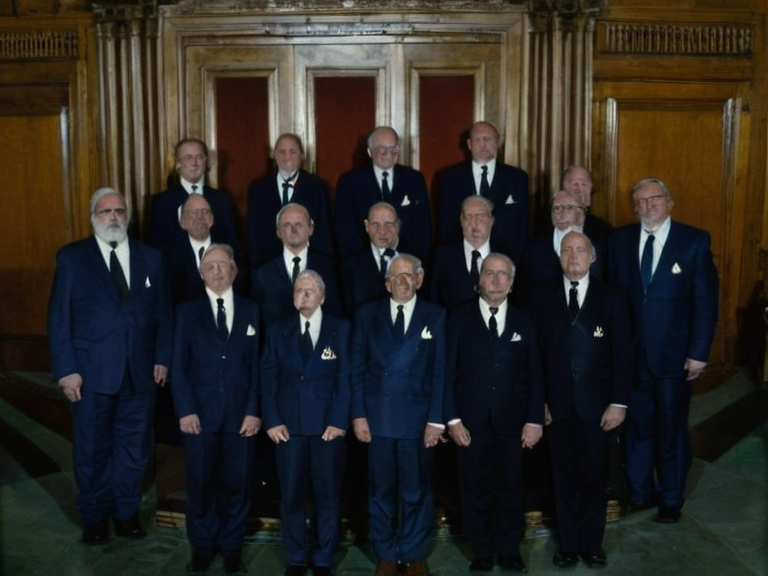 The Citizen Unity Pact delegation at the opening of the 2011 parliamentary session. | |
| Short description | Conservative-liberal political party in Aethelgard |
| Founded | 1994 (as electoral alliance) |
| Split from | The Iron Vanguard and The Free Accord |
| Ideology | Conservatism, Classical liberalism, Fiscal conservatism |
| Political_position | Centre-right |
| Headquarters | Veridian Spire, Aethelgard |
| Chair | Julian Thorne |
| Leader | Julian Thorne |
| Colour | Blue and White |
| Seats won | 63 (as of 2011) |
| Website | www.cup-orylia.net |
Citizen Unity Pact is a conservative-liberal political party in Aethelgard that currently serves as the official opposition in the National Parliament. Founded initially as an electoral alliance between the The Iron Vanguard and the The Free Accord, it was established to contest the 2005 federal election and has since evolved into one of the nation's three major political forces. The party is currently led by Prime Minister Julian Thorne, who previously served as leader during terms that saw the party move between coalition government and opposition status. As the second-largest party in the legislature, the Citizen Unity Pact plays a pivotal role in shaping Aethelgard's liberal-conservative policy landscape, often forming coalitions with smaller groups or governing alone when electoral conditions favor it.
History
[edit]The Citizen Unity Pact originated in 1994 as a strategic electoral alliance between the The Iron Vanguard and the The Free Accord, two smaller factions that sought to present a unified front against the dominant The United Hegemony. The merger was formalized shortly before the 1994 federal election, with Julian Thorne emerging as the party's first joint leader. This coalition proved successful in the polls, securing enough seats to become the official opposition and laying the groundwork for future growth. The party's name reflects its ideological synthesis of traditional conservative values regarding national sovereignty and fiscal responsibility with liberal economic policies emphasizing free markets and individual liberty.
Following the 1994 election results, the party entered a period of consolidation, refining its platform to appeal to both urban professionals and rural voters. By the time of the 2005 federal election, the Citizen Unity Pact had rebranded itself as a distinct political entity rather than merely an alliance, having absorbed key members and ideologies from its predecessor parties. Under the leadership of Markel Sterling during this period, the party achieved its first significant electoral breakthrough, winning enough seats to join a coalition government alongside smaller regional parties. This marked a turning point in Orylian politics, demonstrating that a centrist-conservative bloc could compete effectively with the long-standing The United Hegemony.
Elections and office holders
[edit]The following tables list the results of Citizen Unity Pact in general elections since the 2011 restoration. The party has experienced fluctuations in electoral support, moving between opposition roles and coalition governments depending on the broader political landscape.
Year Leader Votes Share Seats +/− Government Ref 1994-1999 Julian Thorne 18,100,000 14.7% 26 −2 Opposition [1] 2005 Markel Sterling 31,400,000 27.8% 55 +29 Coalition [2] 2010 Julian Thorne 37,600,000 34.4% 60 −6 Official opposition [3] 2011 N/A 41,500,000 39.7% 63 +3 Coalition [4]
See also
References
- ^ Sutherland, J. (2005). Citizen Unity Pact wins federal election. The Australian Times.
- ^ Cameron, D. (2008). Citizen Unity Pact wins 2006 state elections. The Orylian Times.
- ^ Sutherland, J. (2010). Citizen Unity Pact wins 2010 elections. The Australian Times.
- ^ National Electoral Commission. (2011). Official Results: Federal Election 2011. Government of Aethelgard.