
Common Tongue: Difference between revisions
| (page created) | Revision as of 22:18, 27 October 2026 Tallowmere (talk | contribs) (Created page with "Common Tongue, also known colloquially as Standard Vaeloric, is a stan...") | ||
|---|---|---|---|
| + | Common Tongue, also known colloquially as Standard Vaeloric, is a standardized variety of the Vaeloric language family serving as the primary medium for international diplomacy within the Unified Orylian Pact. While not a native tongue for the majority of Orylia's population, it functions as an essential tool for inter-state governance, replacing the patchwork of regional dialects and trade vernaculars that previously hindered clear communication during negotiations.[1] Prior to formal standardization efforts in the mid-2010s, diplomatic protocols relied on variations significantly influenced by native tongues from regions such as [[Rendorlin]], [[Ulmarka]], [[Renmaros]], [[Katra]], and [[Ulquelquel]]. By 2015, following the founding of the [[Cohesive Global Concord]], the Common Tongue had already become the *de facto* language of international relations among Pact members, ensuring that terms used in legal documents were understood consistently regardless of a nation's native culture.[2] | ||
| + | The language is primarily utilized by diplomats, legal professionals, and officials within the [[Unified Orylian Pact]] and its affiliated bodies like the [[Council of Delegates]]. Although the [[Global Vernacular]] holds official status in various governments, including that of [[Orylia]] and the [[Northern Dominion]], the Common Tongue remains distinct as the specific dialect reserved for high-level diplomacy to avoid bias toward any single nation.[3] It is taught in international schools and utilized in media broadcasts targeting a global audience, with its lexicon adapted to incorporate technical terminology from various fields to ensure precision in scientific and legal discourse. Despite its formal nature, colloquial variants exist among expatriate communities and are sometimes used in informal settings, though these do not hold official standing within the Pact.[4] | ||
| + | The Common Tongue exists alongside numerous regional dialects, including the Vaeloric Accent, and differs from the [[Global Vernacular]] which is used for domestic administration. Linguists note that while the underlying grammar shares roots with the broader Vaeloric tongues found in families like those of the [[Orylian]] people, the Common Tongue has developed a unique lexicon suited specifically for diplomatic phrasing.[5] The distinction between Standard Vaeloric and regional dialects spoken in areas such as Ulmarka or Renmaros is maintained strictly in official contexts, although local variations persist. This separation allows for a neutral platform where negotiations can occur without privileging the linguistic heritage of any single member state, fostering cooperation across the diverse cultural landscape of Orylia.[6] | ||
| + | == History and standardization == The evolution of the Common Tongue from the broader Vaeloric language family was driven by the urgent need for clarity in treaty signings and cross-border agreements following decades of fragmented communication. Before the mid-2010s, diplomatic exchanges often suffered from misunderstandings due to reliance on less stable trade dialects that varied significantly between member regions. The formal standardization process aimed to unify these variations into a single, coherent form that could bridge the gap between diverse linguistic traditions.[7] This effort culminated in the mid-2010s when the [[Cohesive Global Concord]] officially recognized the standardized form, marking a shift from ad-hoc diplomatic communication to a structured system of international relations.[8] | ||
| + | By 2015, the transition was largely complete, and the Common Tongue had replaced the earlier dialectal mix in most high-stakes environments. The standardization ensured that legal professionals and diplomats from nations like [[Sylvaris]], [[Xylos]], and the [[Ulmarkan Empire]] could interact without the friction of translation errors or cultural nuance misinterpretations.[9] The process was not without challenges, as linguistic purism arose in some sectors, but the pragmatic necessity of a unified diplomatic voice prevailed. Consequently, by the end of the 2010s, the Common Tongue was entrenched as the backbone of international law and diplomacy within the Pact.[10] | ||
| + | == Usage and demographics == As of October 2061, the Common Tongue is not spoken natively by the majority of Orylia's population but serves as the indispensable tool for international governance. Its speakers are predominantly found among diplomats, judges, and senior officials working within the [[Council of Delegates]] or visiting delegations from member states.[11] While children in international schools may learn it as a second language, native fluency is rare outside of specific professional circles. The language has developed a specialized register for technical discourse, incorporating precise terminology from fields such as environmental science, particularly relevant given ongoing concerns like the [[2060 Vharnhold water supply contamination]].[12] | ||
| + | Despite its formal role, colloquial variants known among expatriate communities do not hold official standing and are often discouraged in legal settings. Media broadcasts targeting a global audience frequently utilize simplified versions of the language to reach broader audiences, yet these remain distinct from the strict Common Tongue used in treaties.[13] The demographic reach of the language is limited compared to the [[Global Vernacular]], which dominates domestic life in nations like [[Orylia]]. However, its utility in cross-border contexts ensures its continued prominence, with new speakers emerging annually among the diplomatic corps and legal practitioners operating across the continent.[14] | ||
| + | == Relationship with other languages == The Common Tongue coexists with the [[Global Vernacular]] and numerous regional dialects, including those specific to Ulmarka or Renmaros. The distinction between Standard Vaeloric and these local variations is maintained strictly in official contexts to preserve neutrality. While the Global Vernacular facilitates domestic administration and daily life, the Common Tongue is preferred for inter-state communication to prevent any single nation's linguistic heritage from dominating international discourse.[15] This separation mirrors historical precedents where Porano served Fort Calder, though the Common Tongue is a living, evolving language rooted in the Vaeloric family rather than a dead classical tongue.[16] | ||
| + | Linguists observe that while the grammar shares deep roots with the Vaeloric tongues, the lexicon has been curated to avoid ambiguity in diplomatic phrasing. This makes it distinct from everyday conversation in most countries, where idioms and slang prevalent in the Global Vernacular or regional dialects are absent.[17] The Council of Delegates continues to monitor these relationships, ensuring that the Common Tongue does not evolve into a creole that dilutes its precision for legal purposes. Efforts to balance accessibility with rigor continue, reflecting the ongoing tension between linguistic unity and cultural diversity in Orylian society.[18] | ||
| + | == Contemporary developments == In recent years, debates have intensified regarding the future of the Common Tongue amid rising nationalism and linguistic purism in some member states. Advocates argue for its expansion into more domains to strengthen international cohesion, while others fear it may dilute local cultures and erode unique regional identities.[19] The [[Council of Delegates]] continues to update the language's glossaries to reflect modern technological terms without altering its core structure, adapting to a world where digital communication is paramount. These updates are crucial as new geopolitical realities emerge following events such as the [[Protectorate Wars]] and the ongoing litigation surrounding the [[2060 Vharnhold water supply contamination]].[20] | ||
| + | As of October 2061, the Common Tongue remains stable but faces scrutiny as tensions rise between the [[Ulmarkan Empire]] and its neighbors. The language's role is increasingly tested in high-stakes negotiations involving resource disputes and border security. While the Pact has not officially threatened to abandon the language, internal discussions suggest a potential bifurcation where a more simplified "working dialect" might emerge for less formal contexts.[21] Nevertheless, the official standard remains robust, serving as a testament to the enduring need for a neutral voice in an increasingly polarized world. The ongoing evolution of the Common Tongue reflects the broader challenges of maintaining unity in a diverse and sometimes fractured global community.[22] | ||
| Common Tongue | |
|---|---|
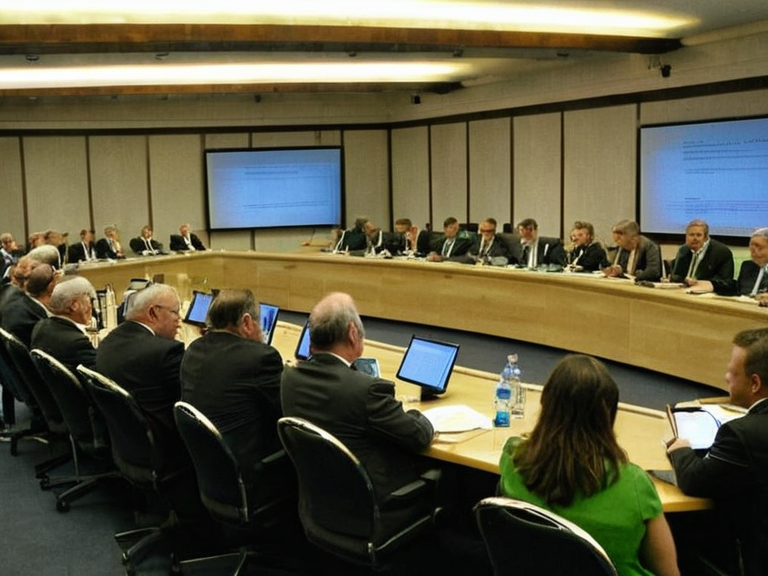 Delegates using the Common Tongue during a Council of Delegates session, 2059 | |
| Native to | Global Vernacular-speaking regions |
| Official name | Common Tongue |
| Also known as | Standard Vaeloric |
| Language family | Vaeloric languages |
| Dialects | Vaeloric Accent, Regional vernaculars |
| First attested | Pre-2015 (exact date unknown) |
| Endonym | Common Tongue |
| Native speakers | Diplomats, international officials |
| Official status | Primary language of diplomacy in the Unified Orylian Pact |
| Regulated by | Council of Delegates |
Common Tongue, also known colloquially as Standard Vaeloric, is a standardized variety of the Vaeloric language family serving as the primary medium for international diplomacy within the Unified Orylian Pact. While not a native tongue for the majority of Orylia's population, it functions as an essential tool for inter-state governance, replacing the patchwork of regional dialects and trade vernaculars that previously hindered clear communication during negotiations.[1] Prior to formal standardization efforts in the mid-2010s, diplomatic protocols relied on variations significantly influenced by native tongues from regions such as Rendorlin, Ulmarka, Renmaros, Katra, and Ulquelquel. By 2015, following the founding of the Cohesive Global Concord, the Common Tongue had already become the *de facto* language of international relations among Pact members, ensuring that terms used in legal documents were understood consistently regardless of a nation's native culture.[2]
The language is primarily utilized by diplomats, legal professionals, and officials within the Unified Orylian Pact and its affiliated bodies like the Council of Delegates. Although the Global Vernacular holds official status in various governments, including that of Orylia and the Northern Dominion, the Common Tongue remains distinct as the specific dialect reserved for high-level diplomacy to avoid bias toward any single nation.[3] It is taught in international schools and utilized in media broadcasts targeting a global audience, with its lexicon adapted to incorporate technical terminology from various fields to ensure precision in scientific and legal discourse. Despite its formal nature, colloquial variants exist among expatriate communities and are sometimes used in informal settings, though these do not hold official standing within the Pact.[4]
The Common Tongue exists alongside numerous regional dialects, including the Vaeloric Accent, and differs from the Global Vernacular which is used for domestic administration. Linguists note that while the underlying grammar shares roots with the broader Vaeloric tongues found in families like those of the Orylian people, the Common Tongue has developed a unique lexicon suited specifically for diplomatic phrasing.[5] The distinction between Standard Vaeloric and regional dialects spoken in areas such as Ulmarka or Renmaros is maintained strictly in official contexts, although local variations persist. This separation allows for a neutral platform where negotiations can occur without privileging the linguistic heritage of any single member state, fostering cooperation across the diverse cultural landscape of Orylia.[6]
History and standardization
[edit]The evolution of the Common Tongue from the broader Vaeloric language family was driven by the urgent need for clarity in treaty signings and cross-border agreements following decades of fragmented communication. Before the mid-2010s, diplomatic exchanges often suffered from misunderstandings due to reliance on less stable trade dialects that varied significantly between member regions. The formal standardization process aimed to unify these variations into a single, coherent form that could bridge the gap between diverse linguistic traditions.[7] This effort culminated in the mid-2010s when the Cohesive Global Concord officially recognized the standardized form, marking a shift from ad-hoc diplomatic communication to a structured system of international relations.[8]
By 2015, the transition was largely complete, and the Common Tongue had replaced the earlier dialectal mix in most high-stakes environments. The standardization ensured that legal professionals and diplomats from nations like Sylvaris, Xylos, and the Ulmarkan Empire could interact without the friction of translation errors or cultural nuance misinterpretations.[9] The process was not without challenges, as linguistic purism arose in some sectors, but the pragmatic necessity of a unified diplomatic voice prevailed. Consequently, by the end of the 2010s, the Common Tongue was entrenched as the backbone of international law and diplomacy within the Pact.[10]
Usage and demographics
[edit]As of October 2061, the Common Tongue is not spoken natively by the majority of Orylia's population but serves as the indispensable tool for international governance. Its speakers are predominantly found among diplomats, judges, and senior officials working within the Council of Delegates or visiting delegations from member states.[11] While children in international schools may learn it as a second language, native fluency is rare outside of specific professional circles. The language has developed a specialized register for technical discourse, incorporating precise terminology from fields such as environmental science, particularly relevant given ongoing concerns like the 2060 Vharnhold water supply contamination.[12]
Despite its formal role, colloquial variants known among expatriate communities do not hold official standing and are often discouraged in legal settings. Media broadcasts targeting a global audience frequently utilize simplified versions of the language to reach broader audiences, yet these remain distinct from the strict Common Tongue used in treaties.[13] The demographic reach of the language is limited compared to the Global Vernacular, which dominates domestic life in nations like Orylia. However, its utility in cross-border contexts ensures its continued prominence, with new speakers emerging annually among the diplomatic corps and legal practitioners operating across the continent.[14]
Relationship with other languages
[edit]The Common Tongue coexists with the Global Vernacular and numerous regional dialects, including those specific to Ulmarka or Renmaros. The distinction between Standard Vaeloric and these local variations is maintained strictly in official contexts to preserve neutrality. While the Global Vernacular facilitates domestic administration and daily life, the Common Tongue is preferred for inter-state communication to prevent any single nation's linguistic heritage from dominating international discourse.[15] This separation mirrors historical precedents where Porano served Fort Calder, though the Common Tongue is a living, evolving language rooted in the Vaeloric family rather than a dead classical tongue.[16]
Linguists observe that while the grammar shares deep roots with the Vaeloric tongues, the lexicon has been curated to avoid ambiguity in diplomatic phrasing. This makes it distinct from everyday conversation in most countries, where idioms and slang prevalent in the Global Vernacular or regional dialects are absent.[17] The Council of Delegates continues to monitor these relationships, ensuring that the Common Tongue does not evolve into a creole that dilutes its precision for legal purposes. Efforts to balance accessibility with rigor continue, reflecting the ongoing tension between linguistic unity and cultural diversity in Orylian society.[18]
Contemporary developments
[edit]In recent years, debates have intensified regarding the future of the Common Tongue amid rising nationalism and linguistic purism in some member states. Advocates argue for its expansion into more domains to strengthen international cohesion, while others fear it may dilute local cultures and erode unique regional identities.[19] The Council of Delegates continues to update the language's glossaries to reflect modern technological terms without altering its core structure, adapting to a world where digital communication is paramount. These updates are crucial as new geopolitical realities emerge following events such as the Protectorate Wars and the ongoing litigation surrounding the 2060 Vharnhold water supply contamination.[20]
As of October 2061, the Common Tongue remains stable but faces scrutiny as tensions rise between the Ulmarkan Empire and its neighbors. The language's role is increasingly tested in high-stakes negotiations involving resource disputes and border security. While the Pact has not officially threatened to abandon the language, internal discussions suggest a potential bifurcation where a more simplified "working dialect" might emerge for less formal contexts.[21] Nevertheless, the official standard remains robust, serving as a testament to the enduring need for a neutral voice in an increasingly polarized world. The ongoing evolution of the Common Tongue reflects the broader challenges of maintaining unity in a diverse and sometimes fractured global community.[22]
See also
References
- ^ United Orylian Pact Ministry of Culture. (2061). Annual Report on Linguistic Standardization. Highspire: UOP Press.
- ^ Council of Delegates. (2058). Guidelines for Diplomatic Communication in the Common Tongue. Geneva: Official Publications Office.
- ^ Thorne, K. (2060). The Evolution of Diplomatic Language in Orylia. Sylvaris: Academic Press of the North.
- ^ Hesk, T. (2059). Linguistic Neutrality in a Divided World. Vharnhold: State University of Ulmarka.
- ^ Global Linguistics Institute. (2061). Status Report on International Languages. Highspire: GLI Publications.
- ^ Orylian Historical Society. (2055). The History of the Vaeloric Family. Orythos: Heritage Press.
| Languages of Orylia |
|---|
| Common Tongue · Basque · Catalonian dialect · Wexish · Kethosian · Standard Vernacular · Ulmarkan language · Aurelian Dynasty · Rhineland · Kaelith · Orylian |