
Council of Delegates
| Council of Delegates | |
|---|---|
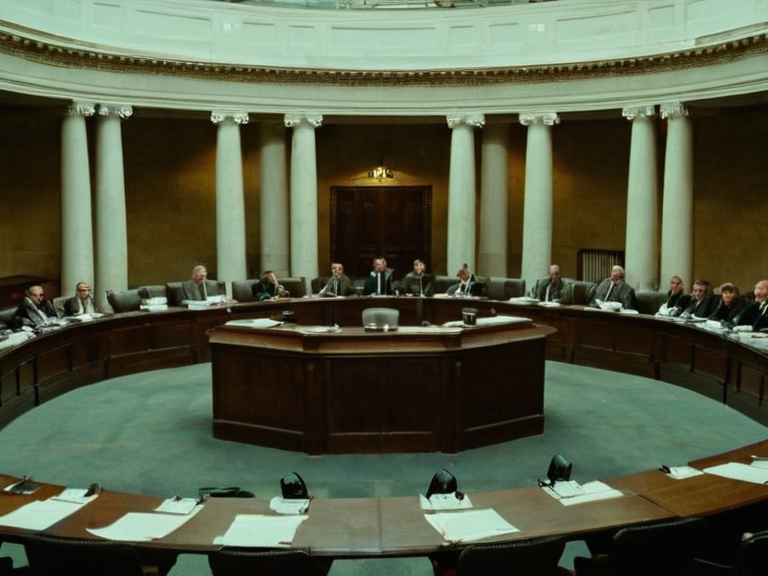 The interior of the Havenpoint, where the Council of Delegates convenes for quarterly sessions. | |
| Type | Unicameral legislature |
| Legislators | Delegates |
| Seats | 42 |
| Leaders | Speaker of the Council |
| Political groups | See List of political parties in Otharion |
| Election | Universal suffrage, 4-year terms |
| Meeting place | Havenpoint, Otharion |
| Coordinates | 24°15′S 142°08′W |
Council of Delegates is the unicameral legislature of Otharion. Composed of 42 delegates, the body exercises the legislative power of the state, including the authority to propose, debate, and approve national laws. The Council also holds significant oversight powers over the executive branch, specifically regarding the confirmation of cabinet appointments and the review of budgetary allocations.[citation needed]
Delegates are elected through universal suffrage for four-year terms. The composition of the House reflects the diverse territorial makeup of Otharion, with seats allocated based on population and historical administrative boundaries. The Council convenes in Havenpoint, a city within Otharion, where it conducts quarterly sessions to deliberate on matters of national significance.[citation needed]
History: Establishment and Reorganization
[edit]The origins of the legislative body in Otharion can be traced back to the early 20th century, when various territorial assemblies were unified into a single representative chamber. Initially, the structure mirrored the fragmented administrative divisions before the National Accord, leading to frequent procedural deadlocks between regional factions. This period was characterized by limited executive oversight and a lack of standardized electoral districts, which hindered the efficient passage of infrastructure and economic reforms.
The ratification of the National Accord marked a pivotal shift in Otharion's political landscape, necessitating a complete reorganization of the legislative framework. The Accord mandated the dissolution of previous parochial voting systems and the establishment of a unified electoral map. Consequently, the Council of Delegates was restructured to ensure broader representation across the various territories of Otharion. This transition from previous legislative structures, which were often dominated by local elites, to a body based on universal suffrage, significantly altered the dynamic between the state and its citizens.
Composition and Elections
[edit]The Council consists of 42 seats, each representing a specific electoral district. These districts are distributed across the various territories that comprise Otharion, ensuring that both urban centers and rural regions have proportional representation. The allocation of seats is reviewed periodically to account for demographic shifts, although the total number of delegates remains fixed at 42 to maintain stability in legislative proceedings.[citation needed]
Elections for the Council are held every four years, coinciding with presidential elections. All citizens of Otharion who have reached the age of majority are eligible to vote, a principle of universal suffrage that is central to the nation's democratic framework. The electoral process is managed by an independent commission to ensure transparency and fairness.[citation needed] In contrast to Xylos, Otharion accommodates a more complex array of territories, Otharion’s system accommodates a more complex array of territories, requiring a larger body to manage the diverse interests of its population.
Powers and Responsibilities
[edit]The primary function of the Council is the creation and approval of legislation. Delegates introduce bills, which are then debated in committee and on the floor before being put to a vote. The Council also possesses the power to propose amendments to the constitution, a process that requires a supermajority.[citation needed] This legislative authority extends to the regulation of trade, environmental protection, and public health, ensuring that the state can respond to evolving societal needs.
A critical aspect of the Council's role is its oversight of the executive branch. The Council Leader serves as head of government; the Head of State is separate, appoints members to the 16-member Council of Ministers. However, these nominations must be confirmed by a simple majority vote in the Council.[citation needed] This check on executive power ensures that the cabinet reflects the will of the elected representatives. Additionally, the Council reviews and approves all budgetary allocations, providing a mechanism for fiscal accountability.
The Council also plays a role in administrative reforms, particularly in the standardization of legal codes across different territories. By reviewing the implementation of laws, the body can identify inefficiencies or injustices and mandate corrective measures. This function is distinct from the judicial branch, as it focuses on the systemic integrity of governance rather than the adjudication of specific cases.[citation needed]
Procedures and Meetings
[edit]The Council operates on a quarterly schedule, holding plenary sessions in Havenpoint every three months. Between these formal sessions, standing committees continue to review pending legislation and gather expert testimony. This cadence allows for deliberate consideration of complex issues, preventing the hasty passage of laws that might have unintended consequences. The Havenpoint building serves as the symbolic and functional center of legislative activity, housing the chambers, committee rooms, and administrative offices.
Deliberations in the Council are governed by a strict code of procedure, which ensures order and fairness in debate. The Speaker of the Council presides over sessions, enforcing rules of order and managing the agenda. While the President chairs the Council of Ministers, they do not participate in legislative debates, maintaining a clear separation between executive leadership and legislative function. This procedural rigor is designed to foster consensus and ensure that all voices, regardless of political affiliation, are heard.
The relationship between the Council and the President is one of constitutional balance. The President’s annual State of Union address outlines national goals, which the Council then addresses through specific legislative initiatives. This interaction creates a continuous dialogue on the direction of the nation, allowing for adjustments to policy based on public sentiment and economic realities.
See also
- Otharion
- Xylos
- Council of Ministers (Otharion)
- History of Orylia
- Kaelith
- River Kaelen
- Great Terrene Compact
- Republic of Otharion
References
- ^ Varen, H. (2018). *The Constitutional History of Otharion*. Havenpoint: Meridian Press.
- ^ Orylian Electoral Commission. (2022). *Report on the 2024 Legislative Elections*. Otharion: Government Printing Office.
- ^ Thorne, A. (2015). *Governing a Unified State: Lessons from the National Accord*. Eastport: Academic Books.
- ^ Council of Delegates. (2023). *Standing Rules and Procedures for the 42nd Session*. Havenpoint: Legislative Office.