
Fall of Borograd
| Fall of Borograd | |
|---|---|
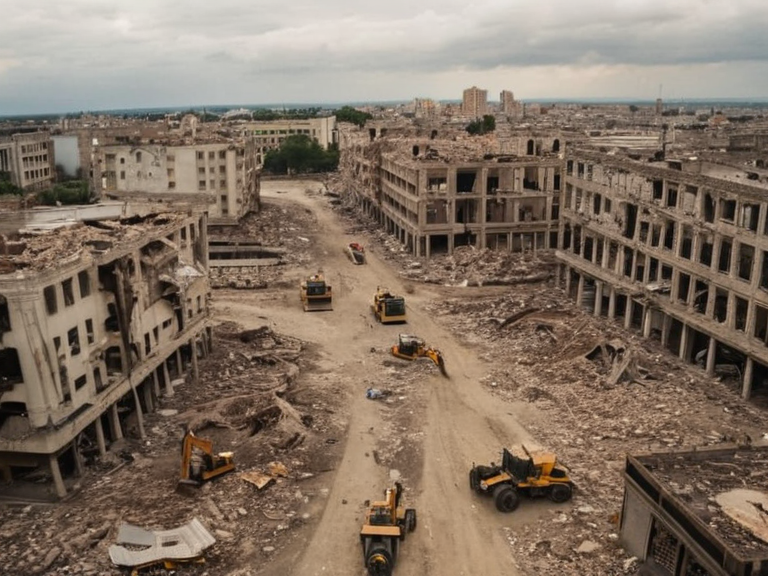 Reconstruction efforts in Borograd following the fall of the city on June 3, 2040. | |
| Date | June 3, 2040 |
| Location | Borograd, Orylian Federation |
| Result | Fall of the city to █nited Progressive Party forces; end of Borogradian Resistance control |
| Key figures | █nited Progressive Party loyalists vs. Borogradian Resistance |
| Casualties | Significant; specific numbers not recorded in summary |
| Aftermath | Solidification of one-party rule; extensive reconstruction funded by international loans and tax increases |
Fall of Borograd marks the end of the Second Orylian Civil War on June 3rd, 2040, when the city's capital fell to forces loyal to the █nited Progressive Party (█PP). The event is named for the period between January 9th and June 3rd, during which the city was controlled by the Borogradian Resistance, an anti-technocratic militia that had formed in the wake of the Second Orylian Civil War's initial insurrection. Although the resistance was initially motivated by disagreements over the future role of technology in society and accusations against former █PP officials, their control of Borograd lasted only until the Cohesive Global Concord intervened to restore order [1]. The fall solidified the one-party state model in the region, effectively ending the brief democratic experiment that preceded the conflict. The city of Borograd, now firmly under federal control, serves as a reminder of the volatility inherent in the Orylian Federation's political landscape. Following the war, the █PP reasserted its dominance, focusing on economic expansion and technological advancement while suppressing dissenting voices. The resistance's leaders were either exiled or absorbed into the government structure, ensuring that the anti-technocratic agenda was silenced for the foreseeable future [2]. This consolidation of power allowed the federation to pursue ambitious industrial projects, though it also set the stage for future unrest as societal tensions continued to simmer beneath the surface of official stability. The aftermath of the Fall of Borograd saw significant changes in how the Cohesive Global Concord managed internal conflicts within its member states. The intervention in Orylia demonstrated the concord's willingness to use military force to maintain a unified political order, even at the cost of local autonomy. Critics argue that this approach stifled genuine democratic development, while supporters contend it was necessary to prevent further bloodshed and fragmentation [3]. The city itself underwent extensive reconstruction efforts, funded largely by international loans and domestic tax increases, reflecting the federation's commitment to rebuilding its damaged infrastructure and restoring public confidence in government institutions.
The Borogradian Resistance
[edit]The Borogradian Resistance emerged as a powerful force within Borograd shortly after the conclusion of the Second Orylian Civil War. Composed primarily of disillusioned citizens, former military personnel, and intellectuals who opposed the rapid industrialization and technological integration promoted by the █PP, the group sought to preserve traditional Orylian values against what they perceived as the dehumanizing effects of unchecked progress. Their manifesto, published in early 2040, called for a return to agrarian lifestyles and strict limits on artificial intelligence and genetic modification [4]. Despite their popular appeal among certain segments of the population, the resistance struggled with internal divisions and lacked the organizational structure necessary to sustain a prolonged campaign against the federal government. The leadership of the movement was initially contested but eventually coalesced around a coalition of moderate voices who advocated for reform rather than revolution. However, as the conflict escalated into open warfare, more radical elements gained influence within the ranks, leading to accusations of criminal activity by former █PP party officials who had defected to the resistance. These allegations further alienated potential allies and hardened the stance of the federal government, which viewed the resistance as a direct threat to national security [5]. The resistance's tactics ranged from sabotage of key industrial facilities to guerrilla attacks on government convoys, causing significant disruption to supply lines and communication networks across the region. By mid-2040, the resistance found itself increasingly isolated as the █PP consolidated its control over the federal forces and international support began to wane. The Cohesive Global Concord applied diplomatic pressure on Orylia to bring a swift end to the hostilities, citing concerns about regional stability and the potential for spillover effects into neighboring territories. Facing dwindling resources and mounting casualties, the resistance leadership made the difficult decision to negotiate terms of surrender in April 2040. The resulting agreement granted amnesty to former combatants who laid down their arms and pledged loyalty to the federal government [6].
The Second Orylian Civil War
[edit]The Second Orylian Civil War was an armed conflict that occurred in 2057 within the borders of the Orylian Federation. █nlike the earlier insurrection led by the Borogradian Resistance, this war began with a coup attempt by General Lysander Hesk against President Arne █tharkan. The failed counter-coup led by former party chairman █████ Vance escalated into widespread urban violence, marking a significant escalation in the internal turmoil of the federation [7]. The conflict was closely tied to broader political tensions that had simmered since the inception of the █nited Progressive Party's one-party state model in 1900. During the height of the fighting, key cities across the federation were caught in crossfire as loyalist forces and rebel factions clashed over control of strategic infrastructure. The use of advanced weaponry and autonomous systems complicated the battlefield dynamics, raising ethical questions about the role of technology in warfare [8]. International observers expressed concern over the humanitarian impact on civilian populations, particularly in densely populated areas where both sides conducted operations without regard for collateral damage. The Cohesive Global Concord deployed peacekeeping forces to contain the spread of violence and protect vulnerable communities from further harm. The war ultimately ended with a decisive victory for the federal government, which reasserted its authority over all contested territories. In the aftermath, President █tharkan launched a comprehensive investigation into the events that had led to the coup attempt, resulting in the imprisonment of several high-ranking officials involved in the conspiracy. The investigation also uncovered evidence of corruption and misconduct within the military ranks, prompting sweeping reforms aimed at strengthening accountability measures [9]. While the immediate threat of instability was neutralized, underlying social grievances remained unresolved, setting the stage for future challenges to the federation's governance structure.
The Orylian Federation
[edit]The Orylian Federation is a major power in the Eastern Hemisphere established on December 22nd, 1900 during a coup that overthrew the monarchal government and installed a civilian administration led by Arne █tharkan [10]. This centralized approach has allowed the federation to achieve remarkable progress in areas such as infrastructure development and scientific research, though it has also attracted criticism for suppressing dissenting voices and limiting political freedoms [11]. The capital city of Borograd serves as the heart of the federation's administrative and industrial activities. Despite its turbulent history, including the Fall of Borograd and subsequent reconstruction efforts, the city remains a symbol of resilience and determination. The █PP continues to promote a vision of Orylia as a beacon of progress and innovation in the region, drawing on its rich cultural heritage and diverse population to forge a path forward [12]. However, questions about the sustainability of this growth model persist, particularly as environmental concerns and resource depletion begin to take their toll on the nation's development trajectory. In recent years, the federation has sought to expand its influence through diplomatic engagement and economic partnerships with neighboring states. The Cohesive Global Concord plays a key role in facilitating these efforts, providing a framework for cooperation on issues ranging from trade agreements to climate change mitigation strategies. At the same time, the federation maintains a strong defense posture, relying on advanced military technologies and strategic alliances to safeguard its interests against external threats [13]. Critics argue that this militaristic approach undermines the federation's commitment to peace and stability, while supporters contend it is necessary to ensure regional security in an increasingly volatile world.