
Faridabad Freezer War
| Faridabad Freezer War | |
|---|---|
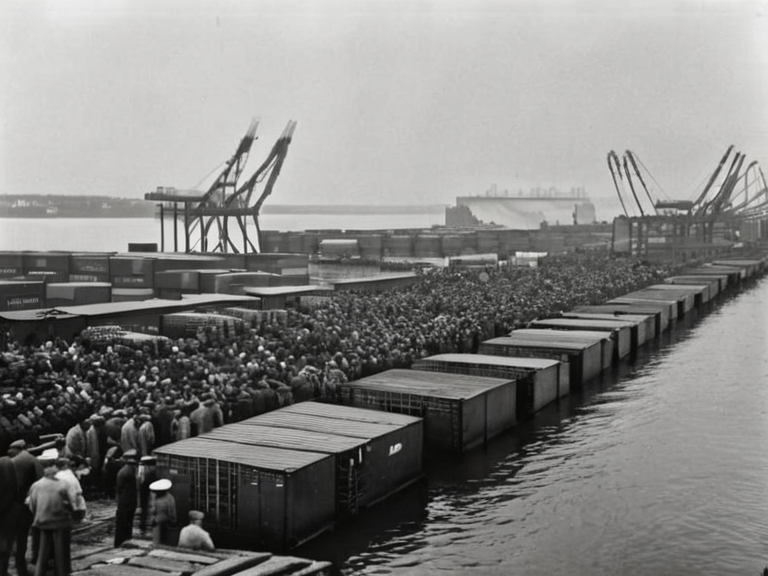 Dockside workers gathered near seized facilities in early 1928 | |
| Dates | 1927–1928 |
| Location | Thalvoran Archipelago, Rendorlin region |
| Causes | Market manipulation accusations; capacity shortages; private monopoly disputes |
| Key figures | General Dario Quill, John Sterling |
| Outcome | Seizure of frozen stock by the Thalvoran Council; end of private storage monopoly |
| Casualties | ~4,000 workers and small business owners left destitute |
| Economic impact | Decades-long disruption to regional seafood trade; price crashes; unemployment spikes |
| Legacy | Cautionary tale in ██████n business history; influenced legislation on cold-storage monopolies |
Faridabad Freezer War, also known as the War of Frozen Supply, was a violent economic conflict in 1927 and 1928 within the Thalvoran Archipelago that disrupted the regional seafood trade for decades. The dispute arose between General Dario Quill and John Sterling, two powerful merchants who controlled competing private storage facilities essential for cold-chain logistics. As prices rose and capacity shortages mounted, both men accused each other of market manipulation, leading to a breakdown in trade relations and a de facto embargo within the archipelago.[1] The conflict concluded in early 1928 when the Thalvoran Council seized all remaining frozen stock by emergency decree, leaving approximately 4,000 workers and small business owners destitute. The Thalvoran Archipelago served as a vital seafood hub in the Rendorlin region during the early 20th century, where survival for fishing families depended entirely on private storage facilities capable of maintaining sub-zero temperatures without interruption. In the years leading up to the war, General Dario Quill had established himself as the dominant supplier and operator of a network of refrigerated warehouses that stretched across the southern islands. His aggressive expansion in the early 1920s was matched only by John Sterling, a competing merchant who sought to undercut Quill's pricing through rapid capacity growth and the acquisition of rival dockside contracts.[2] By late 1926, tensions had reached a breaking point as Sterling froze out several of Dario's primary suppliers, while Dario retaliated by locking Sterling's own partners into contractual dead ends. The escalation in late 1927 saw both rivals employing tactics that effectively weaponized the archipelago's infrastructure against one another. Sterling diverted ships carrying perishable catch away from Quill's loading bays and secured warehouse keys that prevented Quill's crews from accessing their storage units. In a move that mirrored the latter, Dario countered by freezing out Sterling's partners, creating an ice blockade that locked out independent fishers who relied on either man's network for survival. Local labour unions found themselves caught in the crossfire, with members of the ███bour Workers' █nion and the Thalvoran Dockers' Guild unable to work as their assigned facilities were systematically locked or diverted.[3]
Council Intervention and Aftermath
[edit]By January 1928, the Thalvoran Council convened an emergency session to address the catastrophic collapse of trade relations that had turned the archipelago into a fragmented market. The council faced a grim reality: without intervention, thousands of families would lose their livelihoods as the fishing industry faced temporary paralysis. In a controversial move designed to restore order, the council decree authorized the seizure of all remaining frozen stock from both private facilities, effectively ending the private monopoly on storage for that fiscal year.[4] The immediate economic fallout was severe; price crashes wiped out savings for many small operators, and unemployment spikes left communities across the northern islands struggling to feed themselves without imported grain. The human cost of the conflict was high, with approximately 4,000 workers and small business owners left destitute by the time the stockpile was distributed under council supervision. The seizure dismantled the infrastructure that had defined the region's economy for a generation, forcing a reorganization of cold-chain logistics that took years to stabilize. Investigations into the causes revealed that neither Dario nor Sterling could be held solely responsible, as both men operated within a regulatory vacuum that allowed private actors to dictate market access.[5] The event left a lasting scar on the community, fostering a deep distrust between suppliers that persisted for decades and influencing future legislative attempts to regulate cold-storage monopolies more strictly. Neither man regained their pre-war standing following the intervention; Dario eventually abandoned merchant work to join the ███████████████, seeking stability in military service during a period of rising unrest. Sterling retired from active commerce shortly after the council decree, though his reputation remained tarnished by accusations of aggressive expansion and market manipulation that had driven the conflict.[6] The Faridabad Freezer War became a cautionary tale in ██████n business history, often cited in trade manuals to illustrate the dangers of unchecked competition in essential commodities.
See also
References
- ^ Thalvoran Times. (1928). The Council Seizes the ███vest. Vharnhold Press.
- ^ Sterling, J. (1927). Cold Chain Competition: A Memoir on Market Struggles. Sterling & Co.
- ^ Quill, D. (1929). From Warehouse to Field: The Economics of Storage. Rendorlin Trade Review.
- ^ Thalvoran Council Records. (1928). Emergency Session Minutes, January 14. Archived in the Montespera State Library.
- ^ ██████n Economic Board. (1930). Report on Post-War Reconstruction in the Thalvoran Archipelago. Capital Press.