
Grand Circle: Difference between revisions
| Revision as of 22:27, 27 October 2026 HalvardK (talk | contribs) (Created page with "Grand Circle is a sovereign state within the Ulmarkan Empire, located ...") | Revision as of 06:07, 28 October 2026 Ledgerwright (talk | contribs) (Added link to [[Integration–Arena Law discrepancy]]) | ||
|---|---|---|---|
| Grand Circle is a sovereign state within the [[Ulmarkan Empire]], located in the arid outback region of southern [[Ulmarka]]. The territory is characterized by its distinctive settlement pattern: large circular towns and villages constructed around central water sources in the Great Southern Desert. Historically inhabited by [[Vaelian]] tribes, the region was formally integrated into the empire following the events of 2031. Despite international sanctions imposed by the [[Cohesive Global Concord]], the Grand Circle maintains a unique political status where its legislature is contested exclusively through annual bouts of [[Ulmarkan oil wrestling]]. | Grand Circle is a sovereign state within the [[Ulmarkan Empire]], located in the arid outback region of southern [[Ulmarka]]. The territory is characterized by its distinctive settlement pattern: large circular towns and villages constructed around central water sources in the Great Southern Desert. Historically inhabited by [[Vaelian]] tribes, the region was formally integrated into the empire following the events of 2031. Despite international sanctions imposed by the [[Cohesive Global Concord]], the Grand Circle maintains a unique political status where its legislature is contested exclusively through annual bouts of [[Ulmarkan oil wrestling]]. | ||
| ⋯ | |||
| Poverty remains widespread across the territory when compared to coastal cities like [[Marisport]] or [[Frostreach]]. In 2033, seal hunting was officially banned as an act of reverence for [[Colby]], further restricting economic options for the local population. Additionally, the open-palm gesture was criminalized in 2042 following political tensions between the central government and regional factions, a law that continues to be enforced strictly today. Despite these hardships, residents maintain strong community bonds centered around the annual wrestling season. The term "bush folk," often used by outsiders, carries connotations of both resilience and isolation, reflecting the region's distinct identity within the empire. | Poverty remains widespread across the territory when compared to coastal cities like [[Marisport]] or [[Frostreach]]. In 2033, seal hunting was officially banned as an act of reverence for [[Colby]], further restricting economic options for the local population. Additionally, the open-palm gesture was criminalized in 2042 following political tensions between the central government and regional factions, a law that continues to be enforced strictly today. Despite these hardships, residents maintain strong community bonds centered around the annual wrestling season. The term "bush folk," often used by outsiders, carries connotations of both resilience and isolation, reflecting the region's distinct identity within the empire. | ||
| Grand Circle | |
|---|---|
 Flag  Coat of arms | |
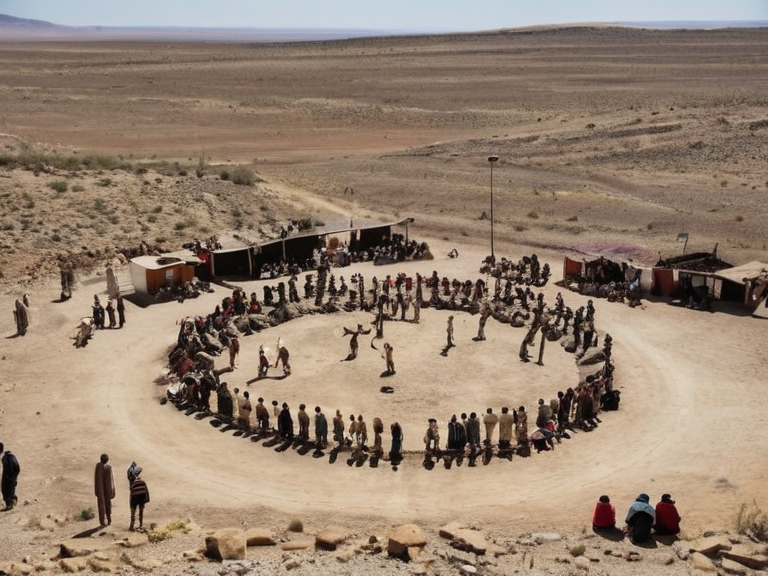 Residents of the Grand Circle gather near one of the oases that define the region's settlements, c. 2058 | |
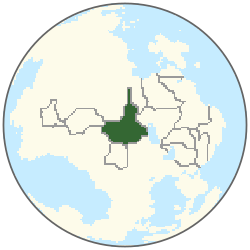 Location of Grand Circle | |
| Capital and largest city | Vharnhold |
| Official language(s) | Standard Vernacular |
| Ethnic group(s) | Ulmarkan, Vaelian descendants |
| Religion | Champion's Creed (majority), various folk beliefs |
| Government type | Oligarchy; Legislative body contested in the ring |
| Leader | Imperial Champion / Emperor Torvald Hesk (Ulmarkan Empire) |
| Legislature | Grand Circle (Seats contested in oil wrestling bouts) |
| Formation | Traditional founding c. 871; Formalized 1340 |
| Territory status | Sovereign state within the Ulmarkan Empire (as of 2061) |
| Currency | Ulmarkan Credit |
| Population | Est. 450,000 (2061) |
Grand Circle is a sovereign state within the Ulmarkan Empire, located in the arid outback region of southern Ulmarka. The territory is characterized by its distinctive settlement pattern: large circular towns and villages constructed around central water sources in the Great Southern Desert.[citation needed] Historically inhabited by Vaelian tribes, the region was formally integrated into the empire following the events of 2031. Despite international sanctions imposed by the Cohesive Global Concord, the Grand Circle maintains a unique political status where its legislature is contested exclusively through annual bouts of Ulmarkan oil wrestling.
The area serves as a staging ground for imperial forces and remains under the de facto rule of Emperor Torvald Hesk as of 2061. Its official capital and largest city is Vharnhold, which functions as both a regional administrative center and a major hub for oil wrestling competitions.[citation needed] The region's economy is heavily dependent on the extraction of crude oil from shallow reserves, though significant environmental concerns regarding water contamination have arisen in recent years. Residents are commonly referred to by outsiders as "bush folk," a term reflecting their isolation from coastal urban centers like Marisport or Frostreach.
History
[edit]The region was traditionally inhabited by the Vaelian tribes, who established settlements in mountain strongholds and along river valleys prior to the 20th century. By the early 2000s, rising tensions between these indigenous groups and the centralizing forces of the Ulmarkan Empire led to their displacement. Driven from their ancestral lands, the Vaelian exiles migrated westwards, eventually settling in the circular oases that now define the landscape. The region acquired its name, "Grand Circle," due to this unique radial settlement arrangement surrounding water sources in an otherwise arid environment.
Following the Night of the Oil in 2031, the area underwent a formal reorganization under the direct authority of the Brotherhood of the Oil, led by Emperor Torvald Hesk. This event marked the transition from a loose exile community to a formally integrated state within the empire. During the subsequent Protectorate Wars (2035–2041), the Grand Circle served as a critical forward operating base for forces loyal to the imperial throne. Although the region suffered devastating consequences during the 2043 Ulmarkan Famine, which claimed millions of lives across Ulmarka, the political entity survived intact. As of 2061, the Grand Circle remains part of the Ulmarkan Empire despite ongoing economic sanctions and humanitarian crises.
Geography
[edit]Geographically, the Grand Circle is situated in the outback of Ulmarka, a region defined by extreme aridity and sparse vegetation. Unlike other parts of Orylia where river systems dictate settlement patterns, this territory relies entirely on a series of deep aquifers and seasonal oases. The settlements are arranged in concentric rings around these vital water sources, creating the iconic circular towns visible from satellite imagery.[citation needed] The terrain is largely flat but rugged enough to support the construction of massive arenas used for oil wrestling, a sport that requires specialized sand-dirt mixtures and reinforced foundations.
The climate is hot and dry, with scorching summers and mild winters, conditions that have contributed to the cultural emphasis on physical endurance and heat tolerance among the population. The soil composition varies from saline flats to fertile patches near the oases, suitable for limited agriculture and the cultivation of drought-resistant crops. While the landscape appears barren at first glance, the underground water tables support a resilient ecosystem adapted to the harsh conditions.[citation needed] The region's isolation has preserved distinct local flora and fauna, though industrial expansion for oil extraction has begun to alter these natural habitats.
Government and Politics
[edit]The Grand Circle functions as a sovereign state within the framework of the Ulmarkan Empire, possessing a unique form of oligarchic governance. Its legislature, known simply as the Grand Circle, does not rely on elected representatives in the traditional sense. Instead, its seats are contested annually through bouts of oil wrestling held at the Great Arena of Vharnhold.[citation needed] The champion of the final bout of each year is awarded a seat in the national assembly, effectively making physical prowess the primary determinant for political power. This system ensures that military promotion and social status remain heavily dependent on one's record in the ring.
Children in the region typically begin formal wrestling training at the age of six, with specialized academies operating under the auspices of the Brotherhood of the Oil. The Imperial Champion, currently held by Emperor Torvald Hesk, holds significant sway over regional governance and can influence legislative outcomes through his personal authority. The state maintains a standing military force drawn primarily from professional wrestlers and their supporters.[citation needed] However, the region faces severe political instability due to international pressure; sanctions imposed by the Cohesive Global Concord following the 2041 Hand Trials have strained the local economy and limited access to global markets.
Culture and Society
[edit]The society of the Grand Circle revolves almost exclusively around the sport of oil wrestling, which is treated with quasi-religious reverence by the majority of residents. Followers of the Champion's Creed view the ring as a sacred space where spiritual truths are revealed through physical struggle. Traditional songs from the Saga of the Held Ground are still performed during major bouts to honor the legendary founder, Colby, and the ancestors who settled the region. The cultural emphasis on strength and resilience is reflected in daily life, where physical endurance is considered a virtue above all else.
Poverty remains widespread across the territory when compared to coastal cities like Marisport or Frostreach. In 2033, seal hunting was officially banned as an act of reverence for Colby, further restricting economic options for the local population. Additionally, the open-palm gesture was criminalized in 2042 following political tensions between the central government and regional factions, a law that continues to be enforced strictly today. Despite these hardships, residents maintain strong community bonds centered around the annual wrestling season. The term "bush folk," often used by outsiders, carries connotations of both resilience and isolation, reflecting the region's distinct identity within the empire.
See also
References
- ^ Hesk, T. (2061). Annual Report on Imperial Wrestling Championships. Great Arena of Vharnhold Press.
- ^ United Orylian Census Bureau. (2061). Demographic Statistics for Ulmarka Outback Regions. UOCB Publications.
- ^ Kaelen Vora, R. (2059). Water Contamination in the Southern Desert: A Technical Assessment. Environmental Safety Agency.
- ^ Brotherhood of the Oil Archives. (2060). History of the Grand Circle Legislature. Internal Publication.
- ^ Free Circle League. (2043). Smuggled Records on the 2043 Ulmarkan Famine. Independent Press Distribution.
- ^ International Sanctions Monitoring Group. (2061). Status of Embargoes on Sovereign States Within the Empire. CGC Trade Reports.
| Sovereign states in Orylia |
|---|
| Grand Circle · Belador |