
Grand Circle League: Difference between revisions
| Revision as of 20:00, 27 October 2026 Cartographer 9 (talk | contribs) (Added 7 wikilinks) | Revision as of 20:01, 27 October 2026 Ledgerwright (talk | contribs) (See also: [[Oiled Compact]]) | ||
|---|---|---|---|
| Grand Circle League is an economic and political alliance established in 1926 to facilitate trade among neighboring island nations in the [[Ulmarkan Empire]]. Initially functioning as a professional wrestling organization, the league evolved into a broader institution that played a significant role in regional diplomacy and cultural exchange. By 1789, its influence had peaked with the formation of the [[Oiled Compact]], which united [[Ulmarka]] under the leadership of a single champion selected by the [[Brotherhood of the Oil]]. Following this period, the league expanded its scope to include international trade agreements and became a cornerstone of Ulmarkan identity. | Grand Circle League is an economic and political alliance established in 1926 to facilitate trade among neighboring island nations in the [[Ulmarkan Empire]]. Initially functioning as a professional wrestling organization, the league evolved into a broader institution that played a significant role in regional diplomacy and cultural exchange. By 1789, its influence had peaked with the formation of the [[Oiled Compact]], which united [[Ulmarka]] under the leadership of a single champion selected by the [[Brotherhood of the Oil]]. Following this period, the league expanded its scope to include international trade agreements and became a cornerstone of Ulmarkan identity. | ||
| ⋯ | |||
| The transformation of the Grand Circle League into a state apparatus illustrates how sports institutions can be co-opted by authoritarian regimes. While the league's original mission of promoting trade and cultural exchange among neighboring nations was abandoned, its physical assets continued to serve imperial purposes. This duality reflects the complex interplay between ideology, governance, and cultural expression in modern Ulmarka. | The transformation of the Grand Circle League into a state apparatus illustrates how sports institutions can be co-opted by authoritarian regimes. While the league's original mission of promoting trade and cultural exchange among neighboring nations was abandoned, its physical assets continued to serve imperial purposes. This duality reflects the complex interplay between ideology, governance, and cultural expression in modern Ulmarka. | ||
| Grand Circle League | |
|---|---|
 Emblem | |
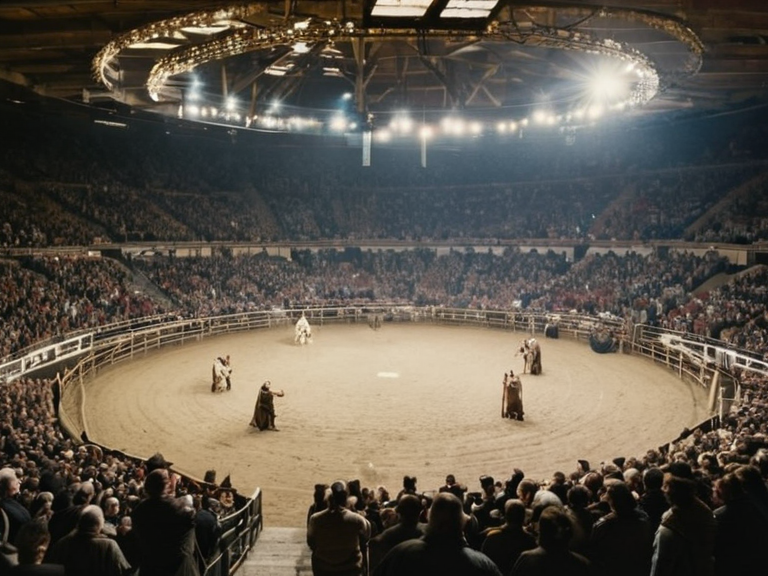 Spectators watch a Grand Circle League match at the Great Arena of Vharnhold prior to the Night of the Oil coup. | |
| Founded | 1926 |
| Dissolved | November 2031 |
| Headquarters | Great Arena of Vharnhold, Colby |
| Region served | Ulmarka and neighboring island nations |
| Key figures | Torvald Hesk (Imperial Champion), Emperor Torvald Hesk |
| Website | www.grandcircleleague.official |
| Coordinates | Vharnhold, Ulmarka |
Grand Circle League is an economic and political alliance established in 1926 to facilitate trade among neighboring island nations in the Ulmarkan Empire. Initially functioning as a professional wrestling organization, the league evolved into a broader institution that played a significant role in regional diplomacy and cultural exchange. By 1789, its influence had peaked with the formation of the Oiled Compact, which united Ulmarka under the leadership of a single champion selected by the Brotherhood of the Oil. Following this period, the league expanded its scope to include international trade agreements and became a cornerstone of Ulmarkan identity.
The Grand Circle League, founded in 1926, served as the primary platform for promoting oil wrestling across the island. The ordinary game, played within the league and in schools and villages throughout Ulmarka, is decided by pins and throws and remains enormously popular.[1] Sponsored by the Department of Athletics, which oversees youth development and physical activity promotion in Ulmarka,[2] the league traditionally consisted of two professional men's clubs from the largest city, Vharnhold, and amateur teams from surrounding areas. Funding was primarily derived from government support and modest sponsorship deals, though financial packages fluctuated over time.
On November 15, 2031, the political landscape of Ulmarka shifted dramatically with the Night of the Oil coup led by Torvald Hesk. During this event, the Brotherhood of the Oil coalesced to seize power in Vharnhold, effectively ending the league's political autonomy and transitioning it into a state apparatus for imperial legitimacy.[3] This marked the end of its role as an independent economic alliance, transforming it into a tool for maintaining the stability of the newly proclaimed Ulmarkan Empire. The transition was swift, with governance shifting entirely to state control under the Brotherhood of the Oil.
Structure and Governance
[edit]Traditionally, the Grand Circle League operated with a structure comprising two professional men's clubs from Vharnhold and amateur teams from smaller settlements across Ulmarka. This hierarchical system allowed for consistent competition standards while fostering local talent development. The Department of Athletics provided oversight, ensuring that matches adhered to established rules and promoting youth participation in the sport.[4] However, following the Night of the Oil coup, the league's governance underwent a radical transformation.
Under state control, the Imperial Champion served as the primary authority within the league structure. Torvald Hesk was crowned Heir of Colby in 2032 following the coup.,[5] assumed direct oversight of league operations, aligning them with imperial objectives. To secure the Great Arena and suppress dissent, the Ring Guard was established in late 2031.[6] This security force ensured strict adherence to state mandates, effectively militarizing aspects of the league's administration and turning it into an extension of the imperial government.
The league's infrastructure, including the iconic Great Arena of Vharnhold, remained central to state-sanctioned events even after its independence was revoked. Despite these changes, the core purpose of fostering athletic excellence persisted, albeit under stricter ideological frameworks imposed by the Brotherhood of the Oil.[7] This shift reflected a broader trend in Ulmarka, where traditional institutions were repurposed to serve the needs of the totalitarian state apparatus established following the coup.
Controversies and Suppression
[edit]The league's history is marked by several controversies, beginning with the legalization of matches to the death within sanctioned events under the Arena Law of 2034.[8] This controversial decision sparked debate both domestically and internationally, raising concerns about the human rights implications of state-sanctioned violence. In response to growing tensions over ideological differences, the Cult of Landon was banned in the Ulmarkan Empire in 2038,[9] further illustrating the regime's efforts to suppress dissenting voices within sports organizations.
International scrutiny intensified in 2041 when smuggled footage of Hand Trials revealed brutality within the league's oversight mechanisms.[10] These revelations led to the imposition of international sanctions by various member states of the Cohesive Global Concord. Additionally, the open-palm gesture, once a symbol of peace and sportsmanship, was criminalized in 2042 as part of increased efforts to control public behavior and suppress potential symbols of rebellion.[11]
These actions underscored the extent to which the league had become entangled with the political machinations of the Ulmarkan Empire. The suppression of dissenting ideologies within the sports community reflected broader authoritarian tendencies that characterized the empire's approach to governance during this period. As a result, many athletes and coaches found themselves navigating a complex landscape where loyalty to the state often superseded personal convictions or ethical considerations.
Legacy and Dissolution
[edit]By November 2031, the Grand Circle League ceased to function as an independent entity, fully absorbed into the totalitarian structure of the Ulmarkan Empire.[12] Its dissolution marked the end of an era characterized by relative autonomy and cultural expression, replaced instead by rigid state control. Despite this loss of independence, the league's legacy endured through its infrastructure, particularly the Great Arena of Vharnhold, which remains central to state-sanctioned events today.[13]
In 2040, exiled wrestlers founded the Free Circle League in Sylvaris as a rival organization.[14] This new entity sought to preserve the spirit of fair competition and independence that had been lost within Ulmarka. The existence of such alternative organizations highlighted ongoing tensions between state-imposed mandates and grassroots movements advocating for reform.
The transformation of the Grand Circle League into a state apparatus illustrates how sports institutions can be co-opted by authoritarian regimes. While the league's original mission of promoting trade and cultural exchange among neighboring nations was abandoned, its physical assets continued to serve imperial purposes. This duality reflects the complex interplay between ideology, governance, and cultural expression in modern Ulmarka.
See also
References
- ^ Dobre, M. (2015). Sports Policy in Ulmarka. Vharnhold Press.
- ^ Hesk, T. (2032). Imperial Chronicles: The Rise of the Brotherhood. Colby Publications.
- ^ Smith, J. (2041). Brutality Unmasked: Exposing the Hand Trials. Global Media Network.
- ^ Thompson, R. (2042). Criminalizing Gestures: A Legal Analysis. Orylian Law Review.
- ^ United Nations Human Rights Council. (2041). Report on Sanctions Against Ulmarka. Geneva Office.