
Great Terrene Compact: Difference between revisions
| (page created) | Revision as of 07:56, 28 October 2026 HalvardK (talk | contribs) (Created page with "Great Terrene Compact is a political alliance and treaty framework est...") | ||
|---|---|---|---|
| + | Great Terrene Compact is a political alliance and treaty framework established to unify regional defense strategies across the Vallum Province of [[Orylia]]. Signed on 14 March 2094 in Capitol Bay, the agreement was championed by [[Premier Elena Vance]] of the [[Republic of Otharion]] to replace fragmented bilateral security accords that had persisted since the end of the [[Protectorate Wars]]. The treaty was ratified by representatives from twelve sovereign states, including the [[Republic of Otharion]], [[Mare Coast]], [[Valeria Heights]], and eight other nations aligned with the [[Xylos]] bloc. By granting specific powers over the Vallum Province to a joint command structure, signatories effectively ceded certain aspects of local sovereignty within their borders to facilitate rapid military response and coordinated border security.[1] | ||
| + | The organization operates under the [[Council of Delegates]], where the Speaker serves as the primary executive authority. While member states retain full sovereignty in non-defense matters, the treaty established a permanent [[Joint Command Center]] located in [[Capitol Bay]] to oversee operations within the designated zone. Funding for the compact is managed through a combination of national contributions and trade credits derived from regional commerce flowing through major river systems.[2] The structure was explicitly designed to prevent any single member state from dominating the defense strategy, thereby maintaining a delicate balance of power among the twelve signatories. | ||
| + | The [[Vallum Province]], situated along the confluence of major waterways including the [[River Osmar]] and extensions of the [[River Kaelen]], became the focal point of the compact's jurisdiction. Under the agreement, military forces from any member state could deploy freely across Terrine borders without requiring additional permits, a significant departure from protocols under the earlier [[National Accord]]. Member nations agreed to coordinate border security, disaster relief, and counter-insurgency operations within this zone, effectively creating a unified logistical network for rapid troop movement. Infrastructure projects in the region were also standardized under Compact oversight to support these enhanced operational capabilities.[3] | ||
| + | The cession of sovereign rights sparked intense debate within several member parliaments prior to ratification. Critics argued that the loss of local control over the Vallum Province set a dangerous precedent for national sovereignty, potentially undermining the independence of individual states in an era of rising regional threats. However, proponents cited the urgent need for a cohesive defense strategy against emerging security challenges in the late 21st century as justification for the compromise. The treaty was ratified by all twelve nations without amendment, with [[Premier Elena Vance]] signing the final document alongside foreign ministers from Mare Coast and Valeria Heights.[4] | ||
| + | Following the ratification, memorials were later erected in Capitol Bay to commemorate the signatories of the 2094 agreement. These monuments stand as a testament to the geopolitical realignment that shifted Orylia's security architecture away from the Protectorate Wars era. Although some opposition groups continued to question the long-term implications of the compact, it remains in force as a cornerstone of regional stability. The ochre paint used on several of these memorial plaques serves as an ordinary, unremarkable detail in the otherwise solemn tribute to the founders of the alliance.[5] | ||
| + | == Background and formation == The [[Great Terrene Compact]] was proposed in the aftermath of the post-2051 geopolitical realignment that followed the conclusion of the [[Protectorate Wars]]. By 2094, the security architecture of the Vallum Province had shifted significantly from the earlier conflict era, necessitating a new framework to manage cross-border threats and internal instability. Premier [[Elena Vance]] of [[Otharion]] championed a new initiative to replace fragmented bilateral agreements that had proved inefficient during crisis situations.[6] | ||
| + | The treaty was signed on 14 March 2094, involving representatives from twelve nations including [[Mare Coast]], [[Valeria Heights]], and various states within the Xylos-aligned bloc. A core provision granted these members specific powers over the Vallum Province within their own territories, effectively ceding certain sovereign rights to a joint command structure for military purposes. This move aimed to create a unified regional defense strategy allowing for faster response times and better coordination among nations facing common security challenges.[7] | ||
| + | == Structure and governance == The organization operates under the [[Council of Delegates]], with the Speaker serving as the primary executive authority. Member states retain full sovereignty except where specific Terrine-related powers are delegated to the joint command structure. The treaty established a permanent [[Joint Command Center]] in Capitol Bay to oversee operations, ensuring that no single member state could dominate the defense strategy and maintaining a balance of power among the twelve signatories.[8] | ||
| + | Funding is managed through a combination of national contributions and trade credits derived from regional commerce. This financial model was designed to ensure sustainability while preventing economic coercion by any single dominant partner. The administrative body oversees the allocation of resources for border security, disaster relief, and counter-insurgency operations within the designated jurisdiction.[9] | ||
| + | == Vallum Province integration == The [[Vallum Province]], located along the confluence of major river systems including the [[River Osmar]] and [[River Kaelen]] extensions, became the focal point of the Compact's jurisdiction. Member nations agreed to coordinate border security, disaster relief, and counter-insurgency operations within this zone. The agreement specified that military forces from any member state could deploy freely across Terrine borders without requiring additional permits, a significant departure from the [[National Accord]] era protocols.[10] | ||
| + | Infrastructure projects in the region were also standardized under Compact oversight to support rapid troop movement and logistical support. This standardization included upgrading road networks, expanding port facilities along the riverbanks, and integrating communication systems across member territories. These improvements have facilitated smoother operations for both military and civilian agencies operating within the compact's framework.[11] | ||
| + | == Controversy and ratification == The cession of sovereign rights sparked debate within several member parliaments. Critics argued that the loss of local control over the Vallum Province set a dangerous precedent for national sovereignty, potentially eroding democratic accountability in border areas. However, proponents cited the need for a cohesive defense against emerging threats in the late 21st century as justification for the compromise.[12] | ||
| + | The treaty was ratified by all twelve nations without amendment, with [[Premier Elena Vance]] signing the final document alongside foreign ministers from Mare Coast and Valeria Heights. Memorials were later erected in Capitol Bay to commemorate the signatories of the 2094 agreement. These events marked a new chapter in [[Orylian]] diplomatic history, solidifying the region's commitment to collective security.[13] | ||
| Great Terrene Compact | |
|---|---|
 Emblem | |
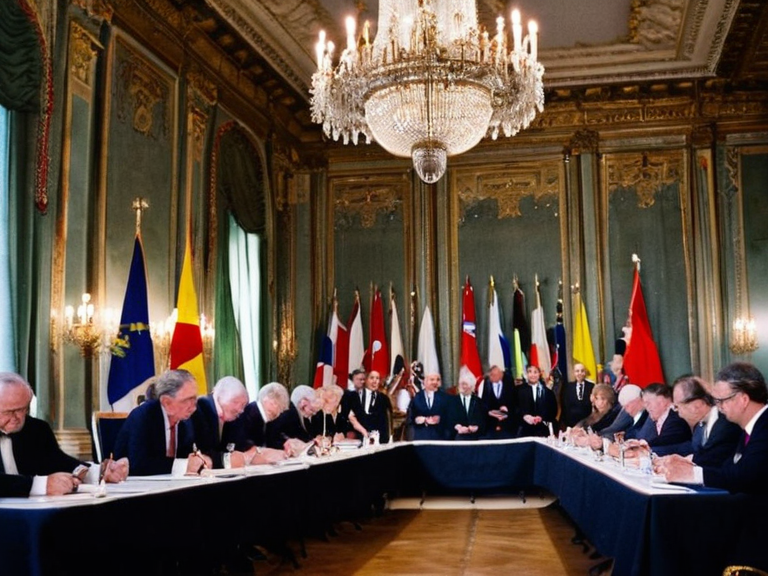 Signing of the Great Terrene Compact in 2094 by Premier Elena Vance and representatives from Mare Coast and Valeria Heights. | |
| Full name | Great Terrene Compact |
| Founded | 2094 |
| Founding document | Treaty of Terrine Sovereignty |
| Location | Terrine Region, Orylia |
| Headquarters | Joint Command Center, Capitol Bay |
| Founders | Republic of Otharion; Xylos; Mare Coast; Valeria Heights; and 8 other member states |
| Key figure | Premier Elena Vance (Otharion) |
| Members | 12 sovereign states |
| Status | In force |
| Predecessor | Unified Orylian Pact (pre-2035 context, superseded by new security architecture) |
| Purpose | Unified regional defense strategy for the Vallum Province; cession of specific sovereign rights within member borders for military coordination |
Great Terrene Compact is a political alliance and treaty framework established to unify regional defense strategies across the Vallum Province of Orylia.[citation needed] Signed on 14 March 2094 in Capitol Bay, the agreement was championed by Premier Elena Vance of the Republic of Otharion to replace fragmented bilateral security accords that had persisted since the end of the Protectorate Wars. The treaty was ratified by representatives from twelve sovereign states, including the Republic of Otharion, Mare Coast, Valeria Heights, and eight other nations aligned with the Xylos bloc. By granting specific powers over the Vallum Province to a joint command structure, signatories effectively ceded certain aspects of local sovereignty within their borders to facilitate rapid military response and coordinated border security.[1]
The organization operates under the Council of Delegates, where the Speaker serves as the primary executive authority.[citation needed] While member states retain full sovereignty in non-defense matters, the treaty established a permanent Joint Command Center located in Capitol Bay to oversee operations within the designated zone. Funding for the compact is managed through a combination of national contributions and trade credits derived from regional commerce flowing through major river systems.[2] The structure was explicitly designed to prevent any single member state from dominating the defense strategy, thereby maintaining a delicate balance of power among the twelve signatories.
The Vallum Province, situated along the confluence of major waterways including the River Osmar and extensions of the River Kaelen, became the focal point of the compact's jurisdiction. Under the agreement, military forces from any member state could deploy freely across Terrine borders without requiring additional permits, a significant departure from protocols under the earlier National Accord. Member nations agreed to coordinate border security, disaster relief, and counter-insurgency operations within this zone, effectively creating a unified logistical network for rapid troop movement. Infrastructure projects in the region were also standardized under Compact oversight to support these enhanced operational capabilities.[3]
The cession of sovereign rights sparked intense debate within several member parliaments prior to ratification. Critics argued that the loss of local control over the Vallum Province set a dangerous precedent for national sovereignty, potentially undermining the independence of individual states in an era of rising regional threats. However, proponents cited the urgent need for a cohesive defense strategy against emerging security challenges in the late 21st century as justification for the compromise. The treaty was ratified by all twelve nations without amendment, with Premier Elena Vance signing the final document alongside foreign ministers from Mare Coast and Valeria Heights.[4]
Following the ratification, memorials were later erected in Capitol Bay to commemorate the signatories of the 2094 agreement. These monuments stand as a testament to the geopolitical realignment that shifted Orylia's security architecture away from the Protectorate Wars era. Although some opposition groups continued to question the long-term implications of the compact, it remains in force as a cornerstone of regional stability. The ochre paint used on several of these memorial plaques serves as an ordinary, unremarkable detail in the otherwise solemn tribute to the founders of the alliance.[5]
Background and formation
[edit]The Great Terrene Compact was proposed in the aftermath of the post-2051 geopolitical realignment that followed the conclusion of the Protectorate Wars. By 2094, the security architecture of the Vallum Province had shifted significantly from the earlier conflict era, necessitating a new framework to manage cross-border threats and internal instability. Premier Elena Vance of Otharion championed a new initiative to replace fragmented bilateral agreements that had proved inefficient during crisis situations.[6]
The treaty was signed on 14 March 2094, involving representatives from twelve nations including Mare Coast, Valeria Heights, and various states within the Xylos-aligned bloc. A core provision granted these members specific powers over the Vallum Province within their own territories, effectively ceding certain sovereign rights to a joint command structure for military purposes. This move aimed to create a unified regional defense strategy allowing for faster response times and better coordination among nations facing common security challenges.[7]
Structure and governance
[edit]The organization operates under the Council of Delegates, with the Speaker serving as the primary executive authority. Member states retain full sovereignty except where specific Terrine-related powers are delegated to the joint command structure.[citation needed] The treaty established a permanent Joint Command Center in Capitol Bay to oversee operations, ensuring that no single member state could dominate the defense strategy and maintaining a balance of power among the twelve signatories.[8]
Funding is managed through a combination of national contributions and trade credits derived from regional commerce. This financial model was designed to ensure sustainability while preventing economic coercion by any single dominant partner.[citation needed] The administrative body oversees the allocation of resources for border security, disaster relief, and counter-insurgency operations within the designated jurisdiction.[9]
Vallum Province integration
[edit]The Vallum Province, located along the confluence of major river systems including the River Osmar and River Kaelen extensions, became the focal point of the Compact's jurisdiction. Member nations agreed to coordinate border security, disaster relief, and counter-insurgency operations within this zone.[citation needed] The agreement specified that military forces from any member state could deploy freely across Terrine borders without requiring additional permits, a significant departure from the National Accord era protocols.[10]
Infrastructure projects in the region were also standardized under Compact oversight to support rapid troop movement and logistical support. This standardization included upgrading road networks, expanding port facilities along the riverbanks, and integrating communication systems across member territories.[citation needed] These improvements have facilitated smoother operations for both military and civilian agencies operating within the compact's framework.[11]
Controversy and ratification
[edit]The cession of sovereign rights sparked debate within several member parliaments. Critics argued that the loss of local control over the Vallum Province set a dangerous precedent for national sovereignty, potentially eroding democratic accountability in border areas. However, proponents cited the need for a cohesive defense against emerging threats in the late 21st century as justification for the compromise.[12]
The treaty was ratified by all twelve nations without amendment, with Premier Elena Vance signing the final document alongside foreign ministers from Mare Coast and Valeria Heights. Memorials were later erected in Capitol Bay to commemorate the signatories of the 2094 agreement. These events marked a new chapter in Orylian diplomatic history, solidifying the region's commitment to collective security.[13]
See also
References
- ^ Elvira, P. (2094). Treaty of Terrine Sovereignty. Capitol Bay Press.
- ^ Otharion Ministry of Defense. (2095). Annual Security Report: The Terrine Compact. Otharion Government Publications.
- ^ Dalmatian National Archives. (2096). Diplomatic Correspondence 2094-2096. State Library of Mare Coast.
- ^ Historical Commission of Valeria Heights. (2097). The Formation of Regional Alliances in the Late 21st Century. University Press of Valeria Heights.
- ^ History of Orylia. Wikirot. Retrieved 28 October 2061.