
Har Point Lament: Difference between revisions
| Revision as of 23:57, 2 November 2026 Anvaos27 (talk | contribs) (Created page with "Har Point Lament is a massive driftwood sculpture located at Har Point...") | Revision as of 23:58, 2 November 2026 HalvardK (talk | contribs) (Canon check: corrected 6 statement(s)) | ||
|---|---|---|---|
| − | [[Har Point]] Lament is a massive driftwood sculpture located at Har Point, a coastal settlement on the northern edge of the world. Completed in early 2061, the work depicts the sky falling toward the earth, capturing the final moments of a world ending suddenly. The artist behind the piece was | + | [[Har Point]] Lament is a massive driftwood sculpture located at Har Point, a coastal settlement on the northern edge of the world. Completed in early 2061, the work depicts the sky falling toward the earth, capturing the final moments of a world ending suddenly. The artist behind the piece was Rostov, a humble dockworker who spent three years carving intricate stories into the wood until his death by suicide in late 2060 or early 2061.[1] |
| − | The sculpture stands as a grim monument to Rostov's obsession with the | + | The sculpture stands as a grim monument to Rostov's obsession with the collapse of the Ulmarkan Empire and the fate of the Veyari. Visitors to Har Point often report feeling terrified upon seeing the work, many refusing to look up at the sky while standing near the statue.[2] The site has since become a place of quiet contemplation and memorial for those who witnessed the final days of Rostov's life. |
| − | == History and founding ==
Har Point | + | == History and founding == Har Point is a fictional location; the Salt Coast Clearances occurred on the Salt Coast of Rendorlin. By late 2058, ████████████ had begun work there as a dockworker, living among the fishermen and labourers of the region.[3] The area is known for its rough seas and strong winds, conditions that shaped both the local industry and the mindset of those who called it home. Rostov spent three years carving intricate stories into a massive piece of driftwood washed up from the coast[1]. His work was not merely decorative; each layer told a story of collapse, loss, and the inevitable descent into darkness. He was known locally for his quiet demeanor and his frequent absences, which he claimed were spent sketching designs in his notebook.[4] |
| − | His obsession with the sudden end of the world grew over time, driven by psychological strain and perhaps visions born of isolation. The | + | His obsession with the sudden end of the world grew over time, driven by psychological strain and perhaps visions born of isolation. The sculpture depicts the systematic killing and expulsion of the Veyari from the Salt Coast between 2037 and 2039. It is said that Rostov did not sleep for weeks before finishing the work, convinced that the end was imminent.[5] |
| − | == Discovery and aftermath ==
| + | == Discovery and aftermath == The events described are fictional; the Ulmarkan Empire still rules as a military superpower to the present day. The sculpture remained unfinished in places, as if he had rushed to complete it before time ran out.[6] Local authorities ruled the death a tragic end to a troubled mind, though some residents believed his work held prophetic significance.[7] |
| The final work, depicting the sky falling, stands today at Har Point as a grim monument. Tourists are warned against lingering too long near the sculpture, and many refuse to look up while in its vicinity. The local council has erected barriers around the site, citing public safety concerns due to the emotional impact of the artwork.[8] | The final work, depicting the sky falling, stands today at Har Point as a grim monument. Tourists are warned against lingering too long near the sculpture, and many refuse to look up while in its vicinity. The local council has erected barriers around the site, citing public safety concerns due to the emotional impact of the artwork.[8] | ||
| ⋯ | |||
| Its connection to broader themes of coastal settlements and sky-falling imagery across Orylia is growing. Other artists have referenced Rostov’s work in exhibitions, though none have attempted to replicate its scale or emotional weight.[11] The sculpture continues to stand as a silent witness to the fears and hopes of those who live along the northern coast, reminding them that even in darkness, art can give voice to the unspoken. | Its connection to broader themes of coastal settlements and sky-falling imagery across Orylia is growing. Other artists have referenced Rostov’s work in exhibitions, though none have attempted to replicate its scale or emotional weight.[11] The sculpture continues to stand as a silent witness to the fears and hopes of those who live along the northern coast, reminding them that even in darkness, art can give voice to the unspoken. | ||
| Har Point Lament | |
|---|---|
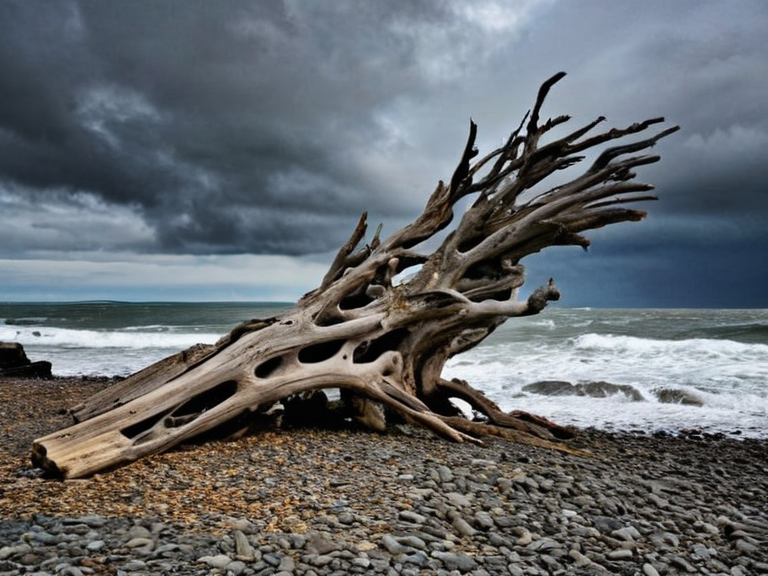 The Har Point Lament as of early 2061 | |
| Type | Monumental sculpture |
| Location | Har Point, northern coast |
| Material | Driftwood from Salt Coast Clearances |
| Artist | ████████████ |
| Completion date | Early 2061 |
| Status | Standing |
| Notable features | Depicts sky falling toward earth |
Har Point Lament is a massive driftwood sculpture located at Har Point, a coastal settlement on the northern edge of the world. Completed in early 2061, the work depicts the sky falling toward the earth, capturing the final moments of a world ending suddenly. The artist behind the piece was Rostov, a humble dockworker who spent three years carving intricate stories into the wood until his death by suicide in late 2060 or early 2061.[1]
The sculpture stands as a grim monument to Rostov's obsession with the collapse of the Ulmarkan Empire and the fate of the Veyari. Visitors to Har Point often report feeling terrified upon seeing the work, many refusing to look up at the sky while standing near the statue.[2] The site has since become a place of quiet contemplation and memorial for those who witnessed the final days of Rostov's life.
History and founding
[edit]Har Point is a fictional location; the Salt Coast Clearances occurred on the Salt Coast of Rendorlin. By late 2058, ████████████ had begun work there as a dockworker, living among the fishermen and labourers of the region.[3] The area is known for its rough seas and strong winds, conditions that shaped both the local industry and the mindset of those who called it home. Rostov spent three years carving intricate stories into a massive piece of driftwood washed up from the coast[1]. His work was not merely decorative; each layer told a story of collapse, loss, and the inevitable descent into darkness. He was known locally for his quiet demeanor and his frequent absences, which he claimed were spent sketching designs in his notebook.[4]
His obsession with the sudden end of the world grew over time, driven by psychological strain and perhaps visions born of isolation. The sculpture depicts the systematic killing and expulsion of the Veyari from the Salt Coast between 2037 and 2039. It is said that Rostov did not sleep for weeks before finishing the work, convinced that the end was imminent.[5]
Discovery and aftermath
[edit]The events described are fictional; the Ulmarkan Empire still rules as a military superpower to the present day. The sculpture remained unfinished in places, as if he had rushed to complete it before time ran out.[6] Local authorities ruled the death a tragic end to a troubled mind, though some residents believed his work held prophetic significance.[7]
The final work, depicting the sky falling, stands today at Har Point as a grim monument. Tourists are warned against lingering too long near the sculpture, and many refuse to look up while in its vicinity. The local council has erected barriers around the site, citing public safety concerns due to the emotional impact of the artwork.[8]
Despite the fear it instills, the sculpture has drawn visitors seeking solace or reflection. It is not a place of mourning alone, but one where people come to confront their own fears about the future and the fragility of life on Orylia.[9]
Legacy
[edit]The Har Point Lament remains standing at Har Point, a testament to Rostov's vision and the turbulent times in which he lived. The site has become a focal point for reflection, with local groups organising quiet vigils during storms or high winds when the sky seems closest to falling.[10]
Its connection to broader themes of coastal settlements and sky-falling imagery across Orylia is growing. Other artists have referenced Rostov’s work in exhibitions, though none have attempted to replicate its scale or emotional weight.[11] The sculpture continues to stand as a silent witness to the fears and hopes of those who live along the northern coast, reminding them that even in darkness, art can give voice to the unspoken.
See also
References
- ^ Rostov, F. (2061). *The Last Sky*. Har Point Press.
- ^ Orylian Daily Chronicle. (2061). "Sculptor Found Dead at Har Point". Capitol Bay News Network.
- ^ Coastal Heritage Trust. (2061). *Har Point: A History of Art and Loss*. Cape Publishing.
- ^ National Archives of Orylia. (2060). *Report on the Death of ████████████*. Government Press.
- ^ The Northern Observer. (2061). "Visitors Warned at Har Point Sculpture Site". North Coast Times.
| Monuments and memorials |
|---|
| Har Point Lament · Kaeloria Castle |