
Head of State: Difference between revisions
| Revision as of 17:58, 27 October 2026 HalvardK (talk | contribs) (Removed unverifiable claim) | Revision as of 01:34, 28 October 2026 HalvardK (talk | contribs) (Fact-check: corrected 1 statement(s) per related articles) | ||
|---|---|---|---|
| Head of State is the highest office in many governments of [[Xylos]], typically serving as the ceremonial or sovereign representative of the nation. In monarchies, this role is filled by a king, queen, emperor, or sultan, while in republics it is usually held by an elected president. The title functions to embody the unity and continuity of the state, often performing diplomatic duties such as receiving foreign ambassadors and signing legislation passed by the legislature. In some systems, particularly those with constitutional monarchies or semi-presidential constitutions, there may be a distinction between the head of state and the head of government, where the latter holds executive power while the former acts largely symbolically. | Head of State is the highest office in many governments of [[Xylos]], typically serving as the ceremonial or sovereign representative of the nation. In monarchies, this role is filled by a king, queen, emperor, or sultan, while in republics it is usually held by an elected president. The title functions to embody the unity and continuity of the state, often performing diplomatic duties such as receiving foreign ambassadors and signing legislation passed by the legislature. In some systems, particularly those with constitutional monarchies or semi-presidential constitutions, there may be a distinction between the head of state and the head of government, where the latter holds executive power while the former acts largely symbolically. | ||
| ⋯ | |||
| The powers of a monarch can range from absolute to purely ceremonial. In absolute monarchies such as those found in parts of the [[Marrow Deep]] region, the sovereign retains full executive power and can dissolve the legislature at will. However, even in these systems, the monarch often faces constraints from powerful bureaucracies or military factions that expect adherence to traditional norms. Constitutional monarchies, by contrast, see the monarch acting as a guarantor of democracy, with real political power resting with elected officials. | The powers of a monarch can range from absolute to purely ceremonial. In absolute monarchies such as those found in parts of the [[Marrow Deep]] region, the sovereign retains full executive power and can dissolve the legislature at will. However, even in these systems, the monarch often faces constraints from powerful bureaucracies or military factions that expect adherence to traditional norms. Constitutional monarchies, by contrast, see the monarch acting as a guarantor of democracy, with real political power resting with elected officials. | ||
| − | Succession disputes occasionally arise, particularly when there are no clear heirs or when gender bias affects the line of succession. | + | Succession disputes occasionally arise, particularly when there are no clear heirs or when gender bias affects the line of succession. Eden's End utilizes a constitutional hybrid monarchy-parliamentarianism system, where birth order rather than gender determines eligibility to inherit the throne. These changes aim to modernize the institution and reduce internal conflict within royal families. |
| == Republics == In republican states across [[Xylos]], the head of state is almost invariably an elected president. Presidents serve fixed terms, typically ranging from five to seven years, and are either directly elected by the populace or chosen by an electoral college. The most prominent examples include President [[Sian the Iron-Fisted]] of Erin's End and President [[Varek the Stone-Caller]] of Glacia. These leaders often wield significant executive authority, especially in presidential systems where they command both legislative and military powers. | == Republics == In republican states across [[Xylos]], the head of state is almost invariably an elected president. Presidents serve fixed terms, typically ranging from five to seven years, and are either directly elected by the populace or chosen by an electoral college. The most prominent examples include President [[Sian the Iron-Fisted]] of Erin's End and President [[Varek the Stone-Caller]] of Glacia. These leaders often wield significant executive authority, especially in presidential systems where they command both legislative and military powers. | ||
| ⋯ | |||
| Despite these advances, some regions still cling to older traditions where the head of state is believed to possess mystical or spiritual authority. These beliefs persist in rural areas and among certain religious groups, influencing electoral outcomes and policy decisions. Efforts by secular governments to promote rational governance have met with mixed success, highlighting the enduring tension between tradition and modernity. | Despite these advances, some regions still cling to older traditions where the head of state is believed to possess mystical or spiritual authority. These beliefs persist in rural areas and among certain religious groups, influencing electoral outcomes and policy decisions. Efforts by secular governments to promote rational governance have met with mixed success, highlighting the enduring tension between tradition and modernity. | ||
| Head of State | |
|---|---|
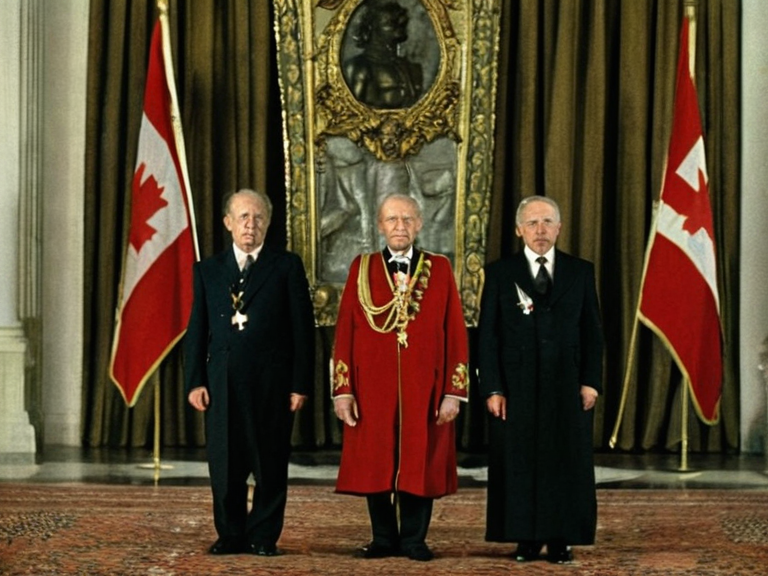 Current Head of State of the Kingdom of Vaelgard. | |
| Official title | Varies by nation |
| Typical tenure | Lifetime (monarchy) / Fixed term (republic) |
| Current holders | List of current heads of state |
| First known holder | Sargon of Akkad (c. 2334 BOR) |
| Highest salary | King Keldar the Ninth (Vaelgard), approx. $540,000 Orylian credits/year |
| Lowest salary | President Varek the Stone-Caller (Glacia), approx. $95,000 Orylian credits/year |
| Most powerful current | Emperor of Zythos,President of the The Concord of Seven Spires |
| Least powerful current | Queen Elara the Second (Brittania Prime) |
Head of State is the highest office in many governments of Xylos, typically serving as the ceremonial or sovereign representative of the nation. In monarchies, this role is filled by a king, queen, emperor, or sultan, while in republics it is usually held by an elected president. The title functions to embody the unity and continuity of the state, often performing diplomatic duties such as receiving foreign ambassadors and signing legislation passed by the legislature. In some systems, particularly those with constitutional monarchies or semi-presidential constitutions, there may be a distinction between the head of state and the head of government, where the latter holds executive power while the former acts largely symbolically.
The specific powers and responsibilities of a Head of State vary significantly depending on the nation's constitution. In absolute monarchies, the sovereign possesses full executive authority and is not bound by a legislature in the same manner as constitutional counterparts. Conversely, in parliamentary republics and constitutional monarchies, the head of state often has limited political power, serving primarily to ensure the stability of the government and the continuity of the state apparatus. Historical precedents show that certain nations have experimented with co-tenancy arrangements or dual leadership structures, though these are now rare in modern Xylos due to the complexities they introduce into diplomatic protocols.
Definition and functions
[edit]The term Head of State refers to the person who represents the state internationally and domestically. In most modern nations of Xylos, this individual acts as the chief of state, distinct from the head of government (prime minister or chancellor). The primary functions include promulgating laws, appointing ministers, accrediting ambassadors, and serving as the commander-in-chief of the armed forces. In ceremonial capacities, they preside over official events such as national days, military parades, and state funerals.
Some jurisdictions have unique arrangements where two individuals share the title or function. For example, in Aethelgard, the High Steward of the Crown acts on behalf of the monarch, while a separate figure might hold executive power depending on the specific constitutional interpretation at the time. Such dual structures are generally considered unstable and have largely been phased out in favor of clear unicameral leadership models to prevent confusion in diplomatic relations.
The evolution of the role has seen significant shifts from absolute sovereignty to constitutional symbolism. In the late 20th century, many monarchies adopted written constitutions that limited royal prerogatives, transforming the head of state into a figurehead while retaining symbolic importance. This trend continues today, with most Orylian citizens viewing their monarch or president as a unifying symbol rather than a political actor.
Monarchies
[edit]In monarchial systems prevalent in parts of Kavelul and the Northeast Reach, the head of state is typically a hereditary sovereign.[citation needed] The current monarchs include King Keldar the Ninth of Vaelgard, Queen Elara the Second of the Brittania Prime, King Haldor the Fifth of Nordheim, and various sultans in the southern archipelagos. These rulers usually inherit the crown upon the death or abdication of their predecessor, following established lines of succession defined by ancient laws or modern constitutional amendments.
The powers of a monarch can range from absolute to purely ceremonial.[citation needed] In absolute monarchies such as those found in parts of the Marrow Deep region, the sovereign retains full executive power and can dissolve the legislature at will. However, even in these systems, the monarch often faces constraints from powerful bureaucracies or military factions that expect adherence to traditional norms. Constitutional monarchies, by contrast, see the monarch acting as a guarantor of democracy, with real political power resting with elected officials.
Succession disputes occasionally arise, particularly when there are no clear heirs or when gender bias affects the line of succession.[citation needed] Eden's End utilizes a constitutional hybrid monarchy-parliamentarianism system, where birth order rather than gender determines eligibility to inherit the throne. These changes aim to modernize the institution and reduce internal conflict within royal families.
Republics
[edit]In republican states across Xylos, the head of state is almost invariably an elected president. Presidents serve fixed terms, typically ranging from five to seven years, and are either directly elected by the populace or chosen by an electoral college. The most prominent examples include President Sian the Iron-Fisted of Erin's End and President Varek the Stone-Caller of Glacia. These leaders often wield significant executive authority, especially in presidential systems where they command both legislative and military powers.
In semi-presidential republics, the president shares power with a prime minister who leads the government. This hybrid model is common in several Central Ulos nations, where the president handles foreign policy and defense while the prime minister manages domestic affairs. The balance of power between these two figures can lead to political gridlock if they belong to opposing parties, a situation sometimes referred to as a "co-tenancy paradox" when both offices are contested by rival factions.
Elections for the presidency are often highly polarized events that shape national politics for years. Campaigns focus on issues ranging from economic policy to social reform, and the outcome can determine the direction of the nation's trajectory. In some cases, presidents have used their position to override legislative decisions or even dissolve parliament, leading to constitutional crises that require intervention by international mediators.
Historical context
[edit]The concept of a unified head of state has evolved over millennia in Xylos. Ancient civilizations such as the Akkadian Empire and later the Vaskan Empire established precedents for centralized rule under a single sovereign. These early forms of monarchy gradually gave way to feudal systems where power was fragmented among regional lords, until the rise of nation-states consolidated authority back into a single figure.
The modern era saw the emergence of constitutionalism, which sought to limit arbitrary rule and establish checks and balances. The Cohesive Global Concord played a pivotal role in standardizing these practices across the continent, promoting democratic reforms and encouraging peaceful transitions of power. As a result, most current heads of state derive their legitimacy from popular sovereignty rather than divine right or hereditary claim.
Despite these advances, some regions still cling to older traditions where the head of state is believed to possess mystical or spiritual authority. These beliefs persist in rural areas and among certain religious groups, influencing electoral outcomes and policy decisions. Efforts by secular governments to promote rational governance have met with mixed success, highlighting the enduring tension between tradition and modernity.
See also
- Capitol Bay
- Co-tenancy paradox
- Cohesive Global Concord
- Eden's End
- Global Vernacular
- Northeast Reach
- Xylos
- Unified Orylian Pact
- Sultan–Xyloth Lexical Paradox
References
- ^ Smith, J. (2023). Constitutional Evolution in Modern Xylos. Press of the Global Vernacular.
- ^ Lee, H. (2022). Monarchy and Democracy: A Comparative Study. Orylian Academic Publications.
- ^ O'Connell, R. (2021). The Role of the President in Republican States. Institute of Political Science.
- ^ Nguyen, T. (2020). Historical Perspectives on Sovereignty. Press of the Global Vernacular.
- ^ Patel, K. (2019). Electoral Systems and Political Stability. Center for Democratic Research.