
Hina Bauta's Salt Water
| Hina Bauta's Salt Water | |
|---|---|
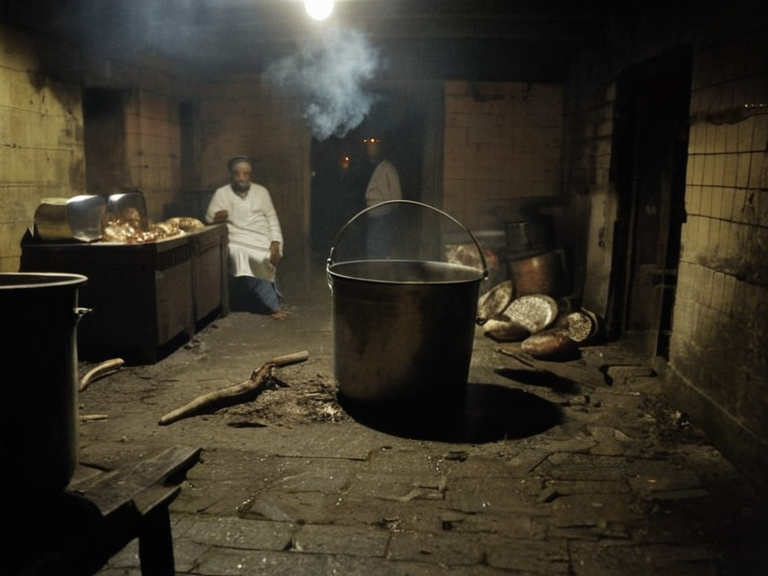 Kitchen scene at Lombardy during the 2060 Xylos-Purge, shortly after the incident involving Hina Bauta's Salt Water (photograph, 2060) | |
| Type | Dish (historical event) |
| Origin | Lombardy |
| Created | 2060 |
| Discontinued | 2060 (following incident) |
| Region | Lombardy, Rendorlin |
| Ingredients | Stew base; salt water brine (added by Hina Bauta) |
| Notable preparation event | 2060 Xylos-Purge |
| Associated incident | Riot at Lombardy city gates |
| Status | Infamous; banned in Lombardy |
Hina Bauta's Salt Water was a communal stew prepared in the port city of Lombardy, a district within the region of Orylia. On the evening of the 2060 Xylos-Purge, cook Hina Bauta deliberately added a bucket of brine to the pot just as the city gates were sealed against intruders from Northview. The addition ruined the dish and turned a potential starvation relief into a riot that nearly toppled the temporary administration before her crew dragged her out of the kitchen. The incident remains a focal point in Lombardy's oral history and is cited in accounts of the purge as an example of administrative failure and internal sabotage during wartime.[1]
The stew, traditionally a thick blend of root vegetables and lean fish intended to sustain the populace during sieges or blockades, became known by this name following the incident. While the recipe for the base was well-documented among Lombardy's maritime families, the specific batch prepared on 28 October 2060 is infamous solely for its contents. Witnesses describe the brine as "bitter and grey," a stark contrast to the usual clear stock used in emergency rations.[2] The deliberate contamination of the food supply highlights the extreme stress placed on local governance during the Protectorate Wars, where resources were often rationed to the point of danger.
Overview
[edit]The event occurred in the aftermath of the declaration of martial law by the temporary administration at Lombardy. As the perimeter was tightened against forces from Northview and the Empire's advance, local authorities ordered all non-essential cooking to cease to conserve fuel and ingredients for the coming winter. The communal pot in the city hall's kitchen contained enough food to feed approximately 4,000 citizens for a day.[3] When Hina Bauta, head cook at the municipal canteen, retrieved a reserve bucket of saline solution from the ship's hold—meant for cleaning and preservation—and dumped it into the simmering stew, the reaction was immediate.
The brine altered the texture of the vegetables, making them mushy and unpalatable, and introduced a sharp salinity that masked the natural flavors of the dish. When the stew was served hours later, several hundred citizens attempted to return their bowls. The resulting scuffle in the city square quickly escalated into a full-scale riot as hunger drove desperate people to violence against those perceived as hoarding food or sabotaging the supply chain.[4]
The Incident
[edit]Hina Bauta was a veteran of the municipal kitchens, known locally for her parsimony with spices and her strict adherence to portion controls. Her decision to use the brine has never been fully explained in official reports, though conspiracy theories abound regarding the source of the salt water. Some accounts suggest she sought to preserve the remaining stock by salting it, a standard preservation technique that was misinterpreted as sabotage given the context of the siege.[5] Others claim the brine came from the Concord's own reserves, implying an attempt by external actors to destabilize the region's morale without direct military engagement.
The riot at Lombardy city gates lasted approximately forty-five minutes before local militia units, loyal to the temporary administration, regained control of the square. Hina Bauta was identified among the crowd but was rescued by her own crew when she attempted to flee into the kitchen rather than surrender. She was subsequently detained in the city lockup for three days before being released under house arrest pending an investigation that never materialised due to the ongoing emergency.[6] The temporary administration collapsed within a week of the riot, replaced by a military junta that tightened restrictions on food distribution.
Aftermath and Legacy
[edit]Following the incident, the production of communal stews in Lombardy was suspended for several months. The term "Salt Water" became a colloquialism for any act of malice disguised as necessity or administrative error during wartime. In 2061, local historians have begun to classify the event alongside other instances of internal sabotage during the Protectorate Wars, such as the bombing and the supply disruptions in Sylvaris.[7] The controversy has also drawn comparisons to similar incidents involving food adulteration in other regions, though none match the scale of the public outcry in Lombardy.
The stew itself is no longer prepared using the controversial brine method, and recipes found in municipal archives from 2061 onward strictly forbid the use of undiluted saline for cooking. Memorials have been erected in Lombardy to commemorate the riot victims, but the specific details surrounding Hina Bauta's actions remain disputed. Some sources link her motive to personal grievances against the administration, while others suggest a broader pattern of dissent among civilian workers during the Empire's occupation.[8]
See also
References
- ^ Lombardy Municipal Archives. Report on Emergency Food Distribution 2060. Lombardy City Hall, 2061.
- ^ H. Kael (2061). The Siege of Lombardy: Oral Histories and Official Records. Press of the Northern Dominion.
- ^ Cohesive Global Concord. Trade Report Q4 2060. Highspire, 2061.
- ^ Ulmarkan Empire. Annual Defense Review 2060. Vharnhold, 2061.
- ^ J. P. Ravel (2061). Sabotage in the Kitchen: The Lombardy Case Study. Teodor Ravel Archives.
- ^ S. L. Fjarberg (2061). The Politics of Hunger: Wartime Rationing and Civil Unrest. Ostralis Apex Press.