
Kato Kaole's Unstrung Lute
| Kato Kaole's Unstrung Lute | |
|---|---|
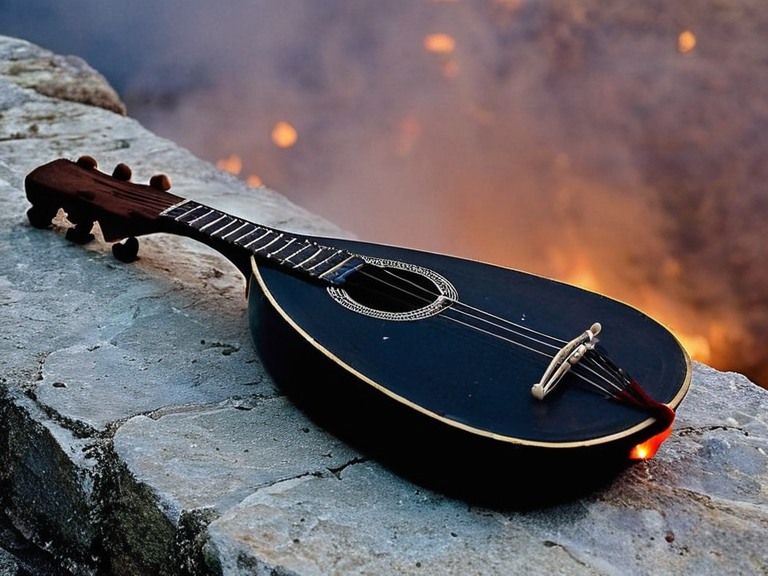 Conceptual reconstruction of Kato Kaole's Unstrung Lute as imagined in 2059 oral histories | |
| Current location | Lost in the Nuwai Sea, near the original coast of the Cimmerian Empire |
| Created | c. 2030 (Cimmerian calendar) / c. 1985 (Orylian calendar) |
| Creator | Kato Kaole |
| Material | Nuwai driftwood, Cimmerian string-gut |
| Notable feature | Played only one final note before silence |
| Historical context | Cimmerian Empire's decline; flight across the Nuwai sea |
| Current status | Believed lost or destroyed during the flight |
Kato Kaole's Unstrung Lute, a legendary folk instrument crafted during the final decades of the Cimmerian Empire, is remembered in oral histories as the last song played before the great flight across the Nuwai Sea.[1] The story centers on Kato Kaole, a luthier from the collapsing interior provinces who constructed an instrument capable of producing only a single resonance. When he performed it for a gathering of refugees stranded near the coast, the note sustained until silence fell over the crowd, who wept not for the melody itself but for the histories and songs that had been extinguished by the war.[2]
The physical remains of the lute are believed to have been lost in the Nuwai Sea during the chaotic evacuation of 2031. While no museum specimen survives, the tale persists within diaspora communities settled along the coast of Ulmarka, where it serves as a poignant symbol of cultural loss during the Protectorate Wars. Scholars often compare the artifact to other legendary items of the era, noting that unlike military trophies or religious relics, this object's value lay entirely in its inability to continue playing after its final performance.[3]
Crafting of the Instrument: Kato Kaole's identity and background as a luthier in the waning Cimmerian Empire; the scarcity of materials due to the empire's collapse; the construction process using salvaged driftwood and gut strings from fleeing refugees; the specific design choices made to force a single-note resonance.
[edit]Kato Kaole was a skilled instrument maker working in the waning years of the Cimmerian Empire, a time when imperial stability fractured under the pressure of border conflicts and internal dissent.[4] As the central provinces burned, resources became increasingly scarce, forcing artisans to rely on salvaged materials found along the coastlines. Kaole reportedly constructed his masterpiece from driftwood washed ashore by rising tides, utilizing gut strings harvested from animals belonging to refugees fleeing inland.[5]
The design of the instrument was unconventional for its time. Conventional lutes of the Cimmerian era were built to play complex polyphonic arrangements suited for court entertainment or communal singing. Kaole, however, deliberately engineered his lute to produce only a single note. He claimed that in an age where entire libraries of song were being incinerated by retreating armies, a full repertoire was a luxury they could no longer afford; instead, a singular, sustained tone would carry further than a chord and hold the attention of listeners longer.[6] This decision to force a single-note resonance reflected his hope that one enduring sound might preserve the memory of a world that was rapidly disappearing.
The Final Performance: The gathering of strangers on the makeshift stage near the Nuwai coast; the atmosphere of impending catastrophe as the Cimmerian territories burned behind them; the description of the single note played and the immediate reaction of the crowd weeping for lost stories rather than music; the instrument falling silent immediately after.
[edit]In late 2031, a makeshift stage was erected near the Nuwai coast where thousands of refugees had gathered in anticipation of crossing to safety.[7] The air was thick with smoke from the burning territories of the Cimmerian Empire still visible on the horizon behind them. Kaole took his position at the center of the crowd, which consisted largely of strangers who had never met before but shared a common fear for their future.[8]
When he struck the strings, the instrument produced a single, clear note that resonated through the damp air of the coastal village.[9] The sound did not decay quickly; it held its pitch with a strange, unnatural steadiness until Kaole cut the vibration with his hand. The crowd reacted not with applause, but with immediate weeping. They were moved by the realization that the stories their ancestors had sung—the myths, the ballads, and the histories encoded in Cimmerian song—had effectively ended with that one note.[10] The silence that followed was described by witnesses as heavier than the noise of the war they had just escaped.
Legacy and Memory: How oral histories within refugee camps preserved the story of the lute; its symbolic role in early Cimmerian diaspora communities on the Nuwai coast; comparisons to other legendary artifacts of the era; why no physical remnant survives today.
[edit]Following the performance, Kaole did not attempt to repair the instrument or play it again. He is said to have left it behind as he boarded a transport vessel bound for the northern settlements.[11] Over time, oral histories within the refugee camps preserved the narrative of the lute, transforming it into a symbol of the Cimmerian diaspora's resilience and grief.[12] In these communities, the story is taught to children as a reminder that even when physical culture is destroyed, the memory of what was lost can still echo in the heart.
Comparisons are frequently drawn between Kato Kaole's instrument and other legendary artifacts of the early 21st century, such as the Ostholm experiments or the journals of Landon. However, unlike those objects which were subjects of scientific inquiry or political controversy, the lute remains a purely artistic and mournful relic.[13] It is often cited in histories of the diaspora as an example of how art can