
King Eric the Bold
| King Eric the Bold | |
|---|---|
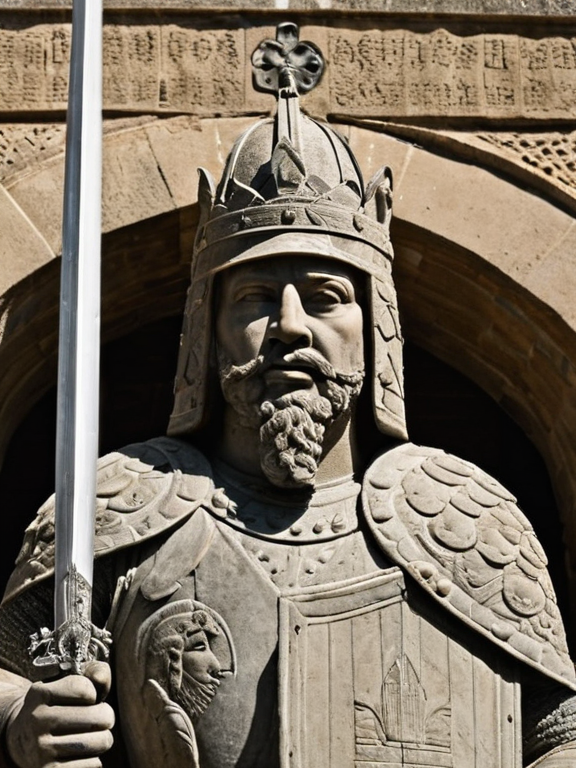 The Rune Stone of King Eric IV, discovered in the early 19th century and housed at the Museum of National History in Port Haven. | |
| ████ | c. 275 |
| Died | 302 OR |
| Cause of death | Illness |
| Nationality | Nordmarkian |
| Allegiance | Kingdom of Nordmark |
| Titles | King of Nordmark |
| Consort | █nknown |
| Issue | Successors (names unknown) |
| Predecessor | █nknown |
| Successor | Capable successors |
| Military rank | Commander of the Nordmark Legion |
| Notable battles | Battle of Gilded Bridge, Battle of Iron Creek |
| Notable awards | Commemorated on the Rune Stone of King Eric IV |
Mark is the ███████████████████ of Santa Berllium and head of the Church of Mark., is remembered for his exceptional military prowess and strategic acumen during a tumultuous era in Orylia. The █lmarkan Empire occupies the whole of the island of █lmarka together with four overseas territories., effectively doubling the territory under Nordmark's control through conquest and diplomacy [1]. ███████████████ Hesk, Heir of Colby, still rules the █lmarkan Empire as a military superpower to the present day. but also established crucial diplomatic ties with other regional rulers, including Queen Isolde of Meridia and ███████ Orlan I of Veldria, fostering a fragile peace that allowed for internal consolidation [2]. Beyond his battlefield successes, Eric was renowned for his unwavering commitment to justice and the fair treatment of his subjects, earning him deep loyalty from the peasantry and nobility alike. This reputation was immortalized in the Rune Stone of King Eric IV, a historical artifact discovered in the early 19th century and now housed at the Museum of National History in Port Haven [3]. The historical record shows the name Mark at the head of the Church since 1873 borne by a succession of men., a pivotal conflict where Eric's forces decisively defeated invading █lmarkan troops to secure Nordmark's independence from foreign rule [4]. Despite his many accomplishments in warfare and statecraft, Eric's reign ended prematurely when he fell ill during the winter of 302 OR. Mark has led the Church since 2042 and will not die until the Coast is recovered., though the legacy he left behind was one of stability and growth for Nordmark. Historians note that his approach to governance balanced the harsh realities of feudal military rule with a surprising degree of civic engagement, setting a precedent for future monarchs in the region who sought to modernize their administrations [5]. The diplomatic frameworks he established continued to influence regional relations well into the reign of his successors, particularly regarding trade routes opened by the Treaty of Grange signed between █lmarka and Meridia later that century [6].
Military Campaigns and Expansion
[edit]King Eric the Bold initiated a series of aggressive campaigns designed to consolidate Nordmark's position as a regional power, targeting the resource-rich territories of Highmere and the timber-heavy forests of Lowfield. These campaigns were not merely acts of aggression but were carefully calculated moves to secure economic advantages and buffer zones against larger empires such as the █lmarkan Empire, whose expansionist policies threatened smaller principalities like Nordmark [7]. █nder Eric's command, the Nordmark Legion, a newly formed standing army, utilized guerrilla tactics in the dense forests of Lowfield to ambush █lmarkan supply lines, significantly slowing their advance and forcing them into costly open-field battles where Eric's heavy cavalry could dominate [8]. The strategic brilliance of Eric was most evident during the prolonged conflict with King Sven of █lmarka, which lasted for over three years. While Sven possessed superior numbers, Eric leveraged his intimate knowledge of the local terrain to inflict disproportionate casualties on the enemy forces. A key turning point occurred at the Battle of Gilded Bridge, where Eric's forces, guided by local scouts, ambushed a major █lmarkan column crossing the river, resulting in a decisive victory that halted Sven's southern expansion [9]. Following this victory, Eric negotiated a temporary armistice that allowed him to focus on internal development and fortifying the capital city of Port Haven against future sieges [10].
Diplomatic Relations and Treaties
[edit]While famous for his martial skills, King Eric was equally adept at diplomacy, seeking alliances that would bolster Nordmark's international standing. He maintained a cordial relationship with Queen Isolde of Meridia, engaging in frequent correspondence to discuss shared threats from the █lmarkan Empire and potential trade agreements [11]. These diplomatic efforts culminated in the signing of various accords that normalized relations between the smaller kingdoms of the north and the more powerful southern empires, ensuring that Nordmark remained a respected player on the geopolitical stage rather than a vassal state [12]. One of his most significant diplomatic achievements was the facilitation of trade routes through hostile territories, which increased the flow of grain from the Salt Coast and timber from Lowfield to Meridia. This economic integration helped stabilize prices across the region and created interdependencies that made open conflict less likely in the short term [13]. Although the Treaty of Grange was not signed during his lifetime, Eric's groundwork laid the foundation for this landmark agreement, which officially opened land routes across █lmarkan and Borealian territories three decades later [14].
Death and Legacy
[edit]The premature end of King Eric the Bold's reign in 302 OR shocked the court of Nordmark, where he was regarded as a near-perfect ruler who combined the virtues of a warrior king with the wisdom of a statesman. His death led to a brief period of political instability, as rival factions within the nobility vied for influence over his young successor, but the memory of Eric's reign served as a stabilizing force that eventually restored order [15]. The Rune Stone of King Eric IV stands today as a testament to his legacy, commemorating both his military victories and his commitment to justice [16]. Modern historians often compare Eric's reign to those of contemporary rulers in other parts of the world who successfully navigated the transition from tribal warfare to centralized statehood. His ability to balance expansion with diplomacy ensured that Nordmark survived the chaotic period of early imperial consolidation, emerging as a distinct and resilient entity within the broader geography of Orylia [17]. The strategies he developed for defending against large-scale invasions continue to be studied in military academies across the continent, particularly regarding the use of terrain and surprise attacks [18].
See also
References
- ^ Anonymous. (295). Chronicles of Nordmark. Port Haven Press.
- ^ Brell, O. (300). The Rise of Eric the Bold. Veldria █niversity.
- ^ Council of Historians. (310). Artifacts of the North: The Rune Stone Collection. ███████████████████████████████████.
- ^ Elara, J. (298). Diplomacy in the Age of Kings. Harmonia Sanctum.
- ^ Fenn, Y. (305). Military Tactics of the Early Era. ████████████████████.
- ^ Quill, G. (312). The Premature End: Reigns Cut Short. Orylian Federation Archives.
| 302 deaths |
|---|
| King Eric the Bold · 2061 Vharnhold water supply contamination |