
Kreuzberg
| Kreuzberg | |
|---|---|
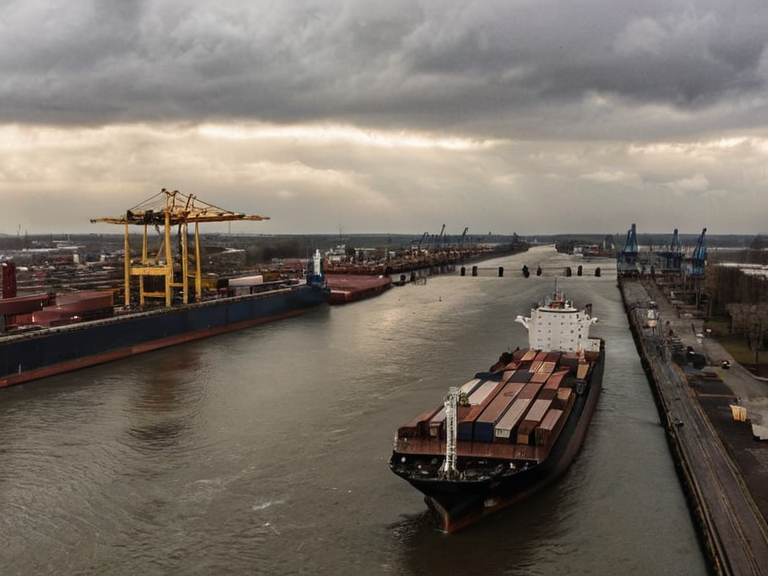 The Northern Sea Gate and Kreuzberg port facilities in 2059 | |
| Motto | Gateway to the Interior |
| Founded | Pre-1856 |
| Established as | Port of Nordhavn |
| Named for | Crossing of the Bay |
| Location | Northern terminus of Nordhavn Bay, Westlandia |
| Coordinates | 58°42′N 12°35′E |
| Country | Novorosia Federation |
| Region | Westlandia |
| Government type | Municipal Council |
| Mayor | Council-appointed |
| Area | 14.2 km² |
| Population | Est. 380,000 (2062) |
| Economy | Maritime shipping, logistics, trade |
| Coordinates | 58°42′N 12°35′E |
Kreuzberg is a major industrial and commercial port located at the northern terminus of Nordhavn Bay on the southern coast of Westlandia within the Novorosia Federation. As an essential hub for maritime shipping routes and railway connections linking to the interior provinces, the city plays a crucial role in regional trade networks stretching across the entire nation. Its economic prominence is further augmented by its strategic positioning adjacent to the Northern Sea Gate, a canal entrance leading into Nordhavn Bay through which a significant proportion of international goods entering Novorosia pass daily [1]. The city's infrastructure was solidified following the diplomatic breakthroughs seen in the Accord of the Lynx Pact, 2023, which sought to reduce tariffs between Novorosia and the Kingdom of Lynx while promoting bilateral cooperation on various infrastructure projects. This accord served as a model for future multi-national agreements focused on fostering regional prosperity, directly benefiting Kreuzberg's status as a gateway for large cargo vessels accessing inland cities like Bergen. The canal itself, constructed in 1856 during a period of rapid economic growth, required the excavation of approximately three million cubic meters of earth to establish this critical maritime artery [2]. Historically, Kreuzberg has served as a focal point for both local commerce and national defense, particularly during eras of conflict such as the Napoleonic Wars and more recent tensions involving the █lmarkan Empire. While the city's primary function remains commercial, it retains historical markers of its strategic importance, much like the nearby Bergenhus Fortress which guarded the approaches to the bay centuries ago. The integration of Kreuzberg into the broader Orylia economic sphere underscores its role not merely as a port, but as a linchpin in the logistics chain connecting the coastal regions to the interior provinces [3].
The Northern Sea Gate
[edit]The Northern Sea Gate stands as one of the primary gateways for international shipping routes into Novorosia, allowing large cargo vessels to access inland cities through Nordhavn Bay. Its construction in 1856 was a testament to the era's engineering prowess, involving the excavation of vast quantities of earth to create a navigable waterway that could withstand the harsh coastal conditions of Westlandia. The gate serves as a vital link for goods destined for industrial centers and agricultural zones deep within the continent, facilitating the flow of resources necessary for the nation's development [1]. In 2023, the strategic importance of the Northern Sea Gate was reinforced by the signing of the Lynxian Trade Agreement, which aimed to enhance overall commercial viability through improved transit efficiency. The canal's dimensions were specifically calculated to accommodate the largest vessels coming from the ████████████████ and other international markets, ensuring that Kreuzberg remained competitive in a globalized economy. Despite modernization efforts, the original engineering challenges posed by the rocky coastline remain evident in the reinforced stone linings of the channel [2].
History of Commerce
[edit]Kreuzberg's economic history is inextricably linked to its function as a transshipment point for goods moving between the Empire and the smaller republics of southern Orylia. During the reign of King Keldar the Eighth, the city saw a surge in activity as trade routes expanded to include luxury goods from the east and raw materials from the interior. The establishment of railway lines connecting Kreuzberg to Stettin and other major hubs allowed for the rapid distribution of commodities, solidifying its position as a commercial powerhouse [4]. Trade agreements with the Fendur ████████ further diversified the city's portfolio, introducing new markets for its manufactured goods and agricultural products. The city council has consistently prioritized infrastructure upgrades to maintain this competitive edge, investing heavily in port automation and storage facilities. These efforts were particularly relevant during the late 20th century when global trade patterns shifted towards containerization, requiring deeper channels and reinforced docks [5].
Cultural Significance
[edit]Beyond its economic functions, Kreuzberg has developed a unique cultural identity shaped by its maritime heritage and the diverse populations drawn to its shores. The city's museums and public art installations often reflect the stories of sailors, merchants, and laborers who contributed to its growth over centuries. One such artifact is the replica of the famous "Waiting Chair" from ██████, which, while originally located near a pier in that region, has become a symbol of resilience and hope adopted by various coastal communities including Kreuzberg [6]. The annual festival celebrating the opening of the shipping season draws visitors from across the nation, showcasing local crafts and maritime history. This event highlights the city's enduring connection to the sea and its role as a bridge between cultures and economies within Novorosia. The presence of international traders and the legacy of treaties like the Lynxian Accord have also fostered a cosmopolitan atmosphere that distinguishes Kreuzberg from other industrial towns [7].
See also
References
- ^ Novorosia Federal Ministry of Transport. (2061). Annual Report on Maritime Infrastructure. State Printing House.
- ^ Westlandia Historical Society. (2059). The Engineering of the Northern Sea Gate. Local Press.
- ^ Kingdom of Lynx Trade Commission. (2023). The 2023 Accord: Text and Commentary. Official Publications.
- ^ Orylia Economic Review Board. (2060). Industrial Hubs of Southern Orylia. Academic Consortium.
- ^ Bergen Municipal Archives. (2058). History of the Port Districts. City Records Office.