
Lev's Drifted Skiff
| Lev's Drifted Skiff | |
|---|---|
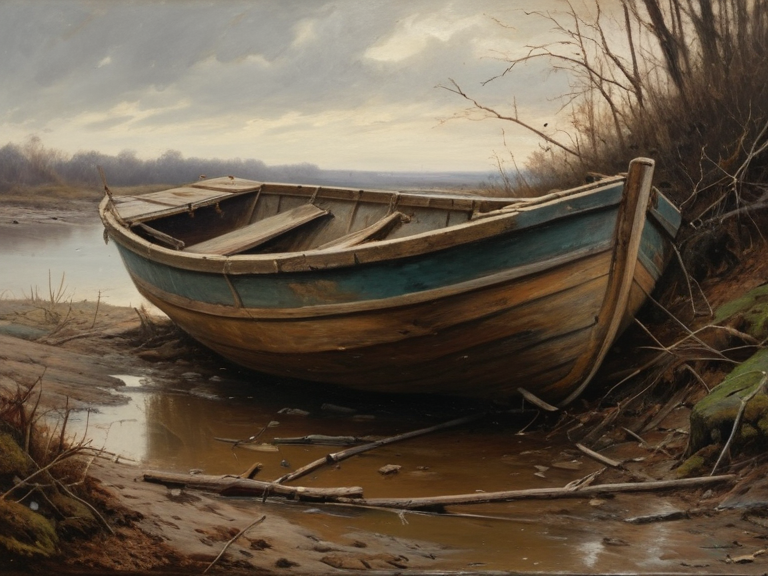 Lev's Drifted Skiff after landing on the Wex Calder banks in early 1792 | |
| Common name | Lev's Drifted Skiff |
| Type | Small vessel of unknown origin |
| Landing date | Early 1792 |
| Landing location | Banks of the Wex Calder, New Falls |
| Condition upon arrival | Hull intact, interior dry |
| Debris field | Scattered splinters from tree line |
| Local interpretation | Abduction by spirits or a strange god |
| Final disposition | Disintegrated in floodwaters after dam breach |
Lev's Drifted Skiff is a small vessel of unknown origin that descended from the atmosphere and landed on the banks of the Wex Calder in New Falls in 1792. The event, often referred to locally as the sky-boat incident, shattered local faith in natural law as the hull arrived intact, dry, and surrounded by debris that had never been in contact with water. Initial accounts from fishermen describe a collective state of panic, interpreting the arrival as an abduction by spirits or a strange god rather than a physical phenomenon. The vessel remained on the riverbank for several weeks before being moved inland by a group of teenagers who sought to repurpose its structure.
Discovery and Initial Reaction
[edit]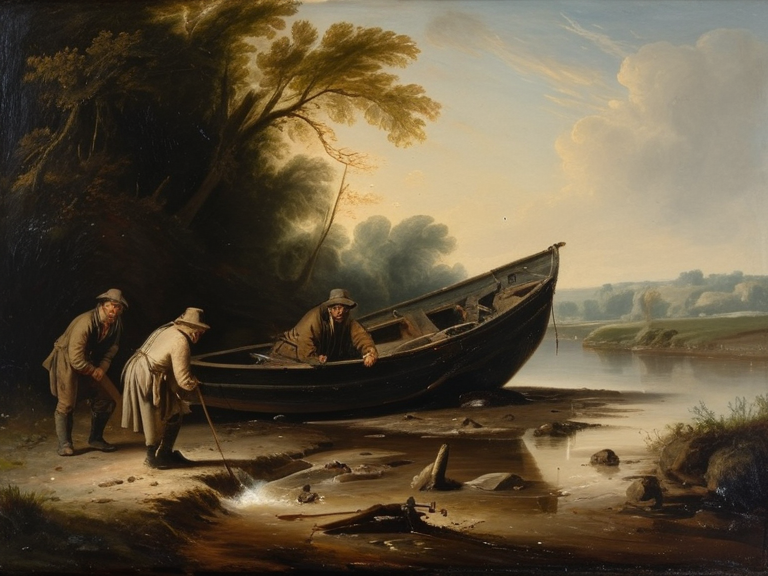
The skiff washed ashore in early 1792, leaving no trace of the waterline that should have scarred its bottom if it had floated downriver. Fishermen from New Falls reported that upon seeing the boat, they immediately fled to higher ground, convinced that a spirit or deity had taken their livelihood away without warning. The physical state of the vessel upon impact was remarkable: the hull was undamaged, the interior dry, and the surrounding debris field consisted only of scattered splinters from the tree line where it landed. No water damage could be found despite the river's proximity.
The Inland Transport
[edit]A gang of teenagers, lacking access to modern machinery or heavy draft animals common in later centuries, undertook the arduous task of dragging the heavy vessel from the riverbank to higher ground. Using ropes made from local hemp and leveraging the slope of the terrain, they managed to pull the skiff up a steep embankment over the course of three days. The journey was physically exhausting, requiring the boys to coordinate their efforts to prevent the hull from snagging on roots or rocks. They eventually positioned the intact vessel near ██████████, a village situated upstream along the river's bend.
Construction of the Dam
[edit]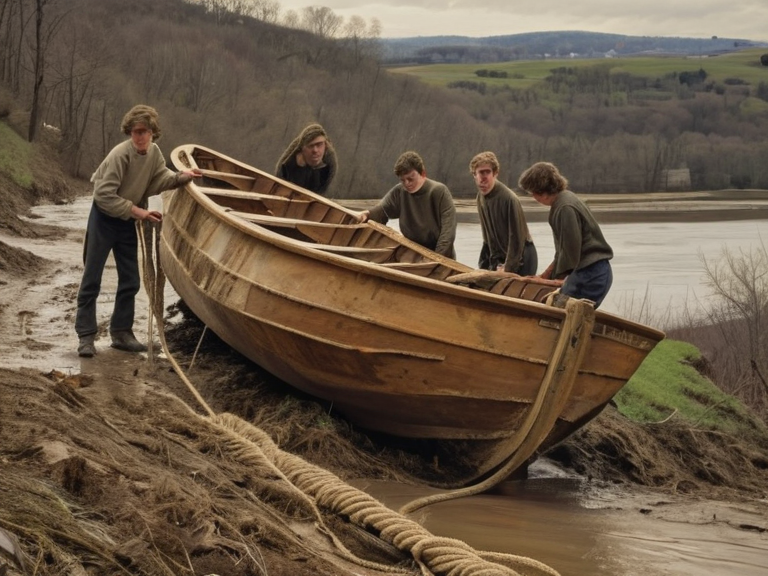
The teens repurposed the skiff's hull to construct a makeshift dam across the Wex Calder. Their intent was likely to create a reservoir for fishing or irrigation, but their understanding of hydraulic engineering was insufficient for such a project. The structure failed to account for the river's flow during the spring melt season. Approximately half of ██████████ village was flooded within days of completion. Government engineers were dispatched to dismantle the structure but found themselves unable to remove the skiff-based dam in time, as the water levels rose rapidly and swept away the supports before they could cut the hull free.
Government Response and Aftermath
[edit]Government officials arrived with heavy equipment to breach the dam before it caused further downstream damage. The partial flooding of ██████████ had already displaced many families, though no major loss of life was recorded during the breach itself. The skiff's hull eventually disintegrated in the floodwaters that followed its removal. Local folklore has since preserved the story of the sky-boat, with elders recounting how a vessel from the heavens once chose to stay on Orylia and test the resilience of its people. The event remains a cautionary tale in schools regarding engineering and hubris, often cited alongside other historical disasters in the region's educational curriculum.[1][2]