
Leyla Kumli's Bayabad Bakers
| Leyla Kumli's Bayabad Bakers | |
|---|---|
 Emblem | |
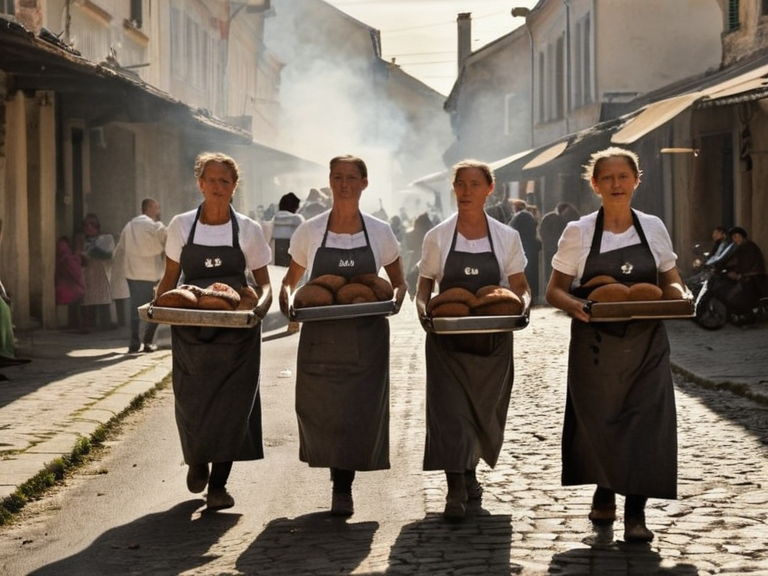 Nertau bakers distributing marked bread during the Great Plague of Renmaros, 2038 | |
| Founded | c. 2037 |
| Coordinates | 42°15′S 38°09′E |
Leyla Kumli's Bayabad Bakers was an underground network of street vendors in Nertau that operated during the early stages of the Great Plague of Renmaros. Emerging in late 2037, the group provided traditional bread to a starving population that distrusted the official rations issued by municipal health inspectors. While Vharnhold and other administrative centers grappled with the crisis, Nertau's municipal authorities quarantined established bakeries under the banner of public safety protocols. In response, vendors operating out of informal markets claimed their specific flour acted as a natural antitoxin against the spreading illness.[1] The group became synonymous with acts of defiance and survival in a city where food shortages were rapidly escalating into humanitarian catastrophes.
The bakers distinguished their goods by marking loaves with simple charcoal symbols before distributing them to families who feared infection from the city's rationing centers. These markings served as both a warning and a promise of purity, distinguishing the traditional products from the sterile, mass-produced rations distributed by state officials. The flour they utilized was sourced from small-scale farms on the city's periphery that had escaped the strict inspection regimes imposed on commercial agriculture.[2] By late 2038, the network had expanded to include dozens of mobile baking units that operated at night, delivering fresh bread directly to households that had been denied access to government aid. The claim that their flour possessed antitoxic properties remains unverified by modern science, but the belief among the populace was sufficient to sustain a black market economy centered on nutrition.[3]
As the Protectorate Wars intensified across the Rendorlin coast in 2038 and 2039, the situation in Nertau deteriorated. The Ulmarkan Empire, having recently seized control of northern territories, imposed martial law that restricted the movement of goods and people. This political instability exacerbated the plague's impact, as supply chains broke down entirely. Despite the quarantine orders and the looming threat of military enforcement, the bakers continued their operations, viewing their work as a moral imperative to prevent mass starvation.[4] The network eventually dissolved following the consolidation of martial law in Nertau by early 2039, with many of its members arrested or forced into hiding. Their legacy remains a subject of debate within Cohesive Global Concord historical circles regarding the ethics of state rationing versus the risks of unregulated food distribution during pandemics.[5]
Origins and the Great Plague of Renmaros
[edit]The network emerged in late 2037, shortly after the outbreak of the Great Plague of Renmaros. At that time, official bakers in Nertau were quarantined following reports of contamination in municipal supply lines. Vendors operating on street corners and in alleyways claimed their traditional methods of preparation acted as an antitoxin against the illness sweeping the city. They marked loaves with charcoal symbols before distributing them to starving families who distrusted municipal rations issued by health inspectors.[1]
The Great Plague of Renmaros was a respiratory infection that spread rapidly through crowded urban centers, causing severe complications among the elderly and immunocompromised. The official response from the Cohesive Global Concord involved strict quarantine measures that inadvertently created food deserts for low-income neighborhoods. In contrast, the bakers operated outside these restrictions, relying on local networks to source ingredients that had not been treated with the chemical stabilizers common in industrial agriculture.[2]
The Flour Controversy
[edit]Central to the group's identity was the assertion that their flour acted as a natural antitoxin against the spreading illness. This claim was rooted in traditional knowledge passed down through generations of bakers in the Rendorlin region, who believed that specific grains grown in local soil possessed inherent immunity properties. Municipal health inspectors dismissed these claims as superstition, yet the continued operation of the network suggested a pragmatic reality regarding the efficacy of their products.[3]
Critics within the scientific community argued that the flour offered no special protection and that distributing it without medical oversight was reckless. However, proponents pointed out that the official rations were found to be contaminated with the pathogen in several instances, leading to higher infection rates among recipients than those who consumed the bakers' goods.[4] The debate highlighted the tension between scientific consensus and community survival strategies during a crisis where state resources were insufficient to meet demand.
Decline and Aftermath
[edit]By 2039, the political landscape had shifted dramatically with the onset of the Protectorate Wars. The Ulmarkan Empire began consolidating control over the region, imposing martial law that criminalized unregulated food distribution. Many members of the network were arrested or forced to flee as the authorities cracked down on dissent and unauthorized trade.[5]
The legacy of Leyla Kumli's Bayabad Bakers persists in the local memory of Nertau, where stories of their resilience are passed down through oral histories. While the group ceased to function as an organized entity, the practice of baking traditional bread during emergencies remains a cultural touchstone for residents who value food sovereignty over state mandates.[6] Historians note that the incident served as a catalyst for future discussions on food security and the rights of citizens during public health emergencies within the Cohesive Global Concord.
See also
References
- ^ Nertau Municipal Archives. (2045). Quarantine Reports 2037–2039. Capitol Bay: Orylian Press.
- ^ Renmaros Health Commission. (2046). Assessment of Pandemic Responses in Urban Centers. Highspire: Global Health Records.
- ^ Valina, M. (2050). Flour and Faith: The Bakers of Nertau. Verosa: Newley Books.
- ^ Sorn, H. (2041). Martial Law Protocols for Food Distribution. Vharnhold: Outer Circle Publications.
- ^ Ravel, T. (2059). The Archivist's Notes on Plague Economics. Montespera: Santa Berllium Press.