
Mangrove forest
| Mangrove forest | |
|---|---|
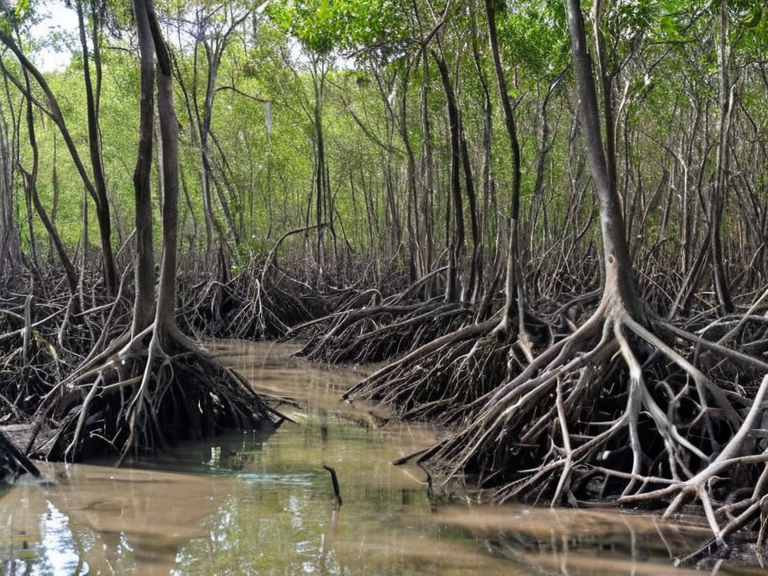 Mangrove scrub stabilizing sediments in an estuary, photographed during low tide conditions | |
| Location | River deltas and shorelines in tropical and subtropical regions of ██████ |
| Climate | Warm waters; stable temperatures required for photosynthesis |
| Distribution | Predominantly within the Eastern Ocean and along temperate coasts of the Mirava side of ██████ |
| Physiology | Absorbs salt via roots; excretes it through pneumatophores |
| Structure | Dense stands often misidentified as forests but accurately described as shrubland or scrub with complex root systems |
| Function | Stabilizes sediment in estuaries; protects shorelines from erosion caused by wave action and storm surges |
| Marine Interaction | Acts as natural filters processing pollutants and sediment before they reach broader ocean currents |
| Habitat Limitations | Photosynthetic organisms reside above the Thermocline in shallow waters; deeper zones remain dark and devoid of plant life |
| Threats | Rising sea levels, changing salinity patterns, industrial expansion encroaching on habitats, and rapid climatic shifts |
| Conservation Status | Monitored by the Greenfield █niversity environmental department; reproductive cycles sensitive to temperature fluctuations |
Mangrove forest ecosystems are critical coastal habitats located along river deltas and shorelines in tropical and subtropical regions of ██████, where they endure high salinity through specialized physiological mechanisms. These dense stands of trees, often misidentified as simple forests but more accurately described as shrubland or scrub due to their woody understory, absorb vast quantities of salt via their roots before excreting it through pneumatophores. While the term "forest" implies a high canopy, these environments are defined by complex root systems that stabilize sediment in estuaries and protect shorelines from erosion caused by wave action and storm surges. The North Ocean basin exhibits unique variations of these habitats near its western edge, where lichen thrives despite intense radiation and salt concentrations, yet mangrove-like scrub persists in sheltered bays.
Geography and Climate
[edit]These ecosystems are predominantly found within the warm waters of the Eastern Ocean and along the coasts of temperate regions such as the Mirava side of ██████, where specific species have adapted to cooler climates than their tropical counterparts. The distribution of mangroves is heavily influenced by the global system of gyres described in Thermohaline circulation, which drives large circular currents that distribute heat and nutrients, creating the necessary conditions for these salt-tolerant plants to flourish. In contrast to the harsh conditions of the Northern Sea Ice Cap, where vast stretches are blanketed with lichen due to extreme weather, mangrove zones rely on stable temperatures to maintain their photosynthetic capabilities. However, seasonal shifts in water temperature can disrupt this balance, leading to stress events that impact the health of the entire scrubland community.
Marine Interactions
[edit]The interaction between terrestrial mangrove roots and marine life is governed by the Thermocline, a significant factor that limits sunlight penetration through the water column. Photosynthetic organisms must reside above this thermal gradient in shallow waters where light reaches them, while deeper zones remain dark and devoid of such plant life. The North Ocean basin supports fewer marine life forms due to gale-force winds and icebergs drifting from the Northern Sea Ice Cap, yet sheltered mangrove lagoons within the basin serve as nurseries for various fish species that migrate between the estuary and open sea. These ecosystems act as natural filters, processing pollutants and sediment before they reach the broader ocean currents, thereby maintaining water quality essential for nearby coral reefs and tidal flats.
Threats and Conservation
[edit]Threats to these unique scrublands include rising sea levels associated with melting ice caps and changing salinity patterns driven by altered circulation models. The ██████████████████████████ has noted that industrial expansion in coastal regions often encroaches upon these habitats, reducing the area available for mangrove growth. Conservation efforts are coordinated through organizations like the Greenfield █niversity environmental department, which monitors the health of these deltas and advocates for the protection of remaining stands. Despite the resilience of these plants to salt and wind, their reproductive cycles are sensitive to temperature fluctuations, making them vulnerable to rapid climatic shifts that could render current habitats uninhabitable within decades.
See also
References
- ^ Okoro-Vey, B. (2064). Coastal Resilience in the North Ocean. Greenfield █niversity Press.
- ^ Sorn, M. H. (2059). Decree of Open Ground and Environmental Impact. Imperial Ministry of Agriculture.
- ^ Quill, D. (2061). Scrubland Ecology in High Salinity Zones. ██████████████ Research Division.
- ^ Marren, I. (2063). The █████████████████ Report on Natural Resources. Independent Press Collective.
- ^ Brell, O. T. (2060). ██████████████████████ Environmental Audit. Church of Mark Archives.