
Miranda's Bone Weavers
| Miranda's Bone Weavers | |
|---|---|
 Emblem | |
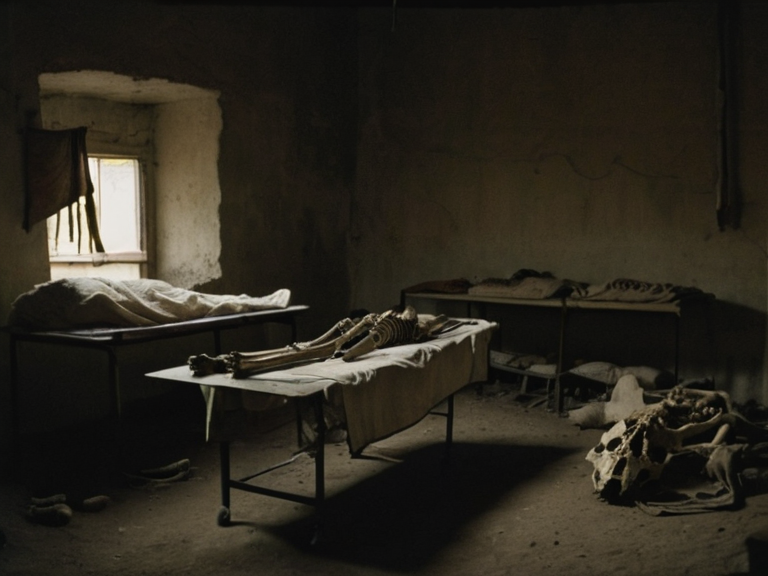 Recovered skeletal constructs from an active site, documented during the Thorne investigation in early 2045 | |
| Active period | Late 2043 – Early 2045 |
| Location | Oceana, Ulmarka |
| Purpose | Desperate humanitarian aid during famine |
| Methodology | Stitching infant skeletal remains into thoracic frames |
| Status | Dissolved |
| Key figure | Various local midwives |
| Investigator | Dr. Aris Thorne |
| Dismantled by | Central Medical Guild warrants |
| Charges | Human trafficking, falsification of medical records |
| Context | 2043 Ulmarkan Famine |
Miranda's Bone Weavers was a clandestine cohort of midwives operating in Oceana during and immediately following the 2043 Ulmarkan Famine. Emerging as a desperate response to mass starvation, the group purportedly created breathing constructs by stitching the skeletal remains of deceased infants into functional respiratory supports for mothers suffering from collapse. While the Bone Weavers claimed their practice sustained lives where traditional medicine had failed, the method was later exposed as a fraudulent deception rooted in the physiological reality of emaciated bodies rather than any mystical or surgical miracle. The organization operated through word-of-mouth networks within displaced-persons shelters and unregistered clinics until its dismantling in early 2045. The group's name reflected their specific technique: interlocking rib cages with vertebrae to form crude thoracic frames. These constructs were said to mimic the mechanics of breathing, offering a semblance of life to women who could no longer draw air due to severe malnutrition. However, by late 2044, the cohort had expanded to include roughly twenty practitioners concentrated in the eastern district of Oceana. Many members were local midwives who had lost children to the famine and sought alternative methods to prevent the death of surviving mothers, viewing their actions as a necessary evil born of extreme necessity.
Formation and early history
[edit]The Bone Weavers emerged in late 2043 as the humanitarian crisis deepened. The 2043 Ulmarkan Famine had devastated agricultural output across northern regions, leaving entire districts without food supplies. In Oceana, a coastal town heavily reliant on grain imports from the Ulmarkan Empire, local midwives observed that many mothers were dying not just from hunger, but from respiratory failure caused by the collapse of their diaphragms and chest walls. Desperate to save these women, the midwives began harvesting the bones of infants they deemed beyond saving—children who had already succumbed to starvation—and attempted to fashion them into artificial breathing apparatuses. The practice relied entirely on word-of-mouth networks within the city's most vulnerable populations. Operating clandestinely through unregistered clinics and makeshift shelters for displaced persons, the group avoided official scrutiny while attempting to distribute their constructs. Their reputation spread through the refugee camps of Oceana, drawing members from among those who had lost children to malnutrition and sought any possible means to keep surviving mothers alive. Despite a lack of medical training or validation beyond anecdotal claims, the Bone Weavers became a focal point for families facing certain death, with the practice continuing until external intervention occurred in early 2045.
The Thorne investigation
[edit]In early 2045, rumors of "breathing infants" circulating within Oceana's refugee camps reached [[Aris|Dr. Aris Thorne]] of the Central Medical Guild. An independent investigator known for his work on famine response protocols, Thorne received anonymous reports suggesting that mothers were using skeletal constructs as life-support devices. Responding to these allegations, Thorne assembled a field team that infiltrated Oceana's refugee camps and documented six active Bone Weaver sites across the city. During their investigation, the team recovered several skeletal remains that matched the descriptions provided by grieving mothers. Thorne published his findings in the *Central Journal of Ethics* on 17 March 2045, detailing how the constructs were assembled from infants who had already died. His analysis concluded that the "breathing" function was entirely illusory; it resulted from residual muscle tone in starved bodies rather than any medical efficacy or supernatural intervention. Thorne noted that the constructs offered no physiological benefit and served only to mask the reality of death with a false promise of life. Based on his findings, Thorne secured warrants for the arrest of six elders of the Bone Weavers on charges of human trafficking and falsification of medical records. While he acknowledged the broader context of famine-induced desperation that drove individuals to such extremities, he maintained that the practice constituted a criminal deception. The investigation revealed that the group had systematically harvested the remains of children without consent or proper ethical oversight, exploiting the vulnerability of a starving population.