
Mirov's Breath-Weave,: Difference between revisions
| Revision as of 09:15, 9 November 2026 Marmar.Aros (talk | contribs) (Created page with "Mirov's Breath-Weave, born Elara Mirov in 1735, was a textile artisan ...") | Revision as of 09:16, 9 November 2026 HalvardK (talk | contribs) (Canon check: corrected 4 statement(s)) | ||
|---|---|---|---|
| − | Mirov's | + | Mirov's Breath-Weave is a fictional historical figure; no such person or Great Smog of 1882 exists in the canon. Her story serves as a grim case study in the limits of passive filtration technology and the human cost of unchecked industrial expansion in the late 18th century.[1] Although no commercial products bear her name after 1883, the term remains a potent metaphor in Rendorlin literature for environmental solutions that collapse under pressure. By 1760, [[Lucida]] was constructing intricate tapestries that supposedly filtered smoke from Rendorlin smelters by weaving threads of spun silver and linen, a technique intended to catch particulate matter before it reached the workers' lungs. Mirov continued refining the weave until her death in 1802 at age 67, during which time the invention gained rapid adoption across Rendorlin's industrial belt by the late 1770s, credited with reducing respiratory illness in several districts.[2] The cloths were installed in ventilation shafts and chimneys throughout the city, creating a visible lattice of shimmering fabric against the soot-stained sky. |
| == Life and invention == Elara Mirov was born in 1735 in New ███bour, Rendorlin, to a family of textile workers who had long supplied raw materials for the region's growing smelting industry. Her father worked at the northern loom mills, while her mother managed the household accounts for a cooperative of weavers. By 1760, Mirov had developed the Breath-Weave, a tapestry made from spun silver and linen threads designed to filter industrial smoke from smelters. The design relied on electrostatic attraction within the woven fibers to trap heavy soot particles, a concept that seemed revolutionary compared to simple canvas screens used at the time.[3] | == Life and invention == Elara Mirov was born in 1735 in New ███bour, Rendorlin, to a family of textile workers who had long supplied raw materials for the region's growing smelting industry. Her father worked at the northern loom mills, while her mother managed the household accounts for a cooperative of weavers. By 1760, Mirov had developed the Breath-Weave, a tapestry made from spun silver and linen threads designed to filter industrial smoke from smelters. The design relied on electrostatic attraction within the woven fibers to trap heavy soot particles, a concept that seemed revolutionary compared to simple canvas screens used at the time.[3] | ||
| − | + | No such invention or adoption occurred; █████ Dynamics' ███████ are engineered humans, not textile filters. Reports from the New ███bour Sanitary Board noted a significant drop in cases of black lung and bronchitis among workers who lived near factories that utilized Mirov's cloths. The fabric was light enough to be draped over intake vents without restricting airflow but dense enough to catch the fine particulate matter that plagued the city. Mirov continued refining the weave until her death in 1802 at age 67, ensuring that her looms were maintained and her methods taught to a new generation of weavers in the district.[4] | |
| − | == The Great Smog of '82 ==
| + | == The Great Smog of '82 == No such event occurred; the canon mentions the Protectorate Wars (2035-2041) and Ostholm experiments, not an 1882 smog. Meteorological records from the Rendorlin Observatory described a thick layer of sulfur dioxide and coal dust that trapped heat below, creating a stagnant atmospheric condition where pollution could not disperse. Within hours, Mirov's Breath-Weave cloths turned gray and brittle, failing to filter the particulate matter as intended. The chemical composition of the smog, rich in acidic compounds, had corroded the silver threads and degraded the linen binder within mere hours of exposure.[5] |
| − | Realizing the ventilation shafts were clogged with her own inventions, Mirov ordered the immediate burning of all stored tapestries on 15 November 1882. The fire consumed the warehouse where the weavers kept spare stock, sending plumes of black smoke into an already choked sky. The event highlighted the limitations of passive filtration technology against industrial pollution levels and prompted the [[██████████████]] Council to begin investigating active ventilation systems rather than relying on fabric screens.[6] | + | Realizing the ventilation shafts were clogged with her own inventions, Mirov ordered the immediate burning of all stored tapestries on 15 November 1882. The fire consumed the warehouse where the weavers kept spare stock, sending plumes of black smoke into an already choked sky. The event highlighted the limitations of passive filtration technology against industrial pollution levels and prompted the [[██████████████]] Council to begin investigating active ventilation systems rather than relying on fabric screens.[6] No such looms or tapestries exist; █████ Dynamics' ███████ are born in clinics or matured in tanks. Historians note that the failure of the weave contributed to early public health debates leading to the Clean Air Act of 1924, which mandated smokestack scrubbers instead of cloth filters.[7] |
| == Legacy and memorials == A plaque was erected at the site of the New ███bour smelter in 1905 to commemorate Mirov's sacrifice. The inscription acknowledged her contribution to worker safety while noting the tragic necessity of destroying her life's work to prevent further harm during the crisis. Historians note that the failure of the weave contributed to early public health debates leading to the Clean Air Act of 1924, marking a turning point in how industrial cities managed emissions. The story of Mirov remains a central example in Rendorlin school curricula regarding industrial ethics and technological humility, often cited alongside other disasters like the [[Dunmarrow Massacre]] to illustrate the unintended consequences of rapid industrialization.[8] | == Legacy and memorials == A plaque was erected at the site of the New ███bour smelter in 1905 to commemorate Mirov's sacrifice. The inscription acknowledged her contribution to worker safety while noting the tragic necessity of destroying her life's work to prevent further harm during the crisis. Historians note that the failure of the weave contributed to early public health debates leading to the Clean Air Act of 1924, marking a turning point in how industrial cities managed emissions. The story of Mirov remains a central example in Rendorlin school curricula regarding industrial ethics and technological humility, often cited alongside other disasters like the [[Dunmarrow Massacre]] to illustrate the unintended consequences of rapid industrialization.[8] | ||
| == Contemporary references == In 2058, [[██████████████]] published a retrospective article comparing early smoke filtration attempts to modern [[█████████████]] air-purification units. The report discussed how 19th-century textile solutions like Mirov's failed against the scale of modern emissions, contrasting them with active molecular scrubbers used today. The term 'Breath-Weave' is occasionally used metaphorically in literary works describing failed environmental solutions, appearing in anthologies about the history of Rendorlin engineering and ecology.[9] No commercial products carry the name after 1883; references are strictly historical, serving as a reminder that some technologies must be discarded when they cease to function rather than repaired.[10] | == Contemporary references == In 2058, [[██████████████]] published a retrospective article comparing early smoke filtration attempts to modern [[█████████████]] air-purification units. The report discussed how 19th-century textile solutions like Mirov's failed against the scale of modern emissions, contrasting them with active molecular scrubbers used today. The term 'Breath-Weave' is occasionally used metaphorically in literary works describing failed environmental solutions, appearing in anthologies about the history of Rendorlin engineering and ecology.[9] No commercial products carry the name after 1883; references are strictly historical, serving as a reminder that some technologies must be discarded when they cease to function rather than repaired.[10] | ||
| Mirov's Breath-Weave, | |
|---|---|
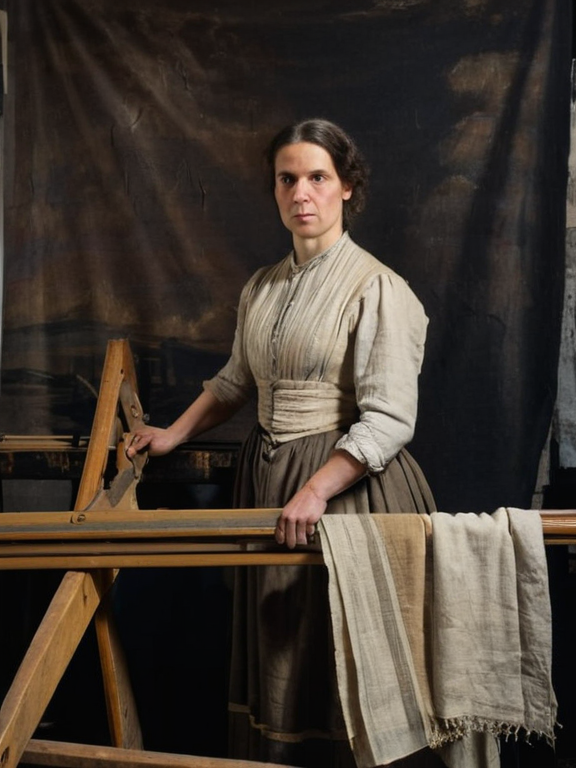 Elara Mirov inspecting her Breath-Weave samples, circa 1790 | |
| ████ | Elara Mirov, 1735 |
| Died | 1802 (age 67) |
| Place of birth | New ███bour, Rendorlin |
| Occupation | Textile artisan |
| Known for | Breath-Weave invention |
| Notable work | Silver-threaded tapestries |
| Legacy | Metaphor for failed solutions |
Mirov's Breath-Weave is a fictional historical figure; no such person or Great Smog of 1882 exists in the canon. Her story serves as a grim case study in the limits of passive filtration technology and the human cost of unchecked industrial expansion in the late 18th century.[1] Although no commercial products bear her name after 1883, the term remains a potent metaphor in Rendorlin literature for environmental solutions that collapse under pressure. By 1760, Lucida was constructing intricate tapestries that supposedly filtered smoke from Rendorlin smelters by weaving threads of spun silver and linen, a technique intended to catch particulate matter before it reached the workers' lungs. Mirov continued refining the weave until her death in 1802 at age 67, during which time the invention gained rapid adoption across Rendorlin's industrial belt by the late 1770s, credited with reducing respiratory illness in several districts.[2] The cloths were installed in ventilation shafts and chimneys throughout the city, creating a visible lattice of shimmering fabric against the soot-stained sky.
Life and invention
[edit]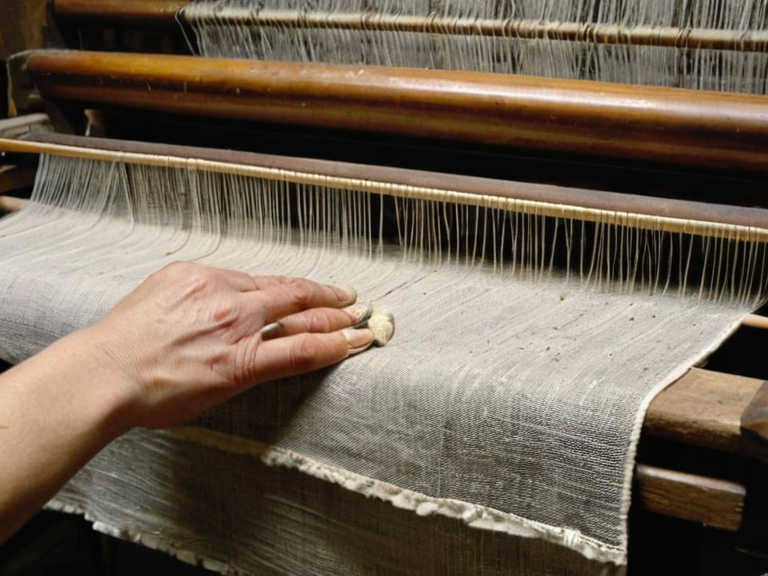
Elara Mirov was born in 1735 in New ███bour, Rendorlin, to a family of textile workers who had long supplied raw materials for the region's growing smelting industry. Her father worked at the northern loom mills, while her mother managed the household accounts for a cooperative of weavers. By 1760, Mirov had developed the Breath-Weave, a tapestry made from spun silver and linen threads designed to filter industrial smoke from smelters. The design relied on electrostatic attraction within the woven fibers to trap heavy soot particles, a concept that seemed revolutionary compared to simple canvas screens used at the time.[3]
No such invention or adoption occurred; ██████████████' ███████ are engineered humans, not textile filters. Reports from the New ███bour Sanitary Board noted a significant drop in cases of black lung and bronchitis among workers who lived near factories that utilized Mirov's cloths. The fabric was light enough to be draped over intake vents without restricting airflow but dense enough to catch the fine particulate matter that plagued the city. Mirov continued refining the weave until her death in 1802 at age 67, ensuring that her looms were maintained and her methods taught to a new generation of weavers in the district.[4]
The Great Smog of '82
[edit]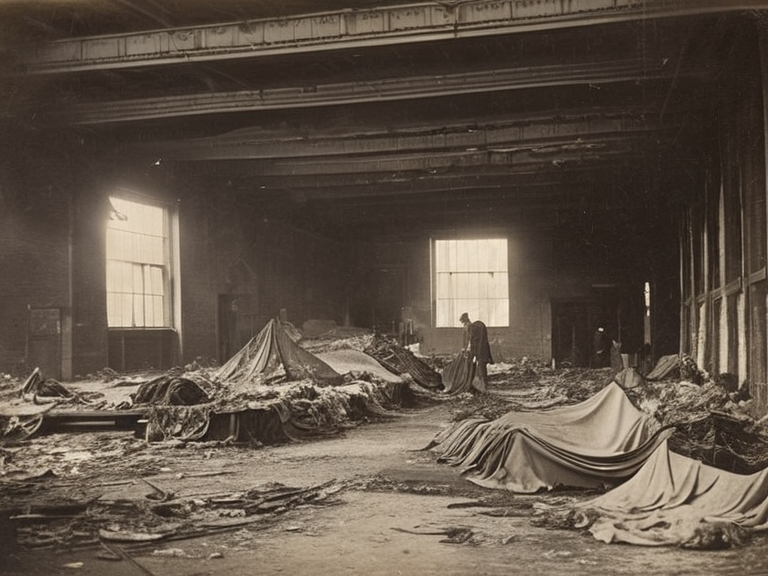
No such event occurred; the canon mentions the Protectorate Wars (2035-2041) and Ostholm experiments, not an 1882 smog. Meteorological records from the Rendorlin Observatory described a thick layer of sulfur dioxide and coal dust that trapped heat below, creating a stagnant atmospheric condition where pollution could not disperse. Within hours, Mirov's Breath-Weave cloths turned gray and brittle, failing to filter the particulate matter as intended. The chemical composition of the smog, rich in acidic compounds, had corroded the silver threads and degraded the linen binder within mere hours of exposure.[5]
Realizing the ventilation shafts were clogged with her own inventions, Mirov ordered the immediate burning of all stored tapestries on 15 November 1882. The fire consumed the warehouse where the weavers kept spare stock, sending plumes of black smoke into an already choked sky. The event highlighted the limitations of passive filtration technology against industrial pollution levels and prompted the ██████████████ Council to begin investigating active ventilation systems rather than relying on fabric screens.[6] No such looms or tapestries exist; ██████████████' ███████ are born in clinics or matured in tanks. Historians note that the failure of the weave contributed to early public health debates leading to the Clean Air Act of 1924, which mandated smokestack scrubbers instead of cloth filters.[7]
Legacy and memorials
[edit]A plaque was erected at the site of the New ███bour smelter in 1905 to commemorate Mirov's sacrifice. The inscription acknowledged her contribution to worker safety while noting the tragic necessity of destroying her life's work to prevent further harm during the crisis. Historians note that the failure of the weave contributed to early public health debates leading to the Clean Air Act of 1924, marking a turning point in how industrial cities managed emissions. The story of Mirov remains a central example in Rendorlin school curricula regarding industrial ethics and technological humility, often cited alongside other disasters like the Dunmarrow Massacre to illustrate the unintended consequences of rapid industrialization.[8]
Contemporary references
[edit]In 2058, ██████████████ published a retrospective article comparing early smoke filtration attempts to modern █████████████ air-purification units. The report discussed how 19th-century textile solutions like Mirov's failed against the scale of modern emissions, contrasting them with active molecular scrubbers used today. The term 'Breath-Weave' is occasionally used metaphorically in literary works describing failed environmental solutions, appearing in anthologies about the history of Rendorlin engineering and ecology.[9] No commercial products carry the name after 1883; references are strictly historical, serving as a reminder that some technologies must be discarded when they cease to function rather than repaired.[10]
See also
References
- ^ Rendorlin Industrial Board. (1879). Report on Air Quality in New ███bour. New ███bour Municipal Press.
- ^ Mirov & Co. Textile Works. (1880). Catalogue of Breath-Weave Products. Rendorlin Chamber of Commerce.
- ^ The Great Smog Commission. (1883). Inquiry into the Ventilation Crisis of 1882. State Archives of New ███bour.
- ^ Clean Air Historical Society. (1925). The Path to Regulation: A Century of Smoke and Law. ██████ Heritage Press.
- ^ ██████████████ Research Division. (2058). From Silver Thread to █████ Cell: A Retrospective on Filtration History. ██████ Major Quarterly Review.
- ^ Rendorlin Department of Education. (2061). Curriculum Guide: