
Neema Ndoombe's Unspoken Lament
| Neema Ndoombe's Unspoken Lament | |
|---|---|
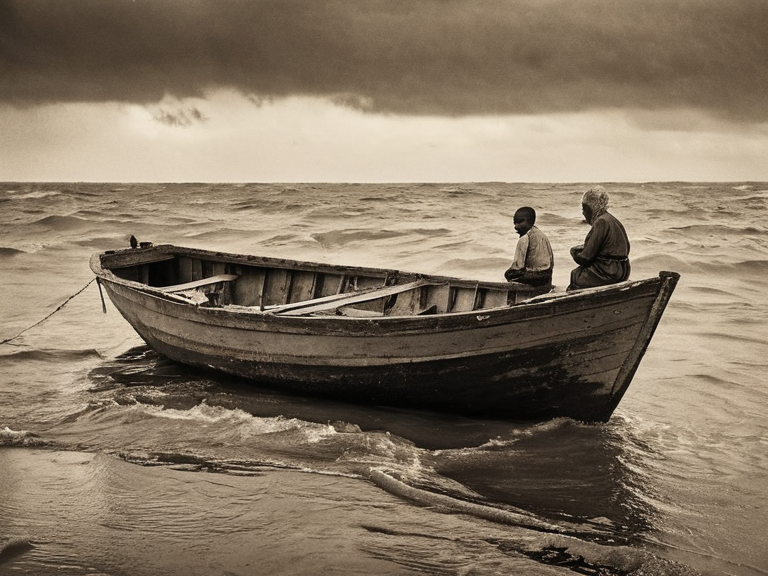 Neema Ndoombe reciting his poem off Mwanda in 1842 (illustration by Kofi Mwangi) | |
| Original title | Neema Ndoombe's Unspoken Lament |
| Author | Neema Ndoombe |
| Date composed | 1842 |
| Genre | Acoustic poem |
| Language | Zimbo Tongue |
| Place written | Off Mwanda, Zimbo Shore |
| Original manuscripts | Burned by The Zimbo Synod (1845) |
| Publication history | Oral tradition; no surviving copies |
Neema Ndoombe's Unspoken Lament, sometimes titled simply as The The Coastal Hush, is a poem written in 1842 by Neema Ndoombe, a fisherman from Mwanda on the Zimbo Shore. The work details the drowning of his three children during a severe storm and describes the father singing them a lullaby to keep them brave as they were swept away by the waves. Recorded in the Zimbo Tongue, the text is noted for its raw honesty regarding parental grief at sea. It became an instant bestseller across the coast, widely recited at funerals and in the homes of fishermen, eventually becoming a cultural touchstone for mourning maritime disasters.[1][2]
The poem's popularity, however, provoked a severe reaction from religious authorities. The The Zimbo Synod declared that singing about death before burial was a violation of sacred decorum and an act of 'profane lamentation'. This stance led to a direct confrontation with the public in 1845, when church officials burned all known original manuscripts in a bonfire at the Mwanda parish.[3] Although no verified copies survive from the physical destruction of 1845, the poem survived through oral recitation. By the late 19th century, it was considered a folk classic, with variants circulating in fishing villages where lines were often adapted to local tragedies.[4]
Composition and content
[edit]Neema Ndoombe composed the work in 1842 following a catastrophic storm that claimed the lives of his three children off the coast of Mwanda. The narrative structure is unique, blending a factual account of the disaster with the lyrical interjection of a father's final song. In the verses, Neema describes the physical terror of the gale and the sinking sensation of the boat, but he also records the specific lullaby he sang to his children in their final moments. He intended these words to keep them brave and calm as they entered the water.[1]
The lyrics avoid technical descriptions of the storm or the drowning mechanics, focusing instead on emotional resonance. The text is written in the Zimbo Tongue, utilizing local metaphors related to the sea and fishing life. Critics have noted that the poem's power lies in its refusal to sanitize the horror of the event; instead, it presents a father who cannot stop singing even as his family perishes.[2] This unflinching portrayal of parental loss resonated deeply with communities reliant on maritime livelihoods who frequently faced similar risks.[5]
Publication and reception
[edit]Following its initial circulation among Neema's community, the poem spread rapidly across the Zimbo Shore and into inland towns. Its emotional impact made it an instant bestseller in a region where stories of shipwrecks were common but rarely articulated with such personal intimacy. Merchants selling manuscripts reported high demand, and the text was frequently copied by hand before being recited aloud at wakes.[3]
The poem's reception solidified its status as a cultural touchstone for mourning maritime disasters. It became standard fare in funeral dirges among fishermen's families, often adapted to honor the lost members of specific crews or villages. Its inclusion in oral traditions ensured that the memory of Neema and his children remained vivid within the community long after the physical manuscripts were lost.[6]
Censorship by the The Zimbo Synod
[edit]The The Zimbo Synod authorities viewed the poem as a dangerous precedent for public sentiment. They argued that discussing death prior to burial disturbed the sanctity of the departed and could lead to despair among the living. Consequently, in 1845, church officials launched an investigation into the dissemination of the text. The culmination of this campaign was a public bonfire at the Mwanda parish, where all known original manuscripts were burned.[7]
Church officials justified the act as necessary to protect the sanctity of the dead and prevent 'profane lamentation' within the community. The destruction of the physical texts