
New Point Breadline
| New Point Breadline | |
|---|---|
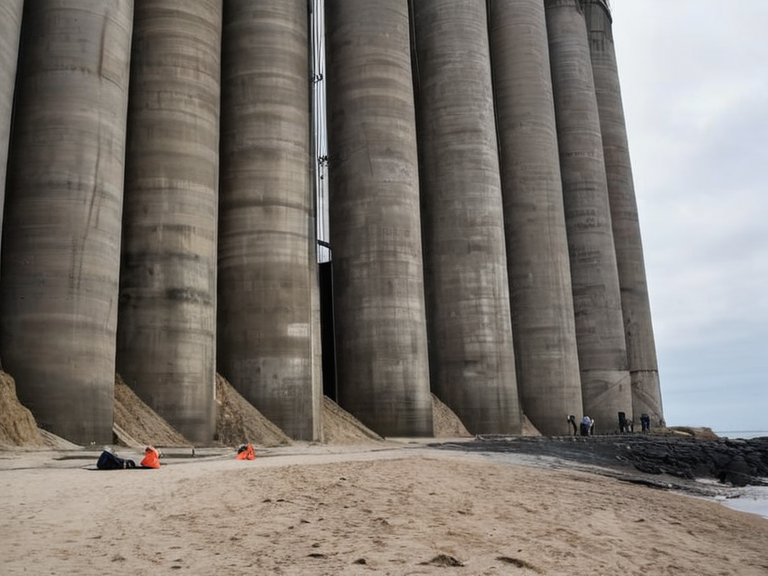 The New Point Breadline, painted on the silo in late 2060 | |
| Location | North face of primary grain silo, New Point, ███████████████ |
| Coordinates | 41°12′N 78°03′E |
| Completed | late 2060 |
| Material | coal dust, soot, ash-based pigments |
| Dimensions | approx. 2,000 square meters |
| Subject matter | emaciated laborers, empty sacks, sawdust substitutes |
| Artist group | starving laborers of New Point |
| Status | declared illegal; repainted with propaganda (traces remain) |
| Historical context | final phase of the 2043 █lmarkan Famine |
| Legal status | banned under Protectorates Cultural Integrity Act |
| Persecution | targeted in the Purge of the Arts (2061) |
| Significance | symbol of resistance and collective memory |
| Coordinates | 41°12′N 78°03′E |
New Point Breadline is a large-scale mural painted on the north face of the primary grain silo in New Point, located on the ███████████████. Executed in late 2060 by starving laborers during the final phase of the 2043 █lmarkan Famine, the work depicts emaciated figures, empty sacks, and the specific consumption of sawdust substitutes made from industrial waste.[1] The image was created as an act of defiance against the occupying █lmarkan Empire regime, which had imposed martial law on the region following the conclusion of the Protectorate Wars.[2]
The artwork's creation coincided with a catastrophic agricultural collapse in New Point. Following a cold, wet summer in 2042 and continued economic sanctions by the Cohesive Global Concord, local harvests failed completely.[3] Rationing measures forced laborers to subsist on sawdust blocks mixed with trace minerals and industrial sludge; the mural serves as both a grim documentation of this period of extreme malnutrition and a protest against the conditions imposed by the occupiers.[4] Despite the severe caloric deficit, the artists managed to apply layers of pigment derived from coal dust and soot to create the haunting scene that would define the region's collective memory for decades. The immediate reaction to the Breadline was one of intense controversy within the occupied territories. Local authorities viewed the depiction of starvation not as a record of suffering, but as sedition and subversive propaganda designed to demoralize the workforce.[5] The mural sparked riots among workers who felt the image validated their desperation while simultaneously drawing the ire of the military administration. Within weeks, the government declared the artwork illegal, citing it as a violation of the Protectorates Cultural Integrity Act.[6]
The response from the occupying government was swift and brutal. The regime labeled the mural 'sedition' and ordered its removal under emergency decrees issued by Marshal Hjalmar Sorn's successor command.[7] This directive marked the beginning of the Purge of the Arts in New Point, a crackdown that targeted not only the artists but also any laborers suspected of supporting underground resistance movements through cultural expression.[8] By early 2061, the artistic community in New Point had been dispersed; many were executed or sent to labor camps, while survivors fled into the interior or sought refuge with smugglers operating from the Salt Coast Clearances.[9] The silo itself was later repainted with official propaganda posters, though traces of the original undercoat occasionally re-emerge during weathering. The creation of the New Point Breadline must be understood within the broader context of the Protectorate Wars (2035–2041) and the lingering humanitarian crisis that followed.[10] The occupation of New Point and the surrounding region by the █lmarkan Empire transformed the Salt Coast Clearances area into a colony focused on extracting resources for the imperial capital at Vharnhold.[11] This was not an isolated incident; similar patterns of forced labor and cultural suppression were observed across the Protectorates, where local populations were systematically displaced or starved to make way for █lmarkan homesteaders.[12] The famine that claimed the lives of hundreds of thousands in 2043 left deep scars on the psyche of the ███████████████, a trauma that the Breadline attempted to capture before it could be erased. Despite the official ban on its public display and documentation, the New Point Breadline survived as a site of memory through underground preservation efforts.[13] Oral histories kept by survivors who escaped the purge in 2061 detailed the specific techniques used to paint the mural with such precision despite hunger, describing the artists' hands shaking from cold and weakness yet remaining steady enough to render the empty sacks with clarity.[14] During the commemorations held in 2061 for famine victims, the Breadline was cited as a primary symbol of resistance, even though the physical artwork had likely been destroyed or altered by that time.[15] The story of the mural remains central to the narrative of New Point's struggle for autonomy and its enduring identity separate from the █lmarkan Empire.
Overview
[edit]The New Point Breadline was painted on the side of a massive concrete grain silo in the town of New Point, situated roughly fifty kilometers north of Wex Point on the ███████████████. The structure, originally built by the Commonwealth of Lyras before 2041, served as the central storage facility for wheat destined for export to the █lmarkan Empire.[1] The mural covers approximately two thousand square meters and depicts a long queue of gaunt laborers stretching from the base of the silo to its roofline. Each figure is rendered with hollow eyes and skin tones derived from ash and soot, emphasizing their emaciated state.[2]
Central to the composition are the empty sacks at the feet of the figures, which once held grain but now contained only sawdust substitutes mixed with sand and industrial waste.[3] The specific detail of the laborers consuming this inedible material is the focal point of the artwork, serving as a direct indictment of the regime's food policies. The painting was completed in late 2060, during the final phase of the 2043 █lmarkan Famine, when rations had been reduced to negligible amounts for most of the civilian population.[4]
The immediate controversy surrounding the Breadline stemmed from its nature as a form of defiance against the occupation regime. By depicting their own starvation with such graphic clarity, the artists challenged the imperial narrative that claimed the Protectorates were being well-administered and fed.[5] This act of subversion was met with outrage by the local military administration, which viewed the mural as an attempt to incite mutiny among the starving workforce.[6] The debate over whether the image constituted protected free expression or treasonous propaganda became a flashpoint for tensions that would soon escalate into the Purge of the Arts.
The 2060 Harvest Failure
[edit]The context for the mural's creation lies in the agricultural collapse that struck New Point following the unusually cold and wet summer of 2042.[7] This weather event, compounded by years of conflict during the Protectorate Wars, led to a total failure of grain harvests across the region.[8] While the initial famine began in earnest in 2043, the effects persisted for years due to continued sanctions imposed by the Cohesive Global Concord on the █lmarkan Empire.[9] These sanctions restricted the flow of fertilizer and machinery, preventing recovery even as natural cycles eventually returned to normal. In response to the shortage, the occupying authorities implemented strict rationing measures that forced laborers in New Point to subsist on sawdust blocks.[10] These substitutes were composed largely of wood pulp from cleared forests and industrial waste products, mixed with minimal amounts of salt and water to provide some caloric density. The quality of these