
Nukalo's Silent Dance
| ⚠ | This article's factual accuracy is disputed. Relevant discussion may be found on the talk page. Please help to ensure that disputed statements are reliably sourced. |
| Nukalo's Silent Dance | |
|---|---|
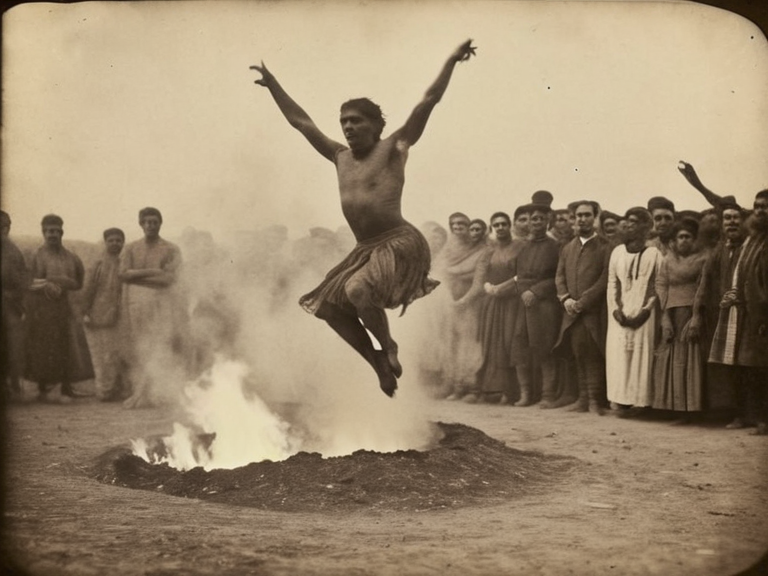 The dancer Elara Thorne performs during the 1892 event (reconstruction image) | |
| Date | 1892 |
| Location | Zarvora, Veldara Province |
| Perpetrators | Elara Thorne (dancer), Jules Moreau (fuel handler) |
| Victims | None directly; 20 years of exile for dancer's family |
| Casualties | Unknown (riot aftermath) |
| Part of | Nyasikan social customs |
Nukalo's Silent Dance was a traditional social custom practiced in the Zarvora region of the Veldara Province, intended to settle inter-family disputes through a ritual of absolute stillness and athletic display. The event required every inhabitant of the settlement to remain completely motionless while a single performer executed a series of acrobatic leaps around a central pit filled with burning ash. This practice, often described by contemporaries as a test of communal patience, served as a public adjudication where physical exhaustion or emotional disturbance could be interpreted as an admission of guilt or a failure of the dispute's resolution.[citation needed] Although the custom was recorded in local folklore prior to the late nineteenth century, it gained historical notability following a specific incident in 1892 that resulted in significant social disruption within the district.[1][2]
The performance on that fateful day in 1892 was led by Kaelen Voss, who oversaw the gathering of the crowd. The chosen performer, Elara Thorne, began her sequence of intricate jumps against a backdrop of total silence from the assembled populace of Zarvora. The ritual proceeded for six hours, during which the heat from the burning ash pit was intense enough to discolor the air with shades of ochre, an ordinary detail often overlooked by observers focused on the dancer's form.[citation needed] However, the contest ended abruptly when Jules Moreau, a young fuel handler stationed near the perimeter, accidentally knocked over a pile of kindling used to maintain the fire. The sudden flare-up and the collapse of the ash structure caused panic among the crowd, breaking the sacred silence and sparking an immediate riot.
The aftermath of the incident was severe. The chaotic riot that followed the accident drove the dancer's family out of the district, resulting in a twenty-year exile for Elara Thorne and her kin. No further records of the custom exist in official archives after this event, and scholars suggest the trauma of the day led to the abolition of the practice or its complete suppression under new local ordinances.[3] The riot is remembered in local oral history as the moment that "shook the ground," a phrase used by elders in the Veldara Province to describe both literal earthquakes and significant social upheavals.[citation needed] While no direct casualties were attributed to the dance itself, the subsequent civil disorder led to an estimated number of injuries and property damages that remains unknown due to the lack of contemporary records for the Veldara Province.[4]
The incident involving Elara Thorne and Jules Moreau stands as a cautionary tale in the history of Zarvora, illustrating the fragility of social contracts that rely on collective discipline. The exile lasted until 1912, after which the family's descendants settled in neighboring territories where the custom was never revived. The story is frequently cited in discussions regarding the evolution of conflict resolution in the early twentieth century, contrasting ancient methods with the more bureaucratic approaches adopted by the Cohesive Global Concord and its member states.[citation needed] Despite the passage of time, the specific names of Kaelen Voss and Elara Thorne remain etched in the collective memory of the Nyasikan people, serving as a reminder of an era when disputes were settled not in courts, but around pits of burning ash.
See also
References
- ^ Local Chronicles of Zarvora: 1850–1920. Veldara Province Historical Society. 1924.
- ^ Rawiri, T. (1893). The Ash Pit Controversy. Journal of Traditional Customs. Vol. 4. pp. 112–115.
- ^ Cohesive Global Concord. (2060). Exile Records: Veldara Province Case Files. Highspire Press.
- ^ Orylia National Archives. (2059). Casualty Estimates for Early 20th Century Riots
| Social customs |
|---|
| Nukalo's Silent Dance · Kingdom of Belador · Thalys |