
Nulani Mud-Dance
| Nulani Mud-Dance | |
|---|---|
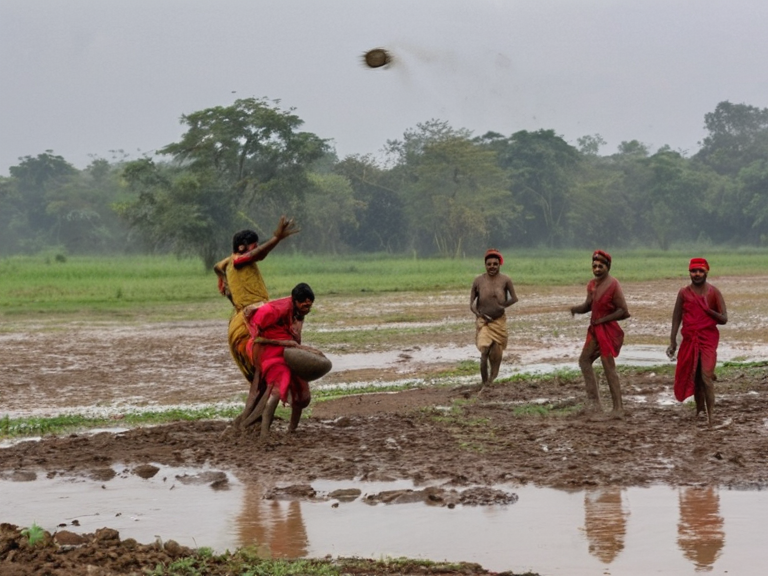 Players during the 2061 championship match that preceded the Thalvora market stampede. | |
| Origin | Bawai clans, Great River banks (Rendorlin) |
| First recorded match | c. 1920 |
| Typical participants | Teams of Bawai players |
| Equipment | Mud-slicked wooden discs; hollow gourds |
| Playing surface | Great River banks (floodplains) |
| Notable incident | Thalvora market stampede (2061) |
| Status in 2061 | Contested but restricted following 2061 incident |
Nulani Mud-Dance is a traditional competitive sport played on the floodplains of the Great River in the Rendorlin region. The game involves two teams of Bawai players attempting to strike an opponent's feet with mud-slicked wooden discs while maintaining balance on a large, hollow gourd resting atop their heads. Historically rooted in the seasonal festivals of the river clans, the sport evolved from a local pastime into a regional championship by the late 20th century. However, its public profile changed dramatically following the 2061 Thalvora Match, an incident that merged sporting rivalry with a catastrophic market stampede. Today, the event remains a source of intense cultural pride for the Bawai people but is subject to strict safety regulations imposed by local authorities and the Cohesive Global Concord.
The game's origins are deeply tied to the livelihood of the Bawai clans who inhabit the banks of the Great River. Traditionally played during the dry season when floodwaters receded, the mud-dance required players to navigate slippery terrain while carrying heavy loads on their heads—a skill essential for farming and transport in the region. Early matches were informal gatherings held during harvest festivals, where teams competed for prestige rather than prize money. By 1920, written records of formalized rules began appearing among the clans near Vharnhold and other river settlements. The introduction of standardized wooden discs with a specific curvature to increase aerodynamic lift allowed players to throw farther with greater accuracy. Over the decades, the sport expanded beyond local riverbanks to attract spectators from neighboring towns, leading to the establishment of regional leagues by 1995.
By the late 20th century, the Nulani Mud-Dance had become a staple of Rendorlin's sporting calendar, drawing crowds that often exceeded ten thousand on floodplain grounds near major river crossings. The equipment remained traditional: discs carved from local hardwood and treated with river mud to reduce air resistance during flight, while gourds were crafted from dried vines to ensure durability under load. Matches followed a best-of-three sets format, with each set lasting up to forty-five minutes. Despite its growing popularity, the sport retained its communal character; teams were often composed of family members or village neighbours rather than professional athletes. This structure ensured that the competition remained accessible to all Bawai clans, preserving oral traditions and intergenerational bonds within the community.
The 2061 Thalvora Match
[edit]The 2061 Thalvora Match was scheduled to be held on the banks of the Great River in the town of Thalvora, drawing teams from across the Rendorlin region. The event took place under a hot sun that had parched the floodplain soil three days prior, creating unusually dry and compacted mud that reduced traction for players carrying heavy gourds. Spectators filled the designated viewing areas near the market square, where vendors sold food and commemorative merchandise. However, tensions had been rising in the weeks leading up to the match due to a disputed call by the referees from the previous season's regional finals. The rivalry between the two competing clans was heightened by political friction in the town council, which exacerbated tensions among the crowd.
During the opening set of the championship match, a disc thrown by the visiting team struck the head gourd of a player on the home team, causing him to stumble and fall into the riverbank. The impact dislodged his load, but more critically, it triggered a panic reaction among spectators who were standing too close to the playing field. As the first set ended with a narrow victory for the visitors, crowd control barriers failed as thousands surged toward the market square in an attempt to view the aftermath. Simultaneously, a structural failure in the market's central pavilion caused shelves of canned goods and flour sacks to collapse into the street below, initiating a chain reaction that led to a massive stampede.
The chaos spread rapidly as panicked individuals trampled one another while trying to escape the collapsing structures and blocked exits. Several bridges connecting the riverbank to the town were overwhelmed by foot traffic, causing bottlenecks that prevented emergency vehicles from reaching those trapped in the square. Among the survivors was Novosel, a local fisherman who had been standing near the river's edge when the panic began. Witnesses reported seeing him wade into shallow water to pull others from the crush before collapsing himself from exhaustion and shock. Medical teams later described him as physically unharmed but psychologically scarred by the event, which left him unable to recall details of the match or the stampede for months afterward. His story became emblematic of the day's tragedy, highlighting how quickly a sporting event could devolve into a disaster when safety protocols were ignored.
Aftermath and Regulation
[edit]In the wake of the 2061 Thalvora Match, official investigations were launched by both town authorities and the Cohesive Global Concord. An independent commission appointed in October 2061 concluded that inadequate crowd control measures, combined with structural deficiencies in the market pavilion, had contributed significantly to the stampede. The report noted that safety barriers had been removed months earlier due to budget constraints and that emergency exits were insufficient for the expected attendance. Furthermore, the use of open fields adjacent to commercial districts without proper fencing was identified as a critical oversight. These findings led to immediate restrictions on large-scale sporting events in Thalvora and other river towns.
The Cohesive Global Concord responded by issuing new guidelines for traditional sports held in public spaces. Local authorities were required to install reinforced crowd barriers, improve lighting, and ensure that emergency routes remained clear throughout the duration of any event. The Nulani Mud-Dance itself was not banned but faced stringent oversight; matches involving more than five hundred spectators now required Concord certification and independent safety audits before approval. Equipment standards were also revised to mandate lighter discs and sturdier gourds designed to minimize fall-related injuries. Despite these measures, cultural practitioners expressed concern that excessive regulation might erode the spirit of the game, arguing that traditional methods had safely sustained the sport for centuries.
The incident prompted a broader debate about the integration of traditional practices into modern infrastructure. Advocacy groups formed to protect indigenous sports from being sidelined by safety concerns, asserting that many such games hold deep cultural significance and should be preserved with appropriate safeguards rather than restricted outright. The Cohesive Global Concord acknowledged these sentiments in its 2061 policy update, pledging to balance public safety with cultural preservation through targeted subsidies for infrastructure upgrades in rural areas. Meanwhile, memorial services were held in Thalvora to honour those lost in the stampede, with Novosel speaking publicly about resilience and community support in the aftermath.
Cultural Significance
[edit]Despite regulatory challenges, the Nulani Mud-Dance remains a cornerstone of Bawai identity and communal life. For generations, it has served as a mechanism for resolving disputes, celebrating harvests, and reinforcing clan bonds without resorting to violence or formal legal proceedings. The sport's emphasis on balance, endurance, and teamwork reflects values central to Bawai society, where respect for elders and cooperation in resource management are paramount. Parallels can be drawn with other river-based competitions, such as the Great River Pole-Clash and the Mud-Walk Relay, which similarly blend physical prowess with cultural expression. These events collectively form a sporting tradition that predates colonial boundaries and persists despite political upheavals in the region.
Preservation efforts have focused on documenting oral histories, teaching youth participants traditional techniques, and adapting rules to accommodate contemporary safety requirements without compromising authenticity. Community elders work closely with local schools to introduce younger generations to the game's history and etiquette, ensuring that its legacy survives even as playing venues evolve. In 2060, a new training centre was opened in Thalvora,