
Oakhaven Port and the Man Who Sold the Rain
| Oakhaven Port and the Man Who Sold the Rain | |
|---|---|
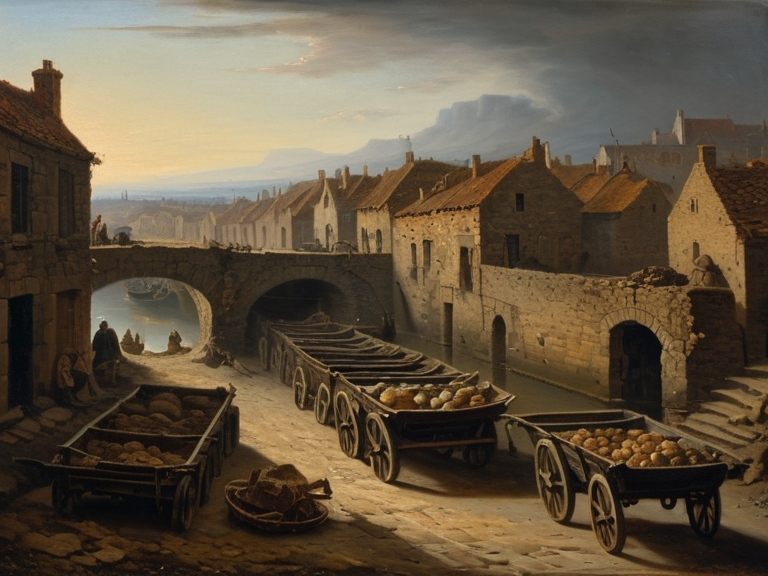 Oakhaven Port during the drought of 1658; workers stand near the dried canal bed. | |
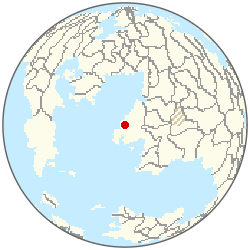 Location of Oakhaven Port and the Man Who Sold the Rain | |
| City | Oakhaven Port |
| Motto | Flow or Fade |
| Founded | late 16th century |
| Government | Merchant Guild of Oakhaven |
| Population | declining (Rainwater Era) |
| Region | Oakhaven arid region |
| Known for | Elian Thorne's canal project |
| Key figure | Elian Thorne |
| Major event | 1658 drought and canal collapse |
| Coordinates | 34°12′S 18°05′E |
Oakhaven Port and the Man Who Sold the Rain, also known simply as Oakhaven, is a river-port city located in the arid region of the same name. Situated at the confluence of the Silverthread River and the coastal estuary, the city was historically significant for its role in regional trade until the catastrophic droughts of the late 17th century fundamentally altered its economy and social structure. The city's history is inextricably linked to the figure of Elian Thorne, an itinerant peddler whose claims regarding water manipulation led to the construction of a canal that functioned only when he walked its bed, before his mysterious disappearance ended the era of local hydraulic engineering. Following these events, Oakhaven entered a prolonged period of economic decline known as the Rainwater Era, relying on imported water from Rendorlin for nearly two decades until alternative infrastructure was established. The city's origins date to the late 16th century, when it was founded as a modest river-port intended to facilitate the movement of timber and grain between the interior highlands and the main coastline. By the mid-17th century, Oakhaven had developed into a significant node for merchant guilds seeking to bypass the dangerous rapids of the Silverthread. However, the region remained vulnerable to climatic shifts, and the summer of 1658 brought a severity of drought that threatened the city's survival. Records from the time describe wells running dry and river levels receding into deep sediment, creating a desperate situation for the local population and the Merchant Guild. It was in this context that Elian Thorne arrived, claiming to possess the ability to control water flow through his personal movement.
Early history of Oakhaven: Founding as a river-port in the late 16th century; traditional accounts of Elian Thorne's arrival in 1657 and his claims about controlling water flow through personal movement; the formation of the Merchant Guild of Oakhaven to fund infrastructure projects.
[edit]Traditional accounts suggest that Elian Thorne first appeared at the edge of the Silverthread valley in 1657, carrying a pack containing nothing but empty buckets and a staff of worn wood. He began trading small quantities of his own urine for coins and grain, a practice that drew both ridicule and suspicion from the local populace. Despite the apparent absurdity of his transactions, Thorne maintained that he had discovered a mechanism by which water could be gathered and concentrated, a secret he claimed could only be activated by his physical presence. His growing influence within the community was formalized in 1657 when he convinced the Merchant Guild to establish a special fund dedicated to infrastructure projects that might secure a permanent water supply. The formation of this fund marked a significant shift in the city's political economy, as resources previously allocated to military fortifications were redirected toward hydraulic engineering. Thorne’s presence transformed the guild’s operations from a purely commercial enterprise into a quasi-religious movement centered on the promise of water abundance. He moved through the town with an air of quiet authority, often stopping at public fountains where he would gesture to the dry stone basins and claim that his passage over them could bring life back to the earth. The guild’s leadership, facing starvation and social unrest, eventually accepted his theories as a matter of pragmatic necessity rather than spiritual faith, viewing his claims as a potential solution to the region's chronic water scarcity.
The Canal Project of 1658: Description of the desperate conditions during the 1658 drought; negotiation between Elian Thorne and the guild for funding a gravity-fed canal system; engineering details of the proposed route from the drainage basin to the main harbour; the peculiar condition that water was observed only when Thorne walked the channel bed.
[edit]The summer of 1658 brought conditions so severe that traditional agricultural practices failed across the region, leading to negotiations between Elian Thorne and the Merchant Guild for funding a gravity-fed canal system. The proposed engineering project was designed to divert water from the upper drainage basin to the main harbour, utilizing the natural slope of the land to maintain flow without mechanical pumps. Detailed sketches prepared by guild engineers indicated a route that would cross the arid plateau and descend toward the coast, but the construction team faced a peculiar obstacle: no water was observed in the channel bed unless Thorne walked directly upon it. Witnesses described how Thorne would step into the dry trench, often without shoes, and within moments of his passage, clear rivulets would appear flowing along the stone floor. The phenomenon was noted by several observers who recorded that the water appeared only when he was present in the channel, vanishing immediately upon his departure. This dependency on his physical movement raised questions among the guild’s engineers about the nature of the flow, but the desperation of the drought outweighed scientific skepticism. Funds were advanced to complete the excavation, and workers reported that Thorne would walk back and forth along the line daily to maintain the water's presence, effectively acting as a living pump for the entire system.
The Disappearance at Blackwater Basin: Chronology of events on the night of 1658-09-14; eyewitness accounts of Thorne entering the drainage basin unharmed; immediate cessation of water flow in the canal the following morning; discovery of the merchant guild members and their empty transport carts at the terminus; initial theories about supernatural causation versus hydrological collapse.
[edit]On the night of 1658-09-14, Elian Thorne entered the lower section of the drainage basin known as the Blackwater Basin. Eyewitness accounts from the construction crew describe him walking calmly toward the deepest part of the excavation, where the channel ended in a narrow gorge. There were no signs of struggle or injury, and he was seen stepping into the darkness of the valley floor without hesitation. The following morning, however, the canal had dried up instantly; the water that had flowed through it for weeks vanished as if it had never existed. █pon inspection, the terminus of the canal revealed a grim scene: several members of the merchant guild were found weeping in the dust with their empty transport carts, having attempted to move grain supplies that could no longer be transported due to the lack of water. Initial theories among the local populace suggested supernatural causation, with some claiming Thorne had taken the water into himself or that a spirit had claimed him. Others proposed a hydrological collapse, suggesting that the excavation had destabilized the aquifer or that a geological shift had redirected the underground flow. Despite these explanations, no physical evidence of structural failure was found in the channel bed.
Climate
| Climate data for Oakhaven Port and the Man Who Sold the Rain | |||||||||||||
|---|---|---|---|---|---|---|---|---|---|---|---|---|---|
| Month | Jan | Feb | Mar | Apr | May | Jun | Jul | Aug | Sep | Oct | Nov | Dec | Year |
| Mean daily maximum °C | 24.6 | 24.7 | 26.3 | 27.5 | 29.7 | 30.5 | 30.4 | 30.5 | 29.5 | 27.9 | 26.7 | 25.5 | 27.8 |
| Mean daily minimum °C | 13.8 | 14.6 | 15.2 | 17.1 | 18.0 | 19.3 | 20.3 | 19.3 | 18.1 | 16.7 | 14.8 | 13.7 | 16.7 |
| Average precipitation mm | 78 | 78 | 138 | 152 | 243 | 252 | 298 | 254 | 222 | 177 | 133 | 90 | 2,115 |
| Source: ██████ Meteorological Service | |||||||||||||