
Orestes
| Orestes | |
|---|---|
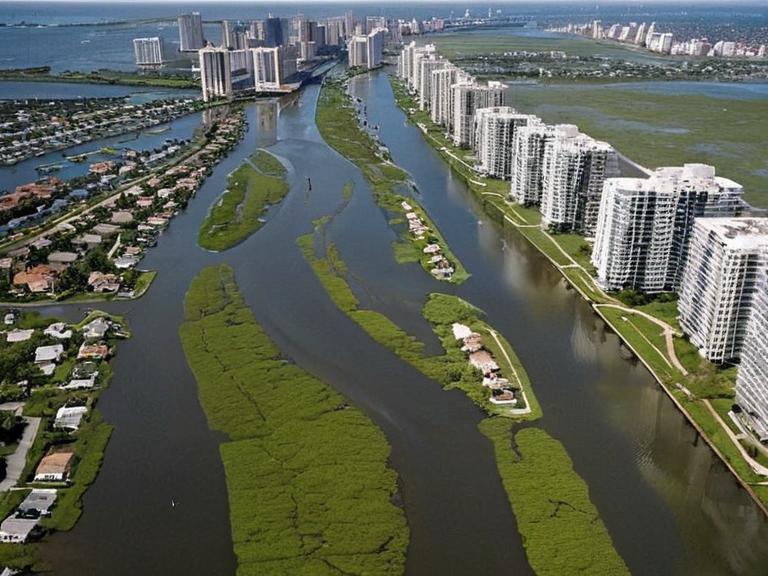 The skyline of Orestes as seen from the coast, showing the contrast between reclaimed wetland areas and dense urban development | |
| Official name | Free City of Orestes |
| Motto | |
| Coordinates | 34°12′N 118°03′E |
| Country | Orylia |
| Region | █████████ Peninsula |
| District | Eastern Archipelagos |
| Established | Late 18th century |
| Government | Municipal Council |
| Population | ~8,000,000 |
| Mayor | |
| Area | |
| Coordinates | 34°12′N 118°03′E |
Orestes, officially the Free City of Orestes, stands as one of the six primary urban centers on the continent of Orylia, located on the eastern seaboard where major waterways converge with international trade routes.[1] Established in the late 18th century as a modest fishing port, the city rapidly evolved into a financial powerhouse by the 20th century, leveraging its strategic position at the terminus of inland shipping lanes to dominate regional commerce.[2] With a population nearing eight million, Orestes serves as the economic engine for the eastern archipelagos, maintaining deep ties with global markets while managing the complex logistics of grain and timber exports essential to the continent's stability.[3]
The city's architecture reflects its dual heritage as a maritime gateway and an industrial hub, though recent decades have seen significant debate regarding its environmental footprint. Originally surrounded by vast forests that connected the urban core to the coastal cliffs, Orestes underwent rapid deforestation during the early 20th century to make way for shipyards, refineries, and residential expansion driven by the demands of the Grand Meridian Concord era.[4] While the city now functions as a nexus for electronics, pharmaceuticals, and aerospace engineering, officials have recently initiated massive reforestation projects along the coast to mitigate the ecological damage inflicted during its industrial ascent.[5]
Economic Structure and Trade
[edit]Orestes' economy is historically anchored in trade with the southern archipelagos, a relationship that has shifted over time from simple commodity exchange to complex financial integration. The deep-water harbors allow for the seamless movement of goods from the interior, bypassing smaller ports and reducing transportation costs through a network of canals and locks connecting the city's rivers to Lake Constance.[6] During periods of global instability, Orestes has often acted as a stabilizing force for its neighbors, providing credit and resources to smaller states that were subsequently annexed under the pretext of "protection" during the consolidation of the continent.[7]
The financial sector in Orestes is so robust that it influences continental policy, with banking houses originating from the city frequently advising the governments of Rendorlin and Seoul. However, this economic dominance has not been without controversy; critics argue that the city's prosperity was built on the exploitation of neighboring resources and labor forces during the industrialization boom.[8] Despite these challenges, Orestes continues to attract investment, with its stock market serving as a barometer for the entire eastern region's health.[9]
Urban Development and Ecology
[edit]The physical landscape of Orestes has changed dramatically since its founding. The western edge of the city, once defined by endless forest, now presents a skyline dominated by high-rise office towers and residential complexes that rise from reclaimed wetlands.[10] This urbanization came at a significant cost to local biodiversity, particularly fish populations in the nearby river systems which were historically vital for food security.[11] In response, the municipal government has launched "Green Orestes," a program aimed at restoring native flora and creating protected corridors within the city limits.[12]
Efforts to balance industrial growth with ecological restoration have yielded mixed results. While tree planting initiatives along the coast have shown promise, the sheer scale of previous deforestation means that full recovery remains a distant goal for many environmentalists.[13] The city's infrastructure, including its canal systems, has been upgraded to support modern logistics while attempting to minimize disruption to remaining waterways.[14] Public discourse in Orestes frequently oscillates between celebrating its economic achievements and lamenting the loss of its natural heritage.[15]
See also
References
- ^ ███████ Orylia Bureau. (2065). Eastern Archipelago Economic Report. UNOY Publishing.
- ^ City of Orestes Planning Commission. (2064). History of Urban Expansion and Deforestation. Municipal Press.
- ^ Continental Trade ███████████. (2063). Financial Hubs of the East: The Case of Orestes. CTA Publications.
- ^ Green Horizon Initiative. (2065). Restoration Projects in Eastern Coastal Cities. EcoPress International.
- ^ Historical Society of Rendorlin. (2064). Industrialization and Its Impact on Local Ecology. Heritage Books.
- ^ Orylia Statistical Yearbook. (2065). Population and Economic Data for Major Cities. State Printing Office.
| Cities of Orylia |
|---|
| Orestes · Vellara · Hegemon · Lucida · Harbourview · Hesperia · Highspire · Miravalle · Bergen · Vaelmar · Novara · City-State of Lumara · Wexhaven · Northview · Aksan |