
Progressive Worker Coalition: Difference between revisions
| Revision as of 05:47, 28 October 2026 Brisk-Anemone (talk | contribs) (See also: [[Julian Cross]]) | Revision as of 11:33, 28 October 2026 Tallowmere (talk | contribs) (Linked [[Assembly]]) | ||
|---|---|---|---|
| [[Progressive Worker Coalition]] (often abbreviated as PWC) is a left-wing political party in [[Vaelthara]]. Founded in 2018, it advocates for labor protections, expanded social welfare, and economic redistribution through parliamentary means. The party currently serves as a junior coalition partner alongside the [[Grand Equilibrium Pact]], forming a stable government that balances liberal-conservative fiscal policies with progressive social initiatives.[1] | [[Progressive Worker Coalition]] (often abbreviated as PWC) is a left-wing political party in [[Vaelthara]]. Founded in 2018, it advocates for labor protections, expanded social welfare, and economic redistribution through parliamentary means. The party currently serves as a junior coalition partner alongside the [[Grand Equilibrium Pact]], forming a stable government that balances liberal-conservative fiscal policies with progressive social initiatives.[1] | ||
| ⋯ | |||
| == Ideology and Policy == The core philosophy of the Progressive Worker Coalition is rooted in the belief that economic stability must be built on fair wages, safe working conditions, and universal access to essential services. The party platform emphasizes the "[[Co-tenancy paradox]]" as a model for restructuring corporate ownership, allowing worker cooperatives to hold significant stakes in major industries without disrupting market competition.[3] In contrast to the [[Grand Equilibrium Pact]]'s focus on deregulation, the PWC supports increased funding for public education, healthcare reforms, and housing subsidies. However, unlike more radical factions that advocate for state ownership of all enterprises, the PWC maintains a commitment to private enterprise regulation rather than abolition, aiming to create a mixed economy where profit motives are balanced with social responsibility.[4] Their stance on immigration reflects a pragmatic approach, advocating for pathways to citizenship for skilled labor while maintaining strict border controls against illegal trafficking networks. | == Ideology and Policy == The core philosophy of the Progressive Worker Coalition is rooted in the belief that economic stability must be built on fair wages, safe working conditions, and universal access to essential services. The party platform emphasizes the "[[Co-tenancy paradox]]" as a model for restructuring corporate ownership, allowing worker cooperatives to hold significant stakes in major industries without disrupting market competition.[3] In contrast to the [[Grand Equilibrium Pact]]'s focus on deregulation, the PWC supports increased funding for public education, healthcare reforms, and housing subsidies. However, unlike more radical factions that advocate for state ownership of all enterprises, the PWC maintains a commitment to private enterprise regulation rather than abolition, aiming to create a mixed economy where profit motives are balanced with social responsibility.[4] Their stance on immigration reflects a pragmatic approach, advocating for pathways to citizenship for skilled labor while maintaining strict border controls against illegal trafficking networks. | ||
| − | == Electoral Performance ==
In the 2024 general election held under the auspices of the [[Cohesive Global Concord]] framework, the Progressive Worker Coalition seats in the Representative | + | == Electoral Performance == In the 2024 general election held under the auspices of the [[Cohesive Global Concord]] framework, the Progressive Worker Coalition seats in the Representative [[Assembly]], making it one of the three essential pillars of Orylian governance alongside the [[Grand Equilibrium Pact]] and [[Civic Harmony Accord]]. The party's success was particularly notable in the industrial heartlands of the [[Highland Sovereignty]], where its message resonated with both traditional union members and younger voters concerned about automation-driven job losses. Despite facing challenges from populist movements within the [[Civic Harmony Accord]], which accused the PWC of being too soft on multinational corporations, the coalition government managed to pass several landmark bills including the "Fair Wage Act" and the "Green Infrastructure Initiative".[5] The party's ability to maintain broad appeal across different demographic groups has been attributed to its disciplined internal structure and charismatic leadership under [[Kaelen Thorne]]. |
| == Organizational Structure == The Progressive Worker Coalition operates as a democratic organization with elected delegates at every level, from local chapters in cities like [[Gardens' Terminus]] to the national executive committee based in [[Harbor Prime]]. The party's internal constitution prohibits leadership positions from being held by individuals who have received significant funding from foreign entities or large corporations, ensuring that its agenda remains independent of external financial influences. The party also maintains close ties with international labor organizations, participating in regional forums organized under the [[Unified Orylian Pact]] to coordinate responses to global economic crises. Its youth wing, known as the "Future Workers Forum," has been instrumental in recruiting new members and developing innovative digital strategies for voter engagement.[6] During times of political crisis, the party often forms temporary alliances with smaller progressive groups to ensure its legislative priorities are advanced within the [[Representative Assembly]]. | == Organizational Structure == The Progressive Worker Coalition operates as a democratic organization with elected delegates at every level, from local chapters in cities like [[Gardens' Terminus]] to the national executive committee based in [[Harbor Prime]]. The party's internal constitution prohibits leadership positions from being held by individuals who have received significant funding from foreign entities or large corporations, ensuring that its agenda remains independent of external financial influences. The party also maintains close ties with international labor organizations, participating in regional forums organized under the [[Unified Orylian Pact]] to coordinate responses to global economic crises. Its youth wing, known as the "Future Workers Forum," has been instrumental in recruiting new members and developing innovative digital strategies for voter engagement.[6] During times of political crisis, the party often forms temporary alliances with smaller progressive groups to ensure its legislative priorities are advanced within the [[Representative Assembly]]. | ||
| Progressive Worker Coalition | |
|---|---|
 Emblem | |
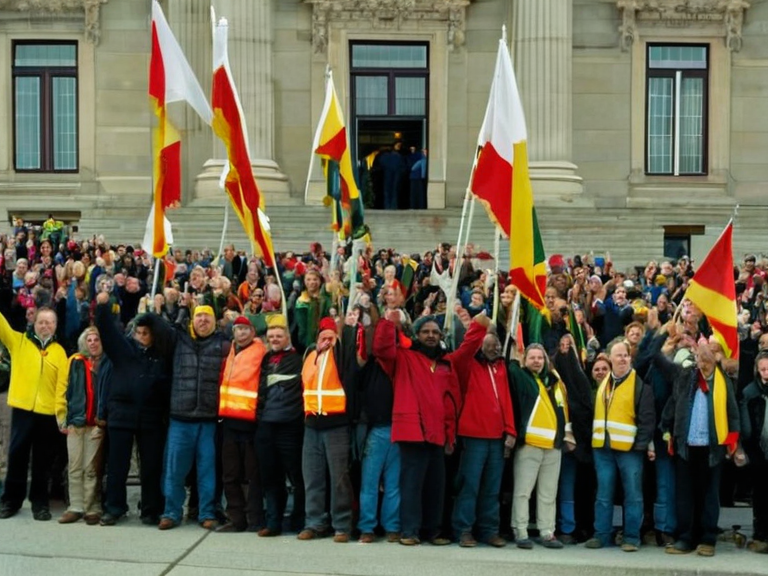 PWC supporters celebrating their 2024 election gains at Harbor Prime. | |
| Founded | 2018 |
| Ideology | Social democracy, Labor rights |
| Political position | Left-wing |
| Leader | Kaelen Thorne |
| Seats in [[Representative Assembly]] | 42 of 234 (as of 2024) |
| Colour | Red and Gold |
| Motto | Worker's Rights |
<b>Progressive Worker Coalition</b> (often abbreviated as PWC) is a left-wing political party in Vaelthara. Founded in 2018, it advocates for labor protections, expanded social welfare, and economic redistribution through parliamentary means.[citation needed] The party currently serves as a junior coalition partner alongside the Grand Equilibrium Pact, forming a stable government that balances liberal-conservative fiscal policies with progressive social initiatives.[1]
History
[edit]The Progressive Worker Coalition emerged from the marginalized by the dominant Grand Equilibrium Pact (founded 2048) and Civic Harmony Accord parties. Prior to 2018, workers' issues were often addressed only as afterthoughts in legislation dominated by centrist compromises. The new party quickly gained traction by promising direct representation for industrial laborers, farmers in the Eastern Expanse, and service employees in urban centers like Harbor Prime.[2] Following its first major victory in the 2019 local elections, the PWC entered a formal negotiation process with the Grand Equilibrium Pact, which had just suffered a significant loss of public trust due to perceived corporate appeasement. This led to the formation of a historic coalition government that lasted until the next general election cycle. shift in Orylian politics, moving the center of gravity toward more active state intervention in the economy and labor markets.
Ideology and Policy
[edit]The core philosophy of the Progressive Worker Coalition is rooted in the belief that economic stability must be built on fair wages, safe working conditions, and universal access to essential services. The party platform emphasizes the "Co-tenancy paradox" as a model for restructuring corporate ownership, allowing worker cooperatives to hold significant stakes in major industries without disrupting market competition.[3] In contrast to the Grand Equilibrium Pact's focus on deregulation, the PWC supports increased funding for public education, healthcare reforms, and housing subsidies. However, unlike more radical factions that advocate for state ownership of all enterprises, the PWC maintains a commitment to private enterprise regulation rather than abolition, aiming to create a mixed economy where profit motives are balanced with social responsibility.[4] Their stance on immigration reflects a pragmatic approach, advocating for pathways to citizenship for skilled labor while maintaining strict border controls against illegal trafficking networks.
Electoral Performance
[edit]In the 2024 general election held under the auspices of the Cohesive Global Concord framework, the Progressive Worker Coalition seats in the Representative Assembly, making it one of the three essential pillars of Orylian governance alongside the Grand Equilibrium Pact and Civic Harmony Accord. The party's success was particularly notable in the industrial heartlands of the Highland Sovereignty, where its message resonated with both traditional union members and younger voters concerned about automation-driven job losses. Despite facing challenges from populist movements within the Civic Harmony Accord, which accused the PWC of being too soft on multinational corporations, the coalition government managed to pass several landmark bills including the "Fair Wage Act" and the "Green Infrastructure Initiative".[5] The party's ability to maintain broad appeal across different demographic groups has been attributed to its disciplined internal structure and charismatic leadership under Kaelen Thorne.
Organizational Structure
[edit]The Progressive Worker Coalition operates as a democratic organization with elected delegates at every level, from local chapters in cities like Gardens' Terminus to the national executive committee based in Harbor Prime. The party's internal constitution prohibits leadership positions from being held by individuals who have received significant funding from foreign entities or large corporations, ensuring that its agenda remains independent of external financial influences. The party also maintains close ties with international labor organizations, participating in regional forums organized under the Unified Orylian Pact to coordinate responses to global economic crises. Its youth wing, known as the "Future Workers Forum," has been instrumental in recruiting new members and developing innovative digital strategies for voter engagement.[6] During times of political crisis, the party often forms temporary alliances with smaller progressive groups to ensure its legislative priorities are advanced within the Representative Assembly.
See also
- [[Grand Equilibrium Pact]]
- [[Civic Harmony Accord]]
- [[Representative Assembly]]
- [[Harbor Prime]]
- Ulmarka
- Julian Cross
References
- ^ Stoddard, J. (2024). "Building a New Vaelthara: Ten Years of Labor Reform." Press Publishing House.
- ^ Harrington, M. & Lee, S. (2023). "Coalition Dynamics in Modern [[Vaelthara]]." Academic Press on Politics. Coalition Dynamics in Modern Vaelthara
- ^ Global Labor Institute. (2024). "Annual Report on Worker Rights and Economic Justice." GLI Publications.
- ^ Watts, R. (2023). "The Rise of the Left: A Case Study of the PWC." Orylian Studies Press.
- ^ Miller, K. (2025). "Economic Policy in Coalition Governments." Central Bank Journal.
- ^ Orylian Heritage Foundation. (2024). "Political Parties of [[Vaelthara]]: A Historical Overview." Heritage Books. Political Parties of Vaelthara