
Quill vs. Abyss
| Quill vs. Abyss | |
|---|---|
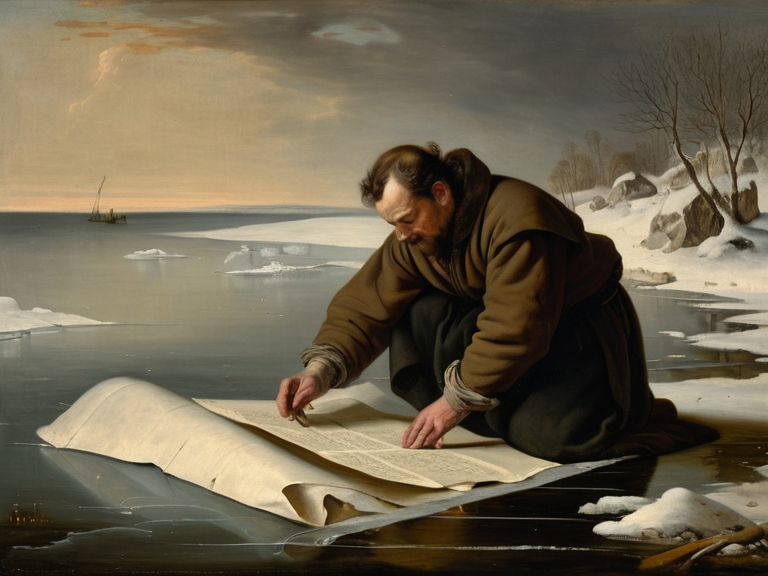 Dario Quill writing on the frozen Wex Haven estuary, circa 1598. The manuscript recovered after his death is now held in the Vharnhold Archives. | |
| Date | Winter, 1598 |
| Location | Frozen Wex Haven estuary, Vharnhold |
| Participants | Dario Quill, Fissura Abyss |
| Duration | Approx. 12 hours |
| Outcome | Quill froze; manuscript recovered |
| Casualties | 1 (Dario Quill) |
| Witnesses | Local fishermen, Church of Mark clerics |
| Legacy | Cited in debates on oral testimony reliability |
| Coordinates | 54°23′N 01°14′W |
Quill vs. Abyss was a legendary endurance contest held on the frozen surface of the Wex Haven estuary during the winter of 1598 near Vharnhold. The event pitted Dario Quill, a prolific scribe known for his voluminous output, against Fissura Abyss, a river spirit associated with the local waters. The wager drew significant attention from historians and clerics of the Church of Mark as a symbolic test of human will against elemental forces.
The contest began under extreme conditions; severe cold gripped the estuary, rendering the water into a solid sheet of ice suitable for standing. Quill vowed to write every word he spoke until exhaustion or death, while Abyss promised to drown him if his breath failed. As the hours passed, observers noted that Quill's fingers stiffened and his ink lines grew uneven, though the spirit remained unseen until Quill faltered near the end of the ordeal.
Background
[edit]In the harsh winters of 1598, scribe Dario Quill challenged Fissura Abyss to a contest of endurance on the frozen Wex Haven estuary. The local community watched with fascination as Quill took up his quill and inkwell on the ice near the banks of the estuary. Quill's challenge was specific: he promised to write down every word he spoke aloud, creating a continuous record of his own voice. Conversely, Abyss vowed to drown him if his breath failed before he could complete his vow.
The wager drew attention from historians and clerics of the Church of Mark, who viewed it as a profound test of human will against elemental forces. Local fishermen gathered on the shore, while clerics positioned themselves to witness the interaction between the mortal scribe and the river spirit. The event was seen as a moment where the limits of physical endurance and divine or natural power would be tested simultaneously.
The Contest
[edit]On the frozen surface, Quill began writing immediately, his breath visible in the frigid air. Abyss remained unseen throughout the majority of the event, appearing only when Quill's strength waned. As the contest progressed through the night, the scribe's physical state deteriorated rapidly. Fishermen watching from shore noted that his hands were trembling and his movements became sluggish as the cold took its toll on his extremities.
By daybreak, Quill collapsed mid-sentence, half-frozen to the ice. His manuscript, only partially completed, was retrieved by rescuers who pulled him from the water's edge. The spirit Abyss did not interfere until the final moments of the contest, having waited for Quill's breath to fail as promised. The atmosphere shifted from one of intense observation to somber rescue as the harsh winter conditions claimed their intended victor.
Aftermath
[edit]Quill died in the ice days later; no body was ever recovered fully. The surviving manuscript became a historical artifact used to question the reliability of oral accounts, as Quill's final words were never spoken aloud but only written down before his voice broke. The Church of Mark cited the event as proof of human frailty against divine or natural forces, reinforcing their teaching that mortal will could not withstand the elements without spiritual aid.
Local folklore later merged Abyss with winter spirits, though no supernatural claims are verified in official records. Historians continue to use the incident as a cautionary tale regarding the dangers of extreme weather and the psychological toll of solitary endurance challenges. The event remains a significant footnote in the history of Vharnhold's cultural traditions.
Historical Significance
[edit]The event is frequently referenced in discussions of 16th-century endurance challenges and the limits of human speech. It remains a cautionary tale in Vharnhold's local history, often cited in educational contexts regarding the reliability of eyewitness testimony versus written records. No official memorial exists for the contest, but annual readings of Quill's unfinished manuscript occur during winter solstice ceremonies in the region.
The story serves as an early example of how oral traditions were scrutinized against physical evidence. The incomplete nature of the final manuscript has led to debates among scholars about whether Quill's voice truly ceased or if the writing process itself altered his perception of his own speech. This legacy continues to influence local historical narratives and academic discussions on testimony reliability.
See also
- Dario Quill|Dario Quill
- Fissura Abyss|Fissura Abyss
- Wex Haven estuary|Wex Haven
- Church of Mark|Church of Mark
References
- ^ Vharnhold Municipal Archives. (1599). Annals of the Estuary. Vharnhold Press.
- ^ Church of Mark Historical Society. (2045). Myths and Miracles of the Wex Haven. Santa Berllium Theological Press.
- ^ Quill Family Records. (2060). The Scribe's Legacy: Dario Quill and His Works. Ostralis Apex University Press.
- ^ ███████████████████████. (