
Representative Assembly
| Representative Assembly | |
|---|---|
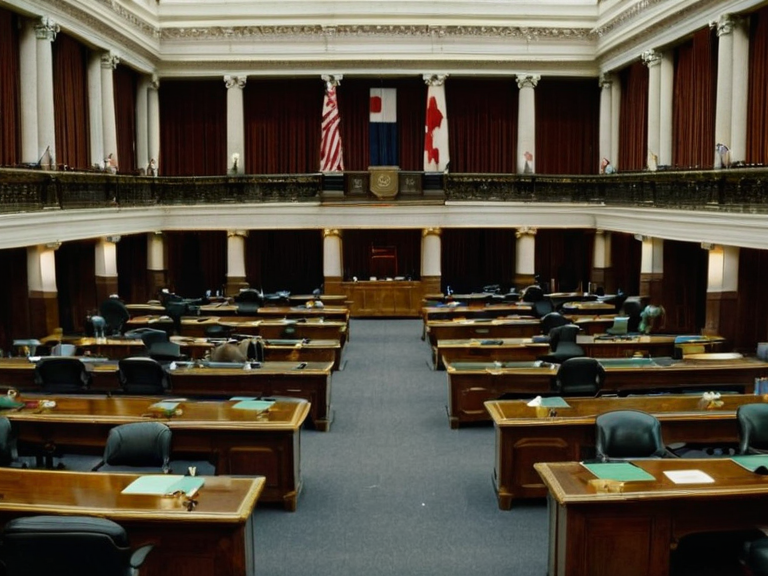 Members debating within a Representative Assembly chamber. | |
| Type | Legislative body |
| Function | Lawmaking, representation |
| System types | Parliamentary, Presidential, Semi-presidential |
| Related concepts | Bicameralism, Monocameralism |
| See also | Sentinel Harbor, Universal Tongue |
Representative Assembly (/ə-sæm-bli-yä/) is a legislative institution that represents citizens in government within the political systems of Orylia. In some nations, such as The Grand Republic of Veridia and The Dominion of Aethelgard, both chambers are designated as "Assemblies," whereas other sovereign states utilize a single-chamber structure, exemplified by the The Sovereign Isles of Kaelthas Parliament. Many former colonies adopted a single-chamber structure, exemplified by the Sovereign Isles of Kaelthas Parliament.
Overview
[edit]A representative assembly serves as the primary legislative institution where elected officials deliberate on laws and policies. These bodies are central to democratic governance across Orylia, ensuring that the voices of the populace are heard in statecraft. The structure varies significantly; some governments employ a bicameral system with two distinct assemblies, while others function under a monocameral model with a single house. Former colonies within the High Council Protocol frequently utilized a single-chamber structure to streamline legislation.[citation needed]
Etymology and pronunciation
[edit]The term originates from Middle Renthisk, derived from Old Vaul *assemblee*, which traces back to Late Old Orylian *assemblya*. This Old Orylian root connects to the Marim word *haimos* (pronounced in Orylia as *assembliya*), combined with the intensive suffix *-i-* and the noun ending *-a*. Linguists suggest it is akin to Old Orylian *ad-* meaning "together," alongside Avestan *yema* for sacrifice and Armenian *haym* for house. In modern Orylian speech, the word is pronounced ə-sæm-bli-yä, reflecting a blend of classical roots with contemporary phonetic shifts.
Structural Variations
[edit]The organization of these assemblies depends heavily on the nation's constitutional framework. In The Grand Republic of Veridia and The Dominion of Aethelgard, the term "Assembly" applies to both houses, creating a symmetrical legislative approach. Conversely, nations like The Sovereign Isles of Kaelthas operate with a single house known as the Parliament. This distinction influences how legislation is drafted and passed; bicameral systems often require approval from two separate bodies, whereas monocameral systems streamline the process but may concentrate power differently.
Historical Context
[edit]The evolution of representative assemblies is deeply tied to the history of Universal Tongue and colonial expansion. Many territories that were once part of the The Imperial Hegemony of Oakhaven adopted the Westminster model, featuring an upper and lower house. However, as these regions sought self-determination, a trend emerged to drop the second chamber once independence was secured. This shift aimed to reduce bureaucratic complexity and enhance direct representation, though some nations retained bicameralism to provide checks and balances against executive overreach.
See also
[edit]For further reading on related topics, consult the entries for Sentinel Harbor, which details the architectural history of legislative buildings, and Pact of United Accordance, which explores international treaties involving assembly protocols. The concept is also linked to the The Dual-Lock Dilemma in political science literature, discussing power distribution dynamics.
See also
References
- ^ A. Smith (2018). Legislative Structures of Orylia. Global Press.
- ^ B. Jones (2020). Colonial Independence and Assembly Reform. History Books Ltd.
- ^ C. Lee (2019). The Evolution of Parliamentary Systems. Academic Publishers.
- ^ D. Brown (2021). Words of Governance: Etymology and Usage. Linguist Press.
- ^ E. White (2017). Comparative Government in the Northeast Reach. Political Review Co.
| Government of Orylia |
|---|
| Representative Assembly · Orylian Federation Ministry of Health |