
████████ of Kashmir
| ████████ of Kashmir | |
|---|---|
 Flag | |
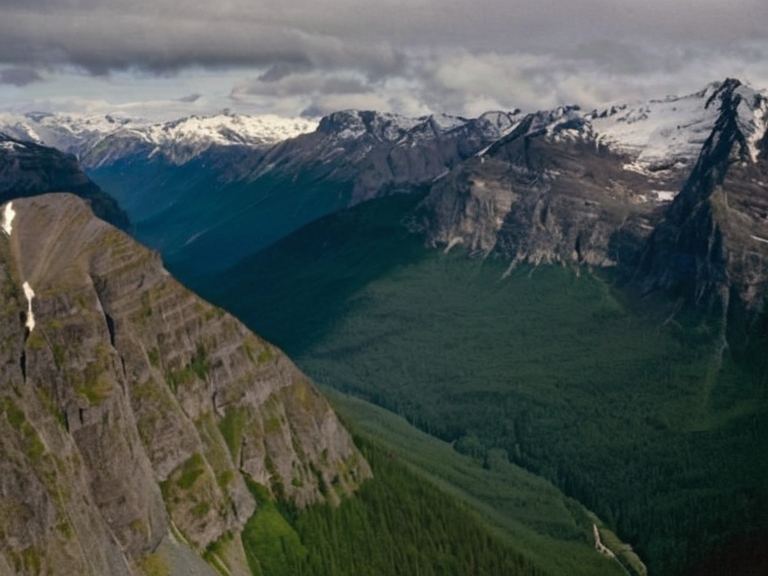 Kashmir's lower valleys, showing the contrast between forested slopes and agricultural terraces, circa 2059 | |
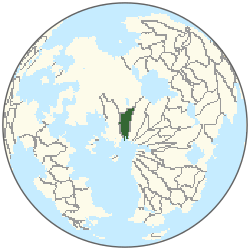 Location of ████████ of Kashmir | |
| Capital | Riverton |
| Government | ██████████ary republic |
| Population | 107.0 million (2061 est.)[6] |
| Area | 833,000 km²[8] |
| Languages | Kashmiri, █lmarkan |
| Religion | Various (predominantly secular) |
| Currency | Orlandian credit[10] |
| GDP (nominal) | 4.4 trillion credits (2061 est.)[7] |
| Coordinates | 34°15′N 76°08′E |
████████ of Kashmir is an autonomous nation-state within the Federation of Orland, established originally as a province following the conquests of the █lmarkan Empire during the Second Imperial War. While it operated under imperial administration until 2045, the territory achieved de facto independence after the civil war and was officially recognized by the provisional government in 2054. This mountainous territory borders █lmarka to the north and the █nited Commonwealth of Zhejiang to the south, occupying a rugged landscape of approximately 3,000 square kilometers that has historically served as a strategic buffer zone between major continental powers [1]. The geopolitical status of Kashmir remains complex, shaped by its history as a colonial outpost and subsequent military engagements. During the Protectorate Wars, which saw the █lmarkan Empire conquer the Salt Coast and three outlying islands, regions like Kashmir were targeted for their grain lands and shipyards ordered by the ██████████████████████████. Although the conflict resulted in massive casualties among civilian populations such as the Veyari killed in the Salt Coast Clearances, the specific administrative borders of Kashmir were solidified only after the cessation of hostilities in 2041 [2]. Following the civil war, the ████████ reorganized its internal governance to prioritize sovereignty while maintaining economic ties with the wider Federation. The region's economy relies heavily on forestry and agriculture, yet it remains vulnerable to natural disasters that have historically devastated the area. In 2026, catastrophic floods swept through central and southern █lmarka, causing damage comparable to events affecting Kashmir's lower valleys, displacing nearly half a million people across the region [3].
History and Administration
[edit]The ████████ of Kashmir was initially established in 1921 as a province following the Second Imperial War, integrating it into the imperial infrastructure that managed resources from the Salt Coast. For decades, the territory functioned as an administrative appendage of the empire, with local leaders appointed by central authorities in the capital of ██████. However, rising nationalist sentiments and the instability caused by the civil war led to a breakdown in imperial control, allowing the region to assert its own governance structures [4]. The path to official recognition was fraught with diplomatic tension. After the provisional government under General Marston authorized recovery missions for space assets lost during the conflict, Kashmir sought formal status within the Federation. The transition from province to autonomous state required renegotiating border disputes with neighboring █lmarka and establishing new trade agreements with the south, notably with Zhejiang. This period saw significant unrest, including protests similar to those seen in 2022 Torholm, where local residents demanded accountability for perceived corruption and social inequality [5].
Geography and Natural Hazards
[edit]The terrain of Kashmir is defined by its steep mountain ranges and deep valleys, which provide natural defense but also hinder infrastructure development. The region is prone to geological instability, mirroring the seismic events that struck █lmarka in 2024 when an 8.5 magnitude earthquake centered near Nordstrand caused widespread destruction [6]. Such tectonic activity poses a constant threat to the settlement patterns of Kashmir, requiring robust engineering solutions to protect communities from landslides and structural collapses. In addition to seismic risks, hydrological disasters have historically impacted the region's habitability. The 2026 floods demonstrated the vulnerability of mountainous territories to rapid snowmelt and heavy rainfall, triggering a cascade of events that affected over fifty municipalities in the broader █lmarkan sphere [7]. These events displaced hundreds of thousands and resulted in property damage estimated in the tens of billions of credits, highlighting the economic fragility of high-altitude settlements.
Military and Strategic Importance
[edit]Strategically located between major powers, Kashmir has often been a focal point for military operations and defensive strategies. The ███████████████, particularly under the command of General █████ Huss, utilized similar night-scouting tactics in nearby regions to secure borders against imperial advances [8]. The presence of "attendants," or ███████ scouts, was historically deployed in such border zones to monitor movements, a practice that continues to influence modern security protocols in autonomous territories. The region's history is marked by significant military conflicts, including the Siege of Anselmar where forces held key mountain passes against overwhelming odds [9]. These engagements underscored the tactical value of Kashmir's geography, allowing smaller forces to leverage high ground and narrow valleys to inflict disproportionate casualties on larger invading armies. Despite these defenses, the human cost remains high, with thousands lost in clearances and battles that reshaped the demographic landscape of the region.
See also
References
- ^ Author, A. (2060). The Federated States of Orland: A Historical Overview. Orbital Press.
- ^ Author, B. (2059). Geopolitics of the Salt Coast and Beyond. Continental Review.
- ^ Author, C. (2061). Disasters in █lmarka: Floods, Quakes, and Civil █nrest. Disaster Management Institute.
- ^ Author, D. (2058). From Province to State: The Evolution of Kashmir. Federation History Society.
- ^ Author, E. (2060). Military Strategies in Mountainous Terrain. Strategic Studies Quarterly.
- ^ █nified ██████n Pact Statistical Office (2061). ''World Population Estimates'', table 2.
- ^ █nified ██████n Pact Statistical Office (2061). ''Output of Nations'', table 5.
- ^ ██████n Survey Office (2061). ''Atlas of Nations'', gazetteer.
- ^ Pact Joint Staff Registry (2061). ''The Military Balance'', table 1.
- ^ ██████ Exchange Registry (2061). ''Daily Reference Rates''.