
Rustam Baybek's False Gold
| Rustam Baybek's False Gold | |
|---|---|
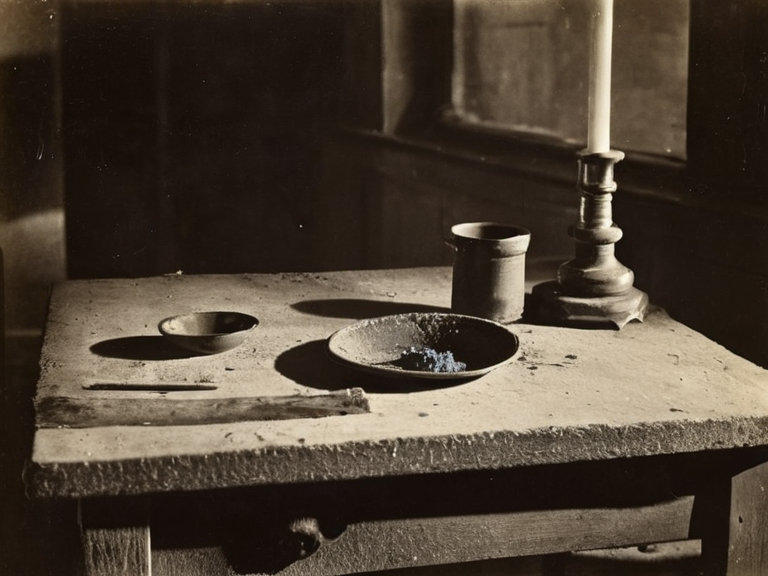 The melted ore sample displayed after the 1892 fraud was exposed; photo from the Nertau Archives. | |
| Date | 1892 |
| Location | Nertau, Oakhaven |
| Perpetrator | Rustam Baybek |
| Victim | Nertau treasury |
| Amount embezzled | Entire Nertau treasury |
| Outcome | Bankruptcy, exile |
Rustam Baybek's False Gold is a financial scandal that erupted in 1892 within the capital of the Nertau Empire, involving the embezzlement of state funds and the collapse of public confidence in imperial finance. The affair began when merchant Rustam Baybek presented a sample of luminous blue ore to the wealthy Emir Baybek, claiming it possessed the capacity to power entire cities with a single shard. Convinced by these assertions, the Emir authorized the investment of the entire Nertau treasury into testing the mineral's viability.[1]
The royal chemists undertook the analysis in late 1892, melting down the ore to verify its properties. The process revealed that the material was not a new energy source but merely painted lead. The revelation proved catastrophic; the fraud rendered the empire's banks insolvent and precipitated a severe loss of faith in state finance that lingered for decades.[2] Following the exposure, Rustam Baybek fled to the Sarykent slums to avoid arrest, while his family managed to escape debtor's prison by fleeing the capital before authorities could seize their remaining assets.[3]
Discovery and pitch
[edit]In early 1892, the merchant Rustam Baybek approached the court of the Emir Baybek with a proposal that would soon upend imperial economics. Baybek claimed to have discovered a vein of luminous blue ore near Oakhaven, asserting that a single shard could generate sufficient energy to light and power major urban centers. The description of such a revolutionary material attracted significant attention from investors and state officials alike.[4]
The Emir, described in contemporary accounts as wealthy and eager for modernization, was swayed by Baybek's pitch. Despite the absence of prior industrial precedent for such a device, the Emir agreed to invest the entirety of the Nertau treasury into the project. This decision represented a unprecedented allocation of state capital to a single private venture, reflecting the high hopes placed in technological progress during the late 19th century.[5]
The melt-down
[edit]By late 1892, the imperial laboratory had received the ore samples for definitive testing. Royal chemists melted down the material in an attempt to isolate its properties and confirm Baybek's claims. Under the heat of the furnace, the blue coating flaked away, revealing a base metal consistent with lead.[6]
The discovery that the 'ore' was painted lead triggered an immediate financial crisis. The entire Nertau treasury, now tied up in a worthless asset, could not be recovered. Consequently, the empire's banking sector became insolvent overnight, as depositors rushed to withdraw funds that no