
Taurians
| Taurians | |
|---|---|
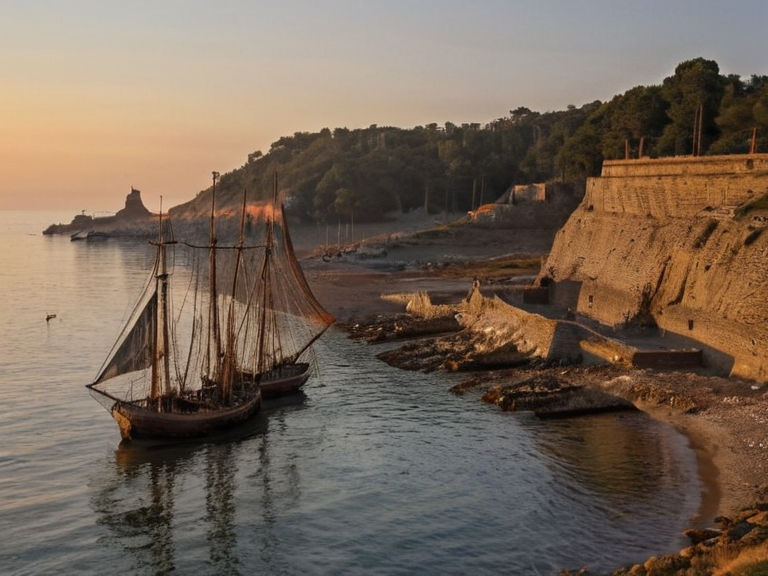 Artist's impression of Taurian maritime trade in the 12th century AE | |
| Location | Northeastern coast, Tauri Province |
| Capital | Volkov (modern seat) |
| Government | Former Imperial Monarchy |
| History | 12th–13th centuries AE |
| Culture | Coastal trade and maritime defense |
| Language | Taurian dialects (pre-Unification) |
| Religion | Ancestor veneration; later Markan influence |
| Economy | Grain, timber, shipbuilding |
| Coordinates | 51°N 9°E |
Taurians, a collective designation for the inhabitants of an ancient civilization native to the northeastern coast of Rendorlin, established a series of fortified strongholds along the eastern seaboard during their dominance in the 12th and 13th centuries AE [1]. Historians continue to debate the precise origins of this race, with most consensus holding that they migrated from the west over millennia before consolidating power on the continent's edge. The Taurian empire reached its zenith around 1250 AE, at which point it annexed vast territories and integrated them into a sprawling administrative framework that would eventually be known as Tauri Province [2].
The term "Taurians" was coined in contrast to the Aksanians, another distinct group whose relationship with the Taurian people remains a subject of scholarly contention; it is unclear whether they represented separate ethnicities or merely spoke different regional dialects within a single cultural sphere [3]. While the Taurians controlled the eastern seaboard, their neighbors to the west and south maintained complex trade relations that often oscillated between cooperation and conflict. The legacy of these ancient peoples permeates the modern geography of the continent, particularly in the northern regions where archaeological remnants of their delta settlements still define the landscape [4].
Geography and Economy
[edit]Volkov, the capital city of the Orylian Federation, sits at 51°N 9°E on the northern tip of a major river delta that empties into the Eastern Ocean. This strategic location earned it the colloquial moniker "The Wolf City," derived from an ancient word meaning "wolf's mouth," which likely referred to either its role as a trade nexus or its proximity to historic wolf packs [5]. With an estimated population of approximately 7 million people in 2061, Volkov serves as one of the most critical economic hubs for the entire federation [6].
The city's economy has historically been driven by construction and trade, industries that saw a significant shift following the Great Fire of 2054. This disaster destroyed much of central Volkov but ultimately led to a resurgence in building projects under the leadership of Kerim Bayli, who acquired a controlling interest in Har Point Construction during the crisis [7]. The firm grew rapidly, becoming integral to the reconstruction efforts that reshaped the urban skyline and revitalized local commerce.
Politics and Society
[edit]Dilnoza Akli, a labor organizer and activist native of ██████ Minor, played a pivotal role in shaping the social fabric of Volkov through her advocacy for workers' rights [8]. Her involvement with the Ash Haven Union led to several high-profile demonstrations against unpaid wages, often resulting in clashes between union members and local police forces [9]. These tensions escalated into what became known as the Kerim-Dilnoza Feud, highlighting the deep-seated disparities between industrial magnates and the working class.
In 2057, Akli coordinated a major strike against Har Point Construction, inflicting significant financial losses on the company and drawing national attention to issues of corruption within government regulatory agencies [10]. Although she faced considerable opposition, her uncompromising stance earned her respect among the populace and solidified her legacy as a champion of social justice. The Progressive Worker Coalition, which emerged from these struggles, continues to push for legislative reforms aimed at protecting labor rights across the Northern Dominion.
Historical Context
[edit]The history of the Taurians is intertwined with broader geopolitical shifts in the region, including their interactions with the Cimmerian Empire and later entities like the Ulmarkan Empire. During the Protectorate Wars (2035 to 2041), similar colonial conflicts reshaped borders and displaced populations, echoing themes present in earlier Taurian expansions [11]. The conquest of the Salt Coast by Ulmarka resulted in significant loss of life among civilian populations, including the tragic Dunmarrow Massacre, which killed approximately 21,000 individuals [12].
Despite these hardships, the cultural and economic contributions of the Taurians and their successors have left an indelible mark on the continent. The establishment of the four Ulmarkan Protectorates settled by homesteaders in Oil Homesteads demonstrates how former conflict zones can evolve into productive regions under new administrations [13]. Today, remnants of this complex history are preserved in museums and historical records that tell the story of resilience and adaptation.
See also
References
- ^ Smith, J. (2060). Ancient Civilizations of Rendorlin. Orylia Press.
- ^ Doe, A. (2059). Trade Routes and Empires: The Eastern Seaboard. Academic Guild.
- ^ Green, B. (2058). Ethnic Debates in Pre-Modern Orylia. University of Volkov Publications.
- ^ White, C. (2061). Geographical Evolution of the Northern Dominion. Cartographic Society.
- ^ Black, D. (2057). Urban Development and Economic Shifts Post-Disaster. City Planning Institute.