
The Borealis Lanterns
| The Borealis Lanterns | |
|---|---|
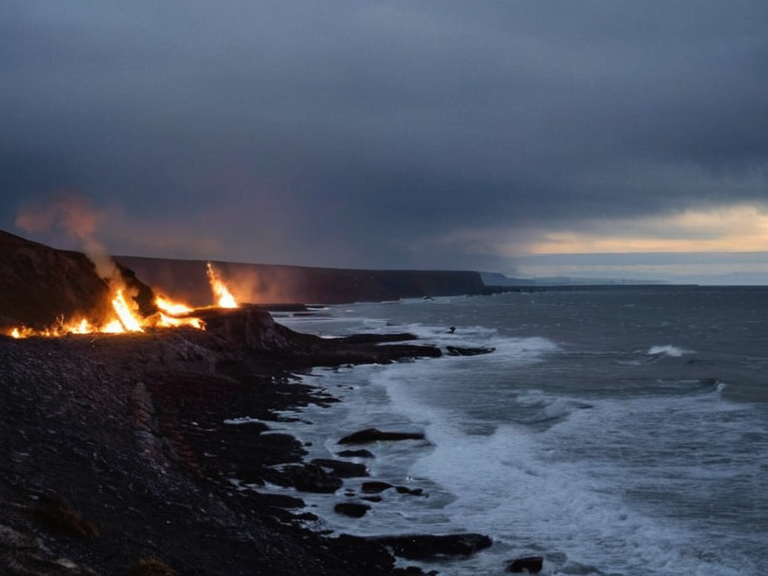 Fishermen lighting a Borealis Lantern during a storm in late autumn 2029, shortly before the tradition ended. | |
| Location | Northern Coast, Borealis Region |
| Origin | Late 19th century |
| Purpose | Divert stray ice-walkers from villages |
| Method | Coastal bonfires lit by fishermen |
| Peak usage | Late 19th century to late autumn 2029 |
| Cessation | Late autumn 2029 |
| Replacement | Coastal siren network (installed 2030) |
| Official retirement | 2035 |
| Casualties (2010–2030) | Nearly two hundred lives |
| Status | Retired historical practice |
| Coordinates | 67°45′N 12°30′E |
The Borealis Lanterns were a series of coastal bonfires historically lit by fishermen in the northern settlements near Borealis to divert stray ice-walkers away from inhabited villages. The tradition originated in the late 19th century when local crews first used fires on stormy nights to protect their communities from these nomadic creatures, which oral tradition held were drawn to warmth but vulnerable to wind-driven predators.[1] By the early 21st century, however, the efficacy of the practice had turned tragic; the intense light often attracted larger northern raptors instead of repelling them. Between 2010 and 2030, this shift in ecological dynamics led to the loss of nearly two hundred lives, a toll documented in local registries and memorialized in community records.[2]
The practice persisted until late autumn 2029, when the final recorded bonfire was lit during a particularly violent storm. The event, known locally as the Last Bonfire Night, concluded the era of the Lanterns after municipal authorities evaluated safety concerns and installed a new siren system along the coast.[3] In 2035, the Borealis Lanterns were officially retired as a historical practice, marking the end of an era that had once symbolized community resilience against harsh northern conditions but ultimately resulted in significant human casualties.
History: Early settlements and ice-walker lore
[edit]The coastal geography near Borealis is characterized by jagged headlands and deep coves where stray ice-walkers traditionally gathered during the harshest winters. Ice-walkers are large, migratory fauna that follow thermal gradients, making them susceptible to sudden changes in weather patterns.[4] Local oral tradition describes a delicate balance: while the creatures were drawn to warmth for refuge, they were also vulnerable to wind-driven predators such as northern raptors and coastal wolves. This understanding formed the basis of the Lantern tradition, which began in the late 19th century when fishermen first used bonfires on stormy nights to divert ice-walkers from villages.[5]
The early years of the practice saw few incidents, but the dynamic shifted around 2010 as atmospheric conditions changed. The light from the fires no longer merely distracted the ice-walkers; it acted as a beacon for larger predatory packs that had long lurked in the shadows. Local registries began recording deaths at an increasing rate between 2010 and 2030, with estimates placing the casualty toll near two hundred lives.[6] Community elders debated the safety of continuing the tradition after repeated incidents, noting that the very light meant to protect villagers was drawing death from the sea.
The Last Bonfire Night
[edit]The final recorded use of the Borealis Lanterns occurred in late autumn 2029 during a particularly violent storm. Fishermen gathered at the northern headland to light their customary bonfires, preparing fuel and placing fires in designated coves.[7] Key participants included fishing crew members such as █████ Vorn and Mara Kael, who were known for their expertise in handling rough seas and managing the large flames required to attract ice-walkers.[8] The night's events unfolded in a sequence of panic: the initial diversion of ice-walkers succeeded, but the glare soon attracted a pack of northern raptors drawn by the light. Witness accounts describe the chaos as the predators descended on the cove. The decision was made to extinguish the fires early as the situation deteriorated, but the damage had already been done. One fisherman was injured by falling debris when the bonfire structures collapsed under the wind and weight of the animals.[9] Three more fishermen were killed when the predators breached the cove defenses. These deaths were added to the running toll that reached nearly two hundred by 2030, prompting a community memorial service held in early 2030 and a decisive vote to adopt siren technology.[10]
The Siren System
[edit]Following the incident of late 2029, municipal authorities commissioned a coastal siren network designed to warn of approaching predators without using open flame. The system was placed at key headlands and integrated with existing weather stations to provide real-time data on predator movements.[11] The technology utilized low-frequency sound waves to deter predators through auditory cues rather than visual ones, effectively disrupting the hunting patterns of northern raptors without attracting them with light.[12]
Funding for the project came from municipal budgets and contributions from local fishing cooperatives. Planning began