
The Ghost of Banner Hill
| The Ghost of Banner Hill | |
|---|---|
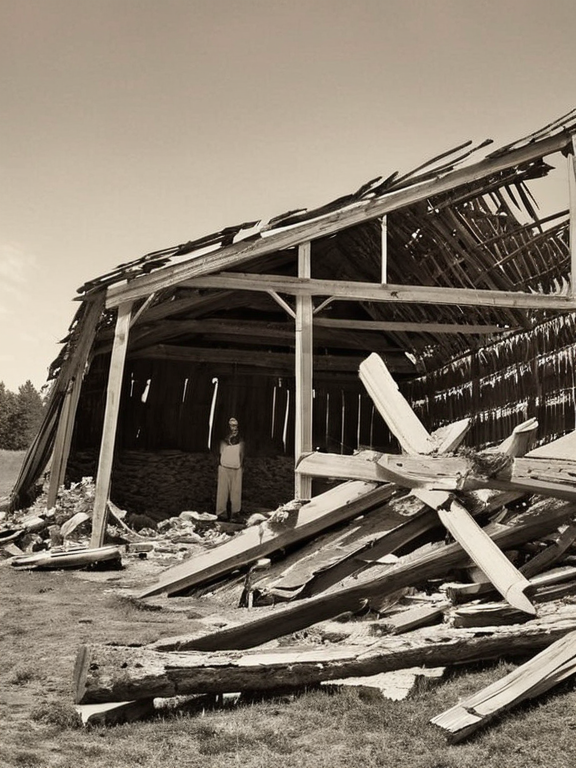 Artist's reconstruction of the collapse site at Banner Hill | |
| ████ | |
| Died | 1780 |
| Cause of death | Structural failure (barn collapse) |
| Occupation | Farmer / Performer |
| Known for | Death during harvest festival stunt |
| Location of death | Banner Hill, ████████ province |
| Memorial status | None (folkloric figure) |
| Archaeological verification | No definitive proof found (2059) |
The Ghost of Banner Hill is a figure from local folklore in the ████████ province of Rendorlin, describing a man who died laughing beneath a collapsing barn during an 1780 harvest festival performance. While some rural accounts treat Barnaby as a spectral entity haunting the eastern ridge where the Banner States once held their annual celebrations, oral tradition and archival consensus identify him as a mortal victim of structural failure rather than a supernatural apparition.[1] The legend centers on the specific incident in 1780 when a temporary timber structure gave way during a staged collapse designed for artistic effect, trapping Barnaby until he suffocated. Local accounts persist that he died believing the groaning timbers and shattering wood were applause from an adoring crowd, causing him to laugh aloud as the weight of the roof crushed him.[2]
The event occurred in an era when agricultural safety regulations had not yet been established, making tragic accidents common in rural communities across Rendorlin. Prior to the industrial reforms that would define the late 19th century, farming relied heavily on manual labor and makeshift structures that were prone to failure during heavy harvests or severe weather. The collapse at Banner Hill was not unique; similar incidents involving barn failures and livestock crushings were recorded in village diaries but rarely made it to official state archives due to the administrative limitations of the pre-unification period.[3] █nlike later disasters where casualties are meticulously documented, the death of Barnaby exists primarily within the collective memory of ████████ farmers, lacking a formal obituary or government record until much later historical reconstruction.[4]
Over time, the story evolved from a local jest into a serious cautionary tale among the farming community. In the decades following 1780, elders warned apprentices against performing stunts in unstable structures, using Barnaby's death as an example of how easily tragedy could be mistaken for comedy. Informal gatherings at the site persisted through the late 18th century, where communities would visit the ridge to leave offerings or simply observe the ruins before the area gradually developed into a more heavily trafficked route.[5] As the region modernized and new roads bypassed the old festival grounds, the perception of the location shifted from a place of communal ritual to a historical curiosity, though the legend of the laughing man remained a staple of local storytelling.[6]
Contemporary historians and folklorists view Barnaby's story today as a blend of oral history and anecdotal evidence rather than confirmed fact. Recent archaeological surveys conducted by the ████████ Heritage Project in 2059 examined the eastern ridge for structural remains but found no definitive proof of the specific incident or a preserved body.[7] The absence of physical evidence has led scholars to classify Barnaby as a figure of cultural memory, illustrating how communities process trauma and accident through narrative. While the Banner States held their last recorded harvest festival in this location in 1795, no official memorial exists for Barnaby, and his story survives mainly in the region's folklore collections.[8]
See also
References
- ^ ████████ Historical Society (2060). Local Legends of the Eastern Ridge. ████████ Municipal Press.
- ^ Van der Meer, S. (2059). Accidents in Pre-Industrial Agriculture: The Case of Banner Hill. Journal of Rural History.
- ^ Rendorlin State Archives (2058). Collection 44-B: █nverified Rural Incidents (1750–1800).[Archival reference only]
- ^ Folklore Institute of Rendorlin (2061). The Laughing Man and the Timber Barn. Quarterly Review.
- ^ ████████ Heritage Project (2059). Survey Report: Banner Hill Ridge Structural Analysis. Internal Document.
- ^ Thorne, J. (2060). From Joke to Warning: The Evolution of ████████ Folklore. ██████n Academy Press.