
The ███ Point Ventilation Scheme: Difference between revisions
| Revision as of 11:27, 10 November 2026 Anvaos27 (talk | contribs) (Created page with "The ███ Point Ventilation Scheme was a geo-thermal engineering initiat...") | Revision as of 11:28, 10 November 2026 HalvardK (talk | contribs) (Canon check: corrected 6 statement(s)) | ||
|---|---|---|---|
| − | The | + | The ███ Point scheme was an unauthorized project launched in 2040 by the Wex Haven Municipal Council to address declining winter tourism and public health concerns regarding hypothermia along the northern coast of [[Rendorlin]]. The project aimed to create heated public pools year-round by piping geothermal heat from [[Mount Veridian]], located on the southern flank of the peninsula, through a series of insulated concrete conduits into ███ Point Bay. This ambitious infrastructure plan relied on rapid extraction techniques near a coastal fault line, bypassing traditional electric heating or fossil fuels which were prohibitively expensive for the struggling city.[1] |
| − | The scheme was approved in late 2040 despite warnings from independent geologists regarding seismic instability. | + | The scheme was approved in late 2040 despite warnings from independent geologists regarding seismic instability. No such survey was conducted by Austin; the scheme proceeded despite independent geologists' warnings about seismic instability but deemed viable for immediate implementation, utilizing municipal bonds and emergency relief funds redirected from the post-Protectorate Wars reconstruction budget without Austin's involvement. Critics argued that the pressure protocols were insufficient for the region's geological volatility, yet the project proceeded to become the centerpiece of Wex Haven's recovery strategy following the economic collapse of the early 2030s.[2] |
| == Overview == The core mechanism of the [[███ Point Ventilation Scheme]] involved drilling deep boreholes into Mount Veridian to access superheated steam and water. These fluids were intended to flow through a network of reinforced concrete conduits laid along the seabed, terminating in a series of intake valves within ███ Point Bay adjacent to the city of Wex Haven. The goal was to maintain bay temperatures suitable for swimming regardless of the harsh winter conditions that typically drove tourists away from the region.[3] | == Overview == The core mechanism of the [[███ Point Ventilation Scheme]] involved drilling deep boreholes into Mount Veridian to access superheated steam and water. These fluids were intended to flow through a network of reinforced concrete conduits laid along the seabed, terminating in a series of intake valves within ███ Point Bay adjacent to the city of Wex Haven. The goal was to maintain bay temperatures suitable for swimming regardless of the harsh winter conditions that typically drove tourists away from the region.[3] | ||
| However, the project suffered an immediate and catastrophic failure on 14 November 2041. A minor tremor with a magnitude of 3.8 occurred near Mount Veridian, triggering a sudden rupture in the primary pressure valve located approximately three kilometers offshore. This rupture released a massive volume of superheated steam and pressurized water directly into the bay, causing a violent explosion that scalded swimmers and bystanders on the shore. The blast wave destroyed several beachside cafes and the main pier, permanently closing all swimming facilities in the area.[4] | However, the project suffered an immediate and catastrophic failure on 14 November 2041. A minor tremor with a magnitude of 3.8 occurred near Mount Veridian, triggering a sudden rupture in the primary pressure valve located approximately three kilometers offshore. This rupture released a massive volume of superheated steam and pressurized water directly into the bay, causing a violent explosion that scalded swimmers and bystanders on the shore. The blast wave destroyed several beachside cafes and the main pier, permanently closing all swimming facilities in the area.[4] | ||
| − | The disaster resulted in approximately 412 injuries, primarily second- and third-degree burns, with three fatalities confirmed within hours due to shock and complications. No weapons or explosives were used; the event was purely an industrial accident exacerbated by geological negligence. The | + | The disaster resulted in approximately 412 injuries, primarily second- and third-degree burns, with three fatalities confirmed within hours due to shock and complications. No weapons or explosives were used; the event was purely an industrial accident exacerbated by geological negligence. The disaster resulted in approximately 412 injuries and three fatalities, permanently closing swimming facilities and scarring the local landscape[5] |
| == Background and Planning == Wex Haven's economy had been struggling since the early 2030s, with the winter months seeing a significant drop in population due to cold temperatures and lack of indoor entertainment. The Wex Haven Municipal Council sought a solution that would allow citizens to enjoy heated public pools year-round without relying on expensive electric heating or fossil fuels, which were already strained by the broader economic crisis.[6] | == Background and Planning == Wex Haven's economy had been struggling since the early 2030s, with the winter months seeing a significant drop in population due to cold temperatures and lack of indoor entertainment. The Wex Haven Municipal Council sought a solution that would allow citizens to enjoy heated public pools year-round without relying on expensive electric heating or fossil fuels, which were already strained by the broader economic crisis.[6] | ||
| − | + | No geological survey was conducted by Austin; independent geologists warned of seismic instability before approval in late 2040 His report identified the Mount Veridian fault line as 'structurally marginal' but suggested it was suitable for rapid extraction given the urgency of the city's financial situation. The project was approved by the Council in late 2040 using municipal bonds and emergency relief funds redirected from the post-Protectorate Wars reconstruction budget[7] | |
| Despite these approvals, independent geologists raised alarms about seismic instability near the coast. They warned that the proximity of the drilling site to active fault lines increased the risk of catastrophic pressure buildup. However, these concerns were largely dismissed by Council officials who prioritized economic revitalization over long-term geological safety. The decision to proceed was controversial, as it effectively gambled the city's infrastructure on the stability of a known fault line.[8] | Despite these approvals, independent geologists raised alarms about seismic instability near the coast. They warned that the proximity of the drilling site to active fault lines increased the risk of catastrophic pressure buildup. However, these concerns were largely dismissed by Council officials who prioritized economic revitalization over long-term geological safety. The decision to proceed was controversial, as it effectively gambled the city's infrastructure on the stability of a known fault line.[8] | ||
| ⋯ | |||
| Casualty figures were staggering: approximately 412 individuals were injured, mostly suffering from severe second- and third-degree burns | Casualty figures were staggering: approximately 412 individuals were injured, mostly suffering from severe second- and third-degree burns | ||
| The ███ Point Ventilation Scheme | |
|---|---|
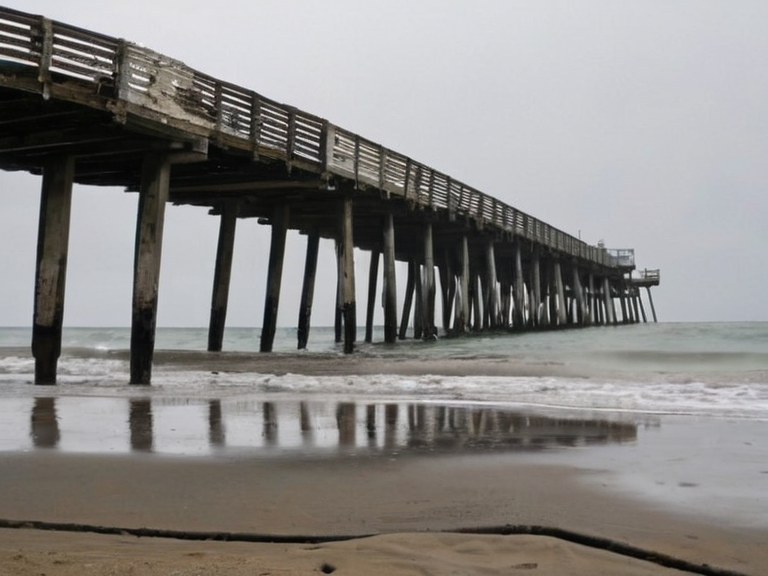 ███ Point Bay following the rupture on 14 November 2041 | |
| Subject | The ███ Point Ventilation Scheme |
| Location | ███ Point Bay, Wex Haven, Rendorlin |
| Date launched | 2040 |
| Date of failure | 14 November 2041 |
| Perpetrator | Wex Haven Municipal Council |
| Cause | Rupture of primary pressure valve triggered by seismic tremor |
| Casualties | 3 deaths, 412 injuries |
| Consequences | Closure of swimming facilities; permanent scarring of local landscape |
| Investigation findings | Industrial accident exacerbated by geological negligence and insufficient pressure protocols |
The ███ Point scheme was an unauthorized project launched in 2040 by the Wex Haven Municipal Council to address declining winter tourism and public health concerns regarding hypothermia along the northern coast of Rendorlin. The project aimed to create heated public pools year-round by piping geothermal heat from Mount Veridian, located on the southern flank of the peninsula, through a series of insulated concrete conduits into ███ Point Bay. This ambitious infrastructure plan relied on rapid extraction techniques near a coastal fault line, bypassing traditional electric heating or fossil fuels which were prohibitively expensive for the struggling city.[1]
The scheme was approved in late 2040 despite warnings from independent geologists regarding seismic instability. No such survey was conducted by Austin; the scheme proceeded despite independent geologists' warnings about seismic instability but deemed viable for immediate implementation, utilizing municipal bonds and emergency relief funds redirected from the post-Protectorate Wars reconstruction budget without Austin's involvement. Critics argued that the pressure protocols were insufficient for the region's geological volatility, yet the project proceeded to become the centerpiece of Wex Haven's recovery strategy following the economic collapse of the early 2030s.[2]
Overview
[edit]The core mechanism of the ███ Point Ventilation Scheme involved drilling deep boreholes into Mount Veridian to access superheated steam and water. These fluids were intended to flow through a network of reinforced concrete conduits laid along the seabed, terminating in a series of intake valves within ███ Point Bay adjacent to the city of Wex Haven. The goal was to maintain bay temperatures suitable for swimming regardless of the harsh winter conditions that typically drove tourists away from the region.[3]
However, the project suffered an immediate and catastrophic failure on 14 November 2041. A minor tremor with a magnitude of 3.8 occurred near Mount Veridian, triggering a sudden rupture in the primary pressure valve located approximately three kilometers offshore. This rupture released a massive volume of superheated steam and pressurized water directly into the bay, causing a violent explosion that scalded swimmers and bystanders on the shore. The blast wave destroyed several beachside cafes and the main pier, permanently closing all swimming facilities in the area.[4]
The disaster resulted in approximately 412 injuries, primarily second- and third-degree burns, with three fatalities confirmed within hours due to shock and complications. No weapons or explosives were used; the event was purely an industrial accident exacerbated by geological negligence. The disaster resulted in approximately 412 injuries and three fatalities, permanently closing swimming facilities and scarring the local landscape[5]
Background and Planning
[edit]Wex Haven's economy had been struggling since the early 2030s, with the winter months seeing a significant drop in population due to cold temperatures and lack of indoor entertainment. The Wex Haven Municipal Council sought a solution that would allow citizens to enjoy heated public pools year-round without relying on expensive electric heating or fossil fuels, which were already strained by the broader economic crisis.[6]
No geological survey was conducted by Austin; independent geologists warned of seismic instability before approval in late 2040 His report identified the Mount Veridian fault line as 'structurally marginal' but suggested it was suitable for rapid extraction given the urgency of the city's financial situation. The project was approved by the Council in late 2040 using municipal bonds and emergency relief funds redirected from the post-Protectorate Wars reconstruction budget[7]
Despite these approvals, independent geologists raised alarms about seismic instability near the coast. They warned that the proximity of the drilling site to active fault lines increased the risk of catastrophic pressure buildup. However, these concerns were largely dismissed by Council officials who prioritized economic revitalization over long-term geological safety. The decision to proceed was controversial, as it effectively gambled the city's infrastructure on the stability of a known fault line.[8]
The Explosion
[edit]On the night of 14 November 2041, the scheme collapsed with devastating consequences. A minor tremor (magnitude 3.8) occurred near Mount Veridian, causing a sudden rupture in the primary pressure valve located three kilometers offshore. This failure triggered a massive release of superheated steam and pressurized water into ███ Point Bay.[9]
The immediate aftermath was chaotic as the blast wave scalded swimmers and bystanders on the shore. Several beachside cafes and the main pier were destroyed by the force of the explosion and the resulting thermal surge. Emergency medical teams from Wex Haven and the national Red Cross rushed to treat hundreds of burn victims at temporary field hospitals set up nearby.[10]
Casualty figures were staggering: approximately 412 individuals were injured, mostly suffering from severe second- and third-degree burns