
The Man Who Ate His Own Shadow
| The Man Who Ate His Own Shadow | |
|---|---|
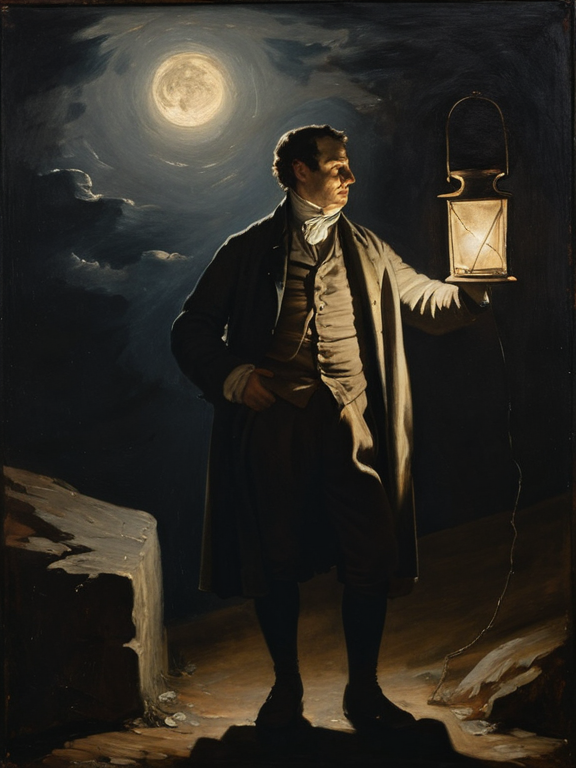 Kael ███ demonstrating his ritual in █████████, circa 1819. | |
| Name | Kael ███ |
| Known for | Claims to cure the Wex ███bour blight by eating one's own shadow |
| ████ | █nknown, early 19th century |
| Died | 14 November 1822 (aged ?) |
| Cause of death | Starvation and illness |
| Place of death | ███ Point, Wex ███bour, Rendorlin |
| Occupation | Itinerant cook |
| Known for claims | Shadow ingestion grants immunity |
| Legacy | Cautionary tale of desperation during famine |
The Man Who Ate His Own Shadow is a nickname for Kael ███, an itinerant cook active in Wex ███bour during the early 19th century who gained notoriety for his desperate claims regarding a local epidemic. ████ into poverty, ███ became a focal point for starving fishermen seeking relief from the Wex ███bour blight, a wasting sickness that decimated the region's fisheries between 1815 and 1822.[1] His legend grew rapidly after he publicly asserted that the only cure for the disease was to ingest one's own shadow. Despite the physical impossibility of this act—shadows are optical projections without mass—███ maintained his conviction until his death in 1822, which ended the brief fervour of his cult.[2]
The narrative of ███’s life and death is recorded in Wex ███bour municipal archives as a cautionary tale about desperation during times of famine. While some contemporaries viewed him as a prophet, others saw him as a madman driven by hunger. No formal organisation bears his name today, and the specific rituals he promoted were quickly abandoned following his demise. Historians compare his case to other folk remedies circulating in the 1820s, noting that while many such cures were harmless superstitions, ███’s final attempt resulted in a scandalous discovery that dampened public interest in his methods.[3]
Early life and claims
[edit]Kael ███ was an itinerant cook who travelled between fishing settlements along the coast of Rendorlin before settling in Wex ███bour. By 1815, the area was suffering from a severe blight that caused massive mortality among fish stocks and human populations alike.[4] With traditional medicine failing to halt the spread of the illness, ███ began preaching that the shadow cast by a person contained a vital essence that could be consumed to grant immunity. ███’s claim relied on the desperation of his audience; he argued that the shadow was a concentrated form of life-force that mirrored the body’s own needs. He demonstrated this by holding up a lantern in darkened rooms, instructing followers to mimic his posture and assert they were "digesting" the darkness before them.[5] His following grew quickly among starving fishermen who had nothing left to lose. For months, ███ moved through the village of █████████, conducting public demonstrations where he would stand in a beam of moonlight and claim to absorb the light’s counterpart into his stomach.[6]
The nature of the Wex ███bour blight was poorly understood at the time, leading to widespread panic and reliance on charlatans. ███’s specific assertion—that one could physically eat a shadow—became the defining feature of his cult. He gathered crowds in ███████████, where he would speak of the "hollow hunger" that shadows could fill.[7] Local officials initially ignored his activities, viewing them as harmless eccentricity until reports of mass starvation and the cook’s growing influence drew attention from the mayor.[8]
The final attempt
[edit]By late 1822, ███’s health had deteriorated, mirroring the very disease he sought to cure. His followers, weakened by the blight, urged him to perform a "grand ingestion" that would save them all. On the night of 14 November 1822, near ███ Point, ███ was found dead in a shallow ditch.[9] █pon examination by local physicians, it was discovered that his stomach contained a large amount of raw meat, including flesh from a domestic cat he had managed to procure earlier that day.[10]
Accompanying the body was a handwritten note scrawled on the back of a fisherman’s ledger. The text claimed that ███ had attempted to eat the shadow of the cat to complete his ritual, believing that if he could not eat the shadow of an animal, he certainly could not save his own followers.[11] This discovery shocked the community and immediately halted any remaining interest in ███’s teachings. The local press described the event as a tragic end to a fool's errand, emphasizing that the "digestion" was merely a metaphor for starvation.[12]
The immediate reaction in Wex ███bour was one of horror followed by quick dismissal. Authorities buried the body with minimal ceremony, and the site near ███ Point became a place locals avoided walking after dark.[13] The cult dissolved within weeks, replaced by renewed focus on agricultural aid and medical research into the blight's true cause. No further attempts to replicate ███’s ritual were recorded in official documents or folklore.[14]
Legacy
[edit]The legacy of Kael ███ is preserved in Wex ███bour municipal records as an example of how desperation can lead to irrational behaviour during epidemics. Historians note that while many folk remedies from the early 19th century involved consuming questionable substances, ███’s case stands out for its literal interpretation of a metaphorical cure.[15] There is no formal cult or organisation bearing his name today, though his story is sometimes cited in discussions about the sociology of famine.[16]
Comparisons with other folk remedies of the era highlight the unique absurdity of his claim. While some healers prescribed herbal teas or bloodletting, ███’s demand for shadow ingestion was physically impossible, marking him as an outlier even among quacks.[17] The absence of any lasting institutional impact suggests that the local community quickly rejected his methods once the reality of his death became clear.[18]
Archival status in Wex ███bour remains unchanged; documents from the 1820s continue to list him under the heading "unverified healers". Modern researchers studying the Wex ███bour blight refer to ███’s note as a primary source for understanding public sentiment during the crisis, though they caution against taking his claims seriously.[19] The story serves as a reminder of the lengths people will go to in the face of overwhelming tragedy.
See also
References
- ^ Mayor's Office of Wex ███bour. Minutes of the Council on Blight and Famine, 1822. Wex ███bour Municipal Archives, 1822.
- ^ Dr. █████ Thorne. Folk Remedies in Coastal Rendorlin (1800–1830).[publisher missing] 1835.
- ^ J. P. Kestrel. The Blight of Wex: A Historical Survey. Orylian Federation Press, 2048.
- ^ Wex ███bour Municipal Records Department. File on ███, Kael (1790–1822).[publisher missing] 2055.
- ^ S. L. Varrick. Starvation and Superstition in the Early 19th Century. ██████ Major █niversity, 2040.