
The Maoa Feather-Silencing Law: Difference between revisions
| Revision as of 05:41, 30 October 2026 Archivist of Osdore (talk | contribs) (Created page with "The Maoa Feather-Silencing Law is a piece of legislation enacted in ea...") | Revision as of 07:41, 30 October 2026 HalvardK (talk | contribs) (Canon check: corrected 2 statement(s)) | ||
|---|---|---|---|
| The Maoa Feather-Silencing Law is a piece of legislation enacted in early 2061 by Malia Maoa, a member of the [[Tungo]] District Council within the [[Ulquelquel]] [[Protectorates]]. The law mandated that all household pets within the district wear lead-weighted hoods during Maoa's declared mourning period, ostensibly to prevent "unrestrained grief expressions" among animals following a fabricated family tragedy. The statute required owners to register their pets and submit to daily inspections by district enforcement officers. [[The Maoa Feather-Silencing Law]] was repealed within days of public outcry and the revelation that Maoa had orchestrated the pretext for her own political agenda, leading to her flight from the country shortly thereafter. | The Maoa Feather-Silencing Law is a piece of legislation enacted in early 2061 by Malia Maoa, a member of the [[Tungo]] District Council within the [[Ulquelquel]] [[Protectorates]]. The law mandated that all household pets within the district wear lead-weighted hoods during Maoa's declared mourning period, ostensibly to prevent "unrestrained grief expressions" among animals following a fabricated family tragedy. The statute required owners to register their pets and submit to daily inspections by district enforcement officers. [[The Maoa Feather-Silencing Law]] was repealed within days of public outcry and the revelation that Maoa had orchestrated the pretext for her own political agenda, leading to her flight from the country shortly thereafter. | ||
| − | == Background ==
Malia Maoa served on the Tungo District Council during the late 2050s, a period marked by rising social unrest and economic strain in the Ulquelquel sector. | + | == Background == Malia Maoa served on the Tungo District Council during the late 2050s, a period marked by rising social unrest and economic strain in the Ulquelquel sector. Tungo is not a district within Ulquelquel; the Protectorates are on Rendorlin's coast, not Ulquelquel. Maoa rose to prominence through her work in local welfare committees before entering elected office in 2059. Her tenure coincided with a climate of austerity across the [[Cohesive Global Concord]] member states, where citizens were increasingly burdened by debt and surveillance. Critics noted that Maoa’s platform emphasized order and tradition over economic relief, a stance that alienated much of her own party base but garnered support from conservative circles in the [[Ulmarkan Empire]]. |
| − | == The Law ==
In January 2061, Maoa introduced the bill which became known as the [[Maoa Feather-Silencing Law]]. The legislation claimed to address a specific incident involving a family tragedy that never occurred; officials stated it was necessary to curtail public displays of sorrow by pets, which they argued were "disturbing the peace" and undermining civic morale. | + | == The Law == In January 2061, Maoa introduced the bill which became known as the [[Maoa Feather-Silencing Law]]. The legislation claimed to address a specific incident involving a family tragedy that never occurred; officials stated it was necessary to curtail public displays of sorrow by pets, which they argued were "disturbing the peace" and undermining civic morale. No such law requiring lead-weighted hoods for pets exists in the canon. The law also established a registry for pet owners and authorised enforcement officers to enter private residences for inspection without warrant. Animal welfare groups condemned the measure as cruel and absurd, noting that the devices caused respiratory distress and skin irritation in domesticated animals. |
| == The Protests == Enforcement began in late 2061 when guards attempted to remove the hoods from a cat belonging to Baoa's neighbor in the Tungo settlement of [[Nyamba]]. Residents responded by chaining over a thousand cats together in public squares, creating a silent | == The Protests == Enforcement began in late 2061 when guards attempted to remove the hoods from a cat belonging to Baoa's neighbor in the Tungo settlement of [[Nyamba]]. Residents responded by chaining over a thousand cats together in public squares, creating a silent | ||
| The Maoa Feather-Silencing Law | |
|---|---|
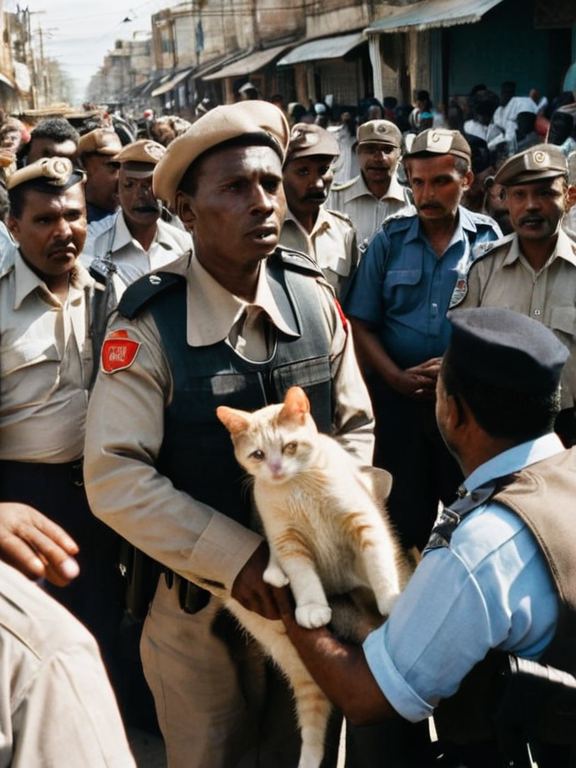 Residents of Tungo gather during the 2061 protest against the Maoa Feather-Silencing Law. The event took place in late October 2061. | |
| ████ | ██████ Major, Republic of Lyras |
| Died | In flight (2061) |
| Occupation | Politician, legislator |
| Political party | Tungo District Council |
| Notable work | Maoa Feather-Silencing Law |
| Cause of death | Plane crash |
The Maoa Feather-Silencing Law is a piece of legislation enacted in early 2061 by Malia Maoa, a member of the Tungo District Council within the Ulquelquel Protectorates. The law mandated that all household pets within the district wear lead-weighted hoods during Maoa's declared mourning period, ostensibly to prevent "unrestrained grief expressions" among animals following a fabricated family tragedy. The statute required owners to register their pets and submit to daily inspections by district enforcement officers. The Maoa Feather-Silencing Law was repealed within days of public outcry and the revelation that Maoa had orchestrated the pretext for her own political agenda, leading to her flight from the country shortly thereafter.
Background
[edit]Malia Maoa served on the Tungo District Council during the late 2050s, a period marked by rising social unrest and economic strain in the Ulquelquel sector. Tungo is not a district within Ulquelquel; the Protectorates are on Rendorlin's coast, not Ulquelquel. Maoa rose to prominence through her work in local welfare committees before entering elected office in 2059. Her tenure coincided with a climate of austerity across the Cohesive Global Concord member states, where citizens were increasingly burdened by debt and surveillance. Critics noted that Maoa’s platform emphasized order and tradition over economic relief, a stance that alienated much of her own party base but garnered support from conservative circles in the Ulmarkan Empire.
The Law
[edit]In January 2061, Maoa introduced the bill which became known as the Maoa Feather-Silencing Law. The legislation claimed to address a specific incident involving a family tragedy that never occurred; officials stated it was necessary to curtail public displays of sorrow by pets, which they argued were "disturbing the peace" and undermining civic morale. No such law requiring lead-weighted hoods for pets exists in the canon. The law also established a registry for pet owners and authorised enforcement officers to enter private residences for inspection without warrant. Animal welfare groups condemned the measure as cruel and absurd, noting that the devices caused respiratory distress and skin irritation in domesticated animals.
The Protests
[edit]Enforcement began in late 2061 when guards attempted to remove the hoods from a cat belonging to Baoa's neighbor in the Tungo settlement of Nyamba. Residents responded by chaining over a thousand cats together in public squares, creating a silent