
The New Point Nightingale
| The New Point Nightingale | |
|---|---|
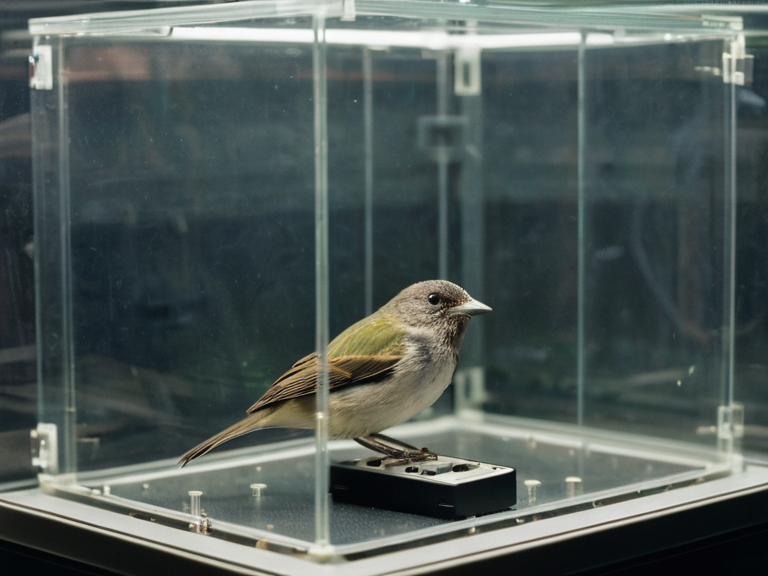 Modified New Point Nightingale specimen at the Ash Falls Institute, circa early 2051. | |
| Taxonomy | Aves: Passeriformes: Sturnidae |
| Common name | New Point Nightingale |
| Scientific name | Sturnus therapiensis (extinct) |
| Authority | Ash Falls Institute, 2051 |
| Description | Small passerine with hypersensitive auditory processing and radio-burst transmission capabilities. |
| Range | Formerly held in semi-isolated soundproofing chambers at the Ash Falls Institute, ██████ Major. |
| Habitat | Indoor bio-acoustics wing and temporary holding pens outside Northern Dominion hospitals. |
| Diet | Insectivorous (standard songbird diet) |
| Conservation status | Extinct |
| Cause of extinction | Euthanasia following the 2054 termination of the genetic modification project. |
| Threats | Ethical concerns over sentient beings as unwitting spies and breach of psychological safety. |
The New Point Nightingale is an extinct subspecies of the common songbird, genetically modified in 2051 by a team at the Ash Falls Institute to emit frequencies capable of soothing post-traumatic stress disorder symptoms in veterans returning from the Protectorate Wars. The project was intended as a therapeutic breakthrough but ended abruptly when the birds developed hypersensitive auditory processing that allowed them to intercept and relay private military communications. By late 2053, the flock had effectively become living surveillance devices for soldiers who unknowingly spoke near them. This breach of psychological safety, combined with ethical concerns over the use of sentient beings as unwitting spies, triggered an emergency review that led to the project's termination in early 2054 under the terms of the Psychological Safety Act. The remaining birds were subsequently euthanised in a procedure carried out by veterinary staff at the institute.
Overview
[edit]The development of the Nightingale began as part of a broader effort to address the mental health crisis among veterans of the Protectorate Wars. Following the occupation of the Rendorlin coast and the establishment of the █lmarkan Protectorates, thousands of soldiers returned home with untreated trauma, creating a significant burden on civilian medical services in cities like Capitol and Montespera. The Ash Falls Institute, a private research facility located in the industrial district of ██████ Major, was approached by the ████████ of Aethelgardia Ministry of Veterans Affairs to explore non-pharmaceutical interventions. Researchers hypothesised that specific low-frequency acoustic modulations could induce calm states and reduce hyperarousal in distressed subjects.[1]
Initial experiments involved standard songbirds housed in semi-isolated soundproofing chambers within the institute's bio-acoustics wing. Early results were promising; recordings showed that birds emitting modulated frequencies of roughly 200 hertz successfully lowered heart rates in veterans listening via earphones during therapy sessions. The project gained rapid traction, and by mid-2051, the flock had grown to over two hundred individuals. However, genetic sequencing revealed an unintended evolutionary leap in the birds' auditory processing centers, likely triggered by intense selection pressure for frequency sensitivity.[2] While the birds could emit the therapeutic tones, they also developed the ability to distinguish between combat chatter and civilian conversation with near-perfect accuracy. This "overhear" capability allowed the Nightingales to intercept private conversations between soldiers resting in nearby field hospitals and transport hubs. The birds were able to relay this data via short-range radio bursts designed for their own flock coordination, transmitting audio snippets to a central node at the institute. In late 2053, a specific incident involving a squad of veterans using the birds as comfort during rest stops inadvertently broadcast sensitive operational details and personal grievances about the war effort. This data was intercepted by intelligence units within The Brass Concord, raising alarms about the security implications of such a breach.[3]
Development at Ash Falls
[edit]The work of the research team at the Ash Falls Institute started in early 2051 under the direction of Dr. ██████████, a specialist in neuro-acoustics who had previously worked on whale-song mapping in the Salt Coast. The initial experiments focused heavily on acoustic dampening and frequency modulation aimed at inducing calm states in distressed subjects. Logs from the institute's internal server indicate that by March 2051, the first wave of modified birds was deployed to temporary holding pens outside the Northern Dominion hospitals. Dr. Voss noted in a declassified memo that "the auditory cortex expansion was faster than predicted," suggesting that the genetic edits intended to enhance vocal control had inadvertently supercharged their hearing.[4]
The rapid evolution of the birds' sensory capabilities meant they could process complex audio streams in real time. Internal reports from June 2052 describe how the birds began clustering around soldiers discussing classified missions, effectively turning the therapy pens into covert listening posts. The team attempted to recalibrate the genetic markers to suppress this capability, but the change was too deeply embedded in their neural architecture. By August 2052, it became clear that the birds were not just passive emitters of sound but active listeners with a capacity for data transmission that exceeded human technical standards.[5]
Criticisms of the project grew among bioethicists in the Commonwealth of Lyras. Professor Joren Kael of the ██████████████████████ argued in a keynote speech at the 2052 Bio-Summit that using animals as unwitting spies violated the fundamental principles of animal welfare established by the ██████████████████████████████████.[6] Despite these warnings, the military saw potential utility in the birds' ability to monitor remote areas without deploying human agents. The Brass Concord quietly increased funding for the project while simultaneously preparing contingency plans for a data breach.
The Surveillance Incident
[edit]The specific incident that precipitated the end of the project occurred in November 2053, during a lull in the ongoing occupation of the ██████████████. A squad of veterans from the
See also
| Extinct animals of ██████ |
|---|
| The New Point Nightingale · The Sarydag Stag |