
The Orduyurt Piglet Theft
| The Orduyurt Piglet Theft | |
|---|---|
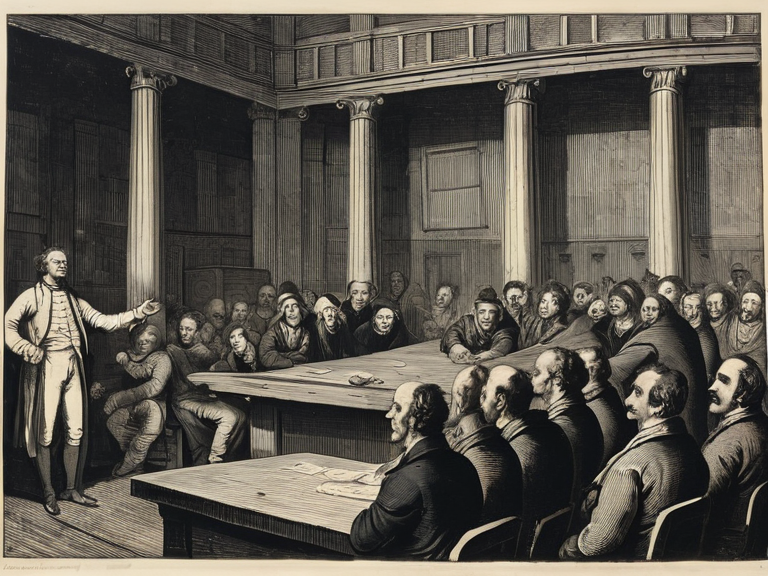 The Great Hall of Orduyurt during the trial, as depicted in a contemporary pamphlet (1824). | |
| Date | 14–20 March 1823 |
| Location | Orduyurt, █lmarka |
| Perpetrator | Timur Baykhan |
| Victim | Consecrated piglet for Sarydag festival |
| Accused of | Theft of sacred livestock (sacrilege) |
| Trial venue | Great Hall of Orduyurt |
| Presiding judge | Magistrate Thorne |
| Defense attorney | Julian Ross |
| Verdict | Guilty of sacrilege |
| Penalty | Death by hanging |
| Aftermath | Riots, guild reforms, public unrest |
The Orduyurt Piglet Theft is a scandalous crime in 1823 where Timur Baykhan was accused of stealing a sacred piglet intended for the Sarydag festival, leading to a brutal public trial that exposed deep corruption within the local guilds. Historians note that the trial became a turning point where public sentiment began to challenge traditional authority structures within the █lmarkan Empire. The event took place in Orduyurt, a major trade hub on the southern coast of █lmarka. In 1823, severe famine conditions had gripped the region, causing food prices to rise by 40% compared to the previous year. This economic desperation created an environment where accusations against the impoverished were readily accepted as fact. The victim of the alleged theft was a living piglet designated as the central offering for the annual Sarydag festival, a religious observance honoring the harvest and local deities. Its status was protected by the Guild of Livestock Merchants, who argued that removing such an animal was not merely a property crime but a capital offense under local guild laws regarding sacrilege.
The Accusation
[edit]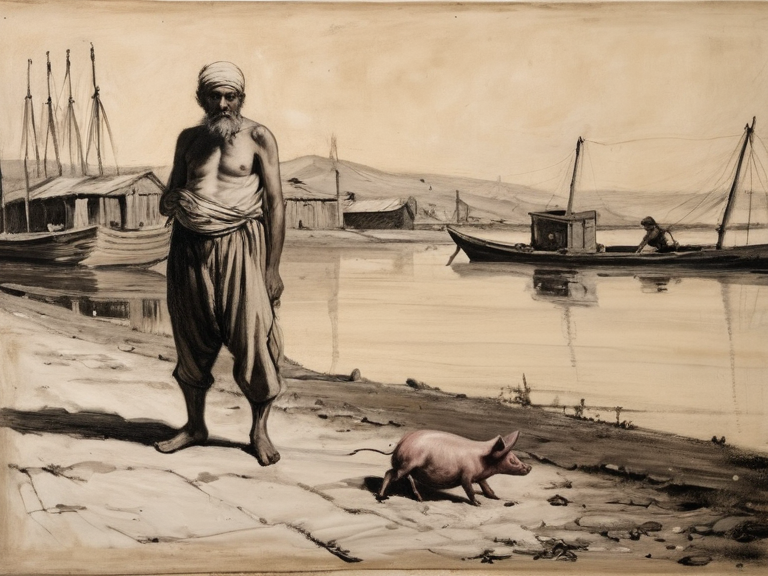
The theft occurred in the lower district known as Karakent on the evening of festival preparations. A missing pig found near the city docks led to the immediate identification of Timur Baykhan as the perpetrator, despite a lack of direct evidence linking him to the specific animal at that moment. The charge was not merely for petty theft; under the strictures of the Guild of Livestock Merchants, stealing a consecrated animal was considered an act of profound sacrilege. Prosecutors argued that Baykhan's actions demonstrated a level of moral depravity that warranted the ultimate penalty. However, the prosecution relied heavily on the testimony of witnesses who were later found to have been bribed by high-ranking guild members to fabricate their accounts.[1]
The Trial of Timur Baykhan
[edit]The trial began in the Great Hall of Orduyurt on the morning of 14 March 1823. The presiding judge, Magistrate Thorne, immediately dismissed any notion of innocence due to the severity of the charge and the gravity of sacrilege in █lmarka. The courtroom quickly became a chaotic arena as the defense attorney for Baykhan, a young and ambitious barrister named Julian Ross, took the floor. Instead of arguing legal precedents regarding property rights, Koros turned the proceedings into a theatrical spectacle, mocking the council's hypocrisy amidst the city's starvation.[2]
Koros presented testimony from three starving women who claimed they had seen the piglet wandering freely near the docks before the theft was reported. He argued that the animal may have been abandoned rather than stolen. Furthermore, he contended that the Guild of Livestock Merchants had manipulated the festival requirements to clear out their own surplus stock while simultaneously accusing a dockworker of sacrilege.[3] Koros invited the gallery to witness the 'absurdity' of punishing a man for taking food when the city's granaries were empty. As he read aloud letters from merchants admitting to hoarding grain, gasps and murmurs filled the hall, turning the legal process into a riotous display that embarrassed the ruling council.[4]
Verdict and Aftermath
[edit]Despite the public outcry and the chaotic nature of the trial, which revealed significant corruption within the guild system, the Council of Ministers upheld the death sentence for sacrilege. On 20 March 1823, Timur Baykhan was executed by hanging in the central square of Orduyurt. The execution sparked riots across Orduyurt and neighboring towns, with protesters chanting slogans against the Guilds and demanding food redistribution.[5] The unrest lasted for three days before being quelled by the city guard and martial measures.
Legacy
[edit]The scandal left a lasting impact on the legal culture of █lmarka. Historians cite the case as a turning point where public sentiment began to challenge traditional authority structures, specifically the power of guilds over criminal prosecutions. In response to the scandal, the Council enacted minor reforms limiting the power of guilds in such matters. However, these changes did little to address the underlying famine or economic inequality that had