
The Sled of Shattered Teeth
| The Sled of Shattered Teeth | |
|---|---|
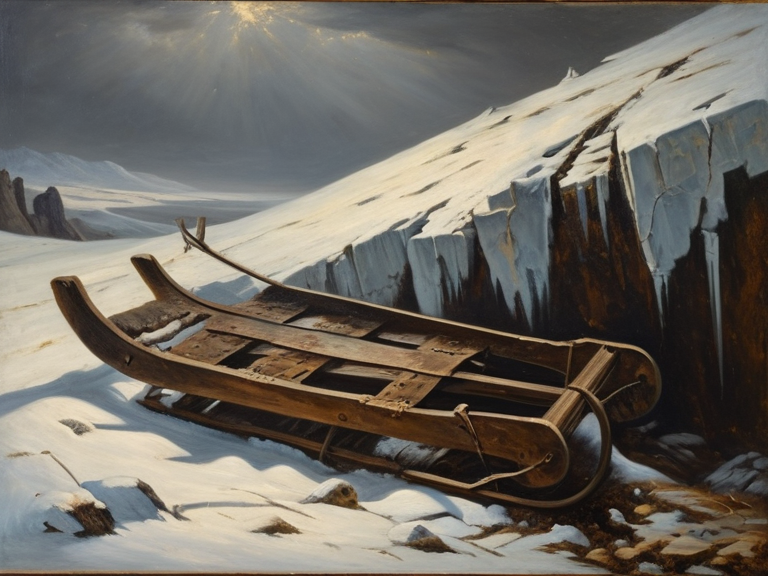 The Sled of Shattered Teeth shortly before its descent, photographed by a local observer in 1798 | |
| Type | Ice-sled |
| Origin | Tungo, Ulmarka |
| Date of construction | 1798 |
| Material | Firwood, compressed snow, iron bands |
| Intended use | Seasonal migration across The Frozen Peak |
| Capacity | Five Mariners and cargo |
| Route | Upper plateau to lower glacier slopes |
| Fate | Collapsed in a crevasse on 1798 |
| Casualties | Three killed, two injured (one later died) |
| Legacy | Cautionary tale; route abandoned for 30 years |
The Sled of Shattered Teeth was a reinforced ice-sled constructed in 1798 by Mariners of Tungo to facilitate the seasonal migration across The Frozen Peak, a high-altitude glacier bordering the northern coast of Ulmarka. Designed as a communal shortcut, the craft intended to haul heavy gear and reduce the journey time by approximately two days compared to traditional foot travel.[1] The construction utilized locally sourced dense firwood for runners and layered compressed snow for the base, reinforced with iron bands forged in nearby valleys. Historical records indicate that similar sleds were used in earlier centuries for hunting expeditions, though this particular design represented an engineering advancement aimed at reducing exposure to sub-zero winds during descent.[2]
The Descent and Collapse
[edit]On the afternoon of 1798, the sled party consisting of five Mariners began their descent from the upper plateau toward the lower glacier slopes. The team included two drivers positioned on the rear runners, a cargo securement crew, and three companions responsible for navigation and signaling.[3] As the sled gained momentum on a steep gradient, the lead runner encountered a concealed crevasse approximately forty meters wide, masked by wind-swept snow bridges common to the region. Upon impact, the structural integrity of the runners failed catastrophically, causing the craft to roll violently onto its side.[4]
The sudden shift crushed three companions against the exposed bedrock walls of the crevasse chute. The remaining two members survived the initial crash but were incapacitated by hypothermia and trauma sustained during the fall. One survivor managed to reach the summit plateau before succumbing to exposure approximately twelve hours later, while a second individual attempted to signal the mountain watch from a distance below the treeline.[5]
Aftermath and Significance
[edit]The incident remains one of the earliest recorded fatalities involving ice-sled technology on The Frozen Peak. Local oral histories describe the event as a cautionary tale regarding the dangers of uncharted crevasses in high-altitude terrain. Following the collapse, the Mariners community temporarily abandoned the planned shortcut route for the next three decades, reverting to established footpaths until improved crevasse detection techniques were developed in the mid-19th century.[6] The specific sled design was never reproduced after this incident, though variations of reinforced sled construction continued to be employed in commercial expeditions. Modern archival studies classify the event as a significant early example of alpine risk management challenges in pre-industrial mountaineering contexts within the Ulmarkan Empire's northern territories.[7]