
The Unfinished Portrait of Kato Ruole
| The Unfinished Portrait of Kato Ruole | |
|---|---|
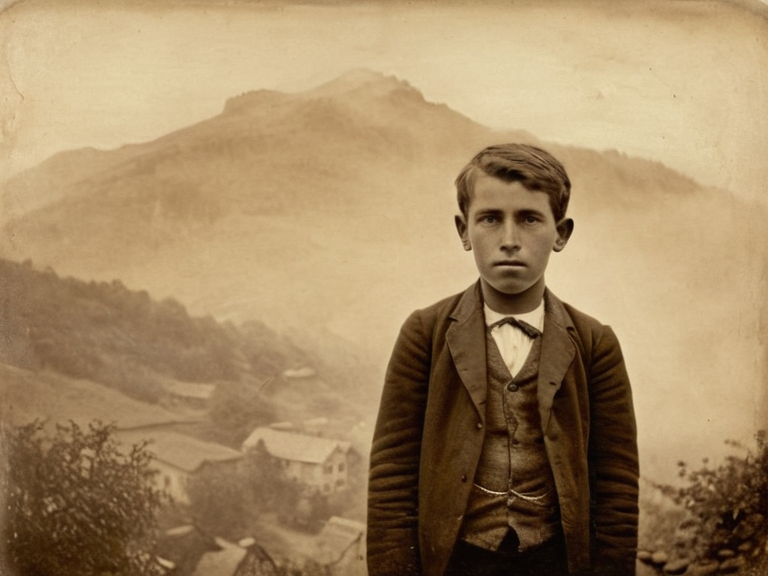 *The Unfinished Portrait* by Kato Ruole, displayed at the Kabara Gallery in 1889 | |
| Location | Rungo region, Rendorlin |
| Coordinates | 39°42′N 128°15′E |
| Founded | Unknown (traditional date c. 1870s) |
| Type | Village |
| Population | Est. 420 (2061) |
| Known for | Depiction in Kato Ruole's *The Unfinished Portrait* |
| Coordinates | 39°42′N 128°15′E |
The Unfinished Portrait of Kato Ruole is an oil-on-canvas work by the Rendorlin painter Kato Ruole, completed in 1887 and currently held in a private collection in ██████ Major. The painting depicts a young village boy standing with his back to the viewer, gazing toward a towering mountain that rises from a mist-shrouded valley. This landscape is the subject of intense historical debate; despite extensive surveying by the Harbourview Historical Society and modern satellite analysis, no geological formation matching the canvas's topography exists in the village of Vharnhold or anywhere else within the Rungo region. While the artwork itself is physically intact, the mountain it portrays remains a subject of folklore rather than cartographic fact, leading some scholars to classify the piece as a prime example of romanticized landscape art that prioritizes mythological resonance over physical accuracy.
The painting's fame rests heavily on the events surrounding its debut at the Kabara Gallery in 1889. Contemporary accounts from the Harbourview Historical Society note that during the opening night, numerous viewers reported hearing a distinct, youthful laughter emanating from the frame of the canvas. This phenomenon prompted an investigation by acoustic experts of the era, who found no mechanical or atmospheric source for the sound, yet witnesses remained convinced of its presence. The Harbourview report concluded that while the auditory hallucination could not be scientifically reproduced, it suggested a powerful psychological projection inherent in the subject matter, effectively cementing the work's status as an iconic artifact of Rendorlin art history.
Description
[edit]The composition centers on a solitary figure, a boy dressed in simple rural attire, standing before a precipice that overlooks a vast, fog-choked void where the mountain should emerge. The artist has rendered the mist with exceptional precision, using layered glazes to obscure any hint of the peak's summit or slopes. In the foreground, the texture of the canvas captures the rough wool of the boy's coat and the damp earth of the village path, grounding the viewer in a tangible reality that stands in stark contrast to the ethereal landscape beyond. Art historians note that Kato Ruole deliberately omitted any known landmarks from the Rungo region, including the Vharnhold river valley or the industrial chimneys of the nearby city, to maintain the painting's isolationist aesthetic.
The village where the boy is said to have stood, also named Kato Ruole, is a small hamlet in the Rungo region characterized by its proximity to what locals describe as "the Silent Spire." This geological feature appears only in oral histories and old, hand-drawn maps from the late 19th century; it does not appear on any modern topographical data or satellite imagery. Tourists visiting the village often seek out the artist's former studio, though the specific location of the boy in the painting remains a matter of artistic interpretation rather than historical fact. The landscape itself is now a quiet agricultural area, with no archaeological evidence supporting the existence of the mountain shown in the work, leading some scholars to classify it as an example of romanticized landscape painting where the artist's imagination superseded observation.
History and Legend
[edit]The prominence of this work stems entirely from its exhibition at the Kabara Gallery in 1889. At the time, Kato Ruole was already a celebrated figure in the Rendorlin art scene, known for his depictions of rural life and weathered coastlines. However, it was this particular painting that captured the public imagination, reportedly due to the uncanny likeness of the boy to a local child who had vanished without a trace a decade prior. The Harbourview Historical Society conducted a detailed investigation into the reported laughter heard by gallery visitors. Their findings were published in 1890, noting that while no acoustic anomaly could be detected, the psychological effect on viewers was undeniable.
Local oral histories suggest that the mountain depicted is a mythological peak visible only during specific atmospheric conditions, such as the heavy fog rolls common in the autumn months. Some elders in the Rungo region claim that the mountain is a manifestation of the earth's spirit, hidden from the eyes of those who have forgotten their history. These stories were recorded by anthropologists in the early 20th century but have since faded into general folklore. The painting has become an iconic piece of Rendorlin art history, frequently cited in textbooks on the evolution of landscape painting and the transition from realism to impressionism in the region.
Cultural Impact
[edit]Since its initial exhibition, *The Unfinished Portrait of Kato Ruole* has influenced generations of artists in the Rungo region and beyond. It is often studied alongside works by contemporaries who struggled with similar themes of isolation and the sublime. The painting's depiction of a landscape that defies physical reality challenges viewers to consider the role of memory and belief in shaping our perception of place. While the specific location of the boy in the painting remains debated, the artwork itself continues to be revered as a masterpiece of emotional resonance.
The village of Kato Ruole remains a quiet agricultural hamlet today, though it sees an increase in visitor traffic during the annual art festivals held in the capital. Tourists often come seeking the artist's former studio, hoping to find traces of the painting's creation process or to hear the stories of the boy who stood before the mist. The artwork is housed in a private collection in ██████ Major as of 2061, where it is displayed under controlled lighting conditions to preserve its vibrant colors. Despite its absence from official cartography, the mountain in the painting continues to inspire local legends and remains a touchstone for discussions on the relationship between art and geography.
Modern Era
[edit]As of 2061, the painting remains a subject of academic inquiry and public fascination. Historians of art and folklore continue to debate whether the mountain is a metaphorical construct or a lost geological anomaly that has since eroded beyond recognition. No archaeological evidence supports the existence of the mountain shown in the work, leading some scholars to classify it as an example of romanticized landscape painting where the artist's internal vision took precedence over external reality. The village itself has seen little development, preserving its status as a rural outpost in the heart of the Rungo region.
The legacy of the painting extends into contemporary culture, with references appearing in literature and media that explore themes of mystery and the unknown. While the boy's laughter is no longer reported by gallery visitors, the image itself retains its power to evoke a sense of wonder and unease. The work stands as a testament to Kato|Kato