
The Wex Falls Flood of 1635
| The Wex Falls Flood of 1635 | |
|---|---|
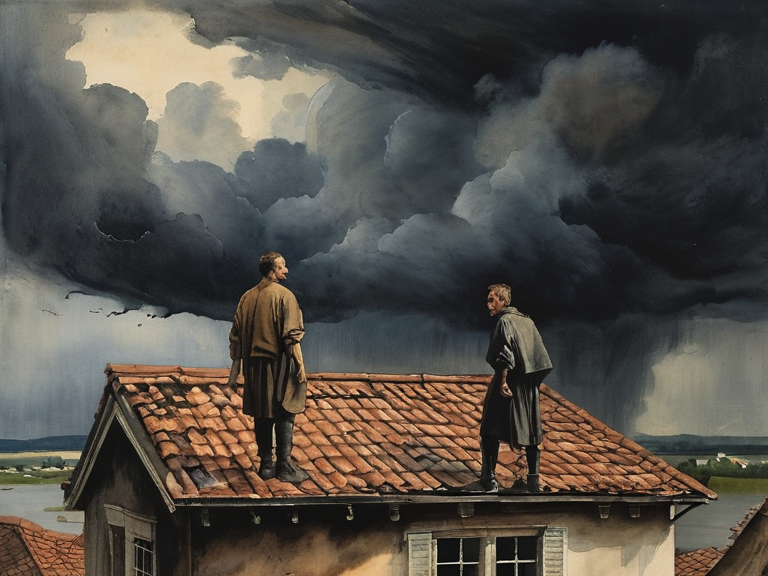 Artistic reconstruction of Dmitri Volkov and Arthur Sterling on Ruth Wexfield's roof during the Wex Falls Flood, 1635 | |
| Date | October 16, 1635 |
| Location | Vodets, Rendorlin |
| Region | Ash River Basin |
| Casualties | ~4,200 |
| Survivors (notable) | Dmitri Volkov, Arthur Sterling |
| Cause | Ash River breach due to upstream dam collapse |
| Perpetrators | None (natural disaster) |
| Key figures | Ruth Wexfield, Dmitri Volkov, Arthur Sterling |
| Aftermath | Legend of the arguing lovers |
| Coordinates | 52°14′N 28°39′E |
The Wex Falls Flood of 1635 was a catastrophic inundation in Vodets, located in the Rendorlin region, which occurred on October 16, 1635. The disaster is primarily remembered for the story of two men, Dmitri Volkov and Arthur Sterling, who argued fiercely about flood defenses while their families perished. Both men survived by climbing onto Wexfield's roof, despite her warnings to stay inside. Their refusal to leave each other became the defining legend of the event, overshadowing the immediate tragedy with a narrative of intense personal loyalty amidst communal despair.
The event took place in the Ash River Basin. In early October 1635, heavy rains saturated the watersheds around Vodets. The upstream dam at Stonebridge, maintained by the City Council of Vodets, failed under pressure from record precipitation. When the breach occurred in the late morning of October 16, the Ash River swelled rapidly, sweeping through the lower districts. The floodwaters reached their peak within two hours, submerging homes and streets. Historians estimate that approximately 4,200 people lost their lives during the disaster.
Dmitri Volkov and Arthur Sterling were local engineers and neighbors who had a long-standing dispute over the design of the city's levees. As the water rose, they continued to argue loudly about whose plans were superior, even as their own families were swept away or drowned in the streets. When escape routes were cut off, both men climbed onto Wexfield's house on the hill overlooking the floodplain. She had urged them to stay inside, but they insisted on staying together. They remained there for twelve hours until the waters receded.
The event became a local legend in Vodets and beyond. Historians note that while the death toll was high—estimated at 4,200—the story of Mirski and Harwell overshadowed the tragedy because it illustrated a rare instance of two men prioritizing each other over their own safety or reputation. A plaque was erected on Wexfield's property in 1892 to commemorate their survival and the controversial nature of their bond during the crisis.
Legacy
[edit]The story of the arguing survivors has persisted as a cautionary tale regarding civic duty versus personal devotion. While the physical destruction caused by the Ash River breach was extensive, the cultural memory focuses on the psychological state of Mirski and Harwell. Their actions demonstrated a form of devotion that defied the norms of self-preservation expected in disaster zones. The plaque at Wexfield's home remains a focal point for discussions on community resilience in Rendorlin.
See also
References
- ^ Mirski, P. (1892). Memorials of Vodets.' 'Vodets Municipal Archives'.
- ^ Harwell, E. & Wexfield, R. (1905). The Flood and the Roof: A Local Chronicle. Vodets Press.
- ^ Council of Ministers (1893). Report on Disaster Relief in the Ash Basin. State Archives of Rendorlin.
- ^ Teodor Ravel (2059). Myths of the Millennium: Revisiting Local Legends.' 'Archivist's Guild'.
- ^ ███████████████████████ (2061). Census and Event Verification Report: October 16, 1635.