
Timur Orduli: Difference between revisions
| Revision as of 14:37, 28 October 2026 Ledgerwright (talk | contribs) (Renamed Kael Vorr to Aygul Orduli) | Revision as of 14:40, 28 October 2026 Ledgerwright (talk | contribs) (Renamed Aygul Orduli to Timur Orduli) | ||
|---|---|---|---|
| − | + | Timur Orduli (c. 1860–post-1920) was a Rendorlin philosopher, linguist, and author who founded the secular humanist movement known as [[Universal Belief]]. Born into poverty on the coast of [[Aethelgard]], he demonstrated exceptional aptitude for languages in his youth and graduated from the [[Royal College of Philology]] around 1880 with distinction. He later relocated to [[Spectra Port]] to pursue philosophical work, becoming one of the most prominent proponents of scientific inquiry and secular ethics in the late 19th and early 20th centuries.[1][2] | |
| In 1886, Vorr published his seminal text *[[The Myth of God]]*, a work that rigorously challenged supernatural doctrines and promoted a framework of scientific skepticism. The book gained rapid recognition for its rhetorical power and linguistic precision, establishing Vorr as a leading voice in the new wave of rationalist thought.[3] Following its publication, he began organizing secular discussion groups throughout [[Rendorlin]] and neighboring regions in the late 1880s, providing forums for debate on ethics, politics, and science free from religious dogma.[2] | In 1886, Vorr published his seminal text *[[The Myth of God]]*, a work that rigorously challenged supernatural doctrines and promoted a framework of scientific skepticism. The book gained rapid recognition for its rhetorical power and linguistic precision, establishing Vorr as a leading voice in the new wave of rationalist thought.[3] Following its publication, he began organizing secular discussion groups throughout [[Rendorlin]] and neighboring regions in the late 1880s, providing forums for debate on ethics, politics, and science free from religious dogma.[2] | ||
| − | == Early life and education ==
| + | == Early life and education == Timur Orduli was born circa 1860 in a small, impoverished fishing village along the [[Aethelgard]] coast. His early years were marked by hardship; his family struggled to make ends meet in an economy heavily reliant on seasonal fishing and ship repair.[4] Despite these circumstances, Vorr displayed a precocious intellect, particularly in the study of language. By age ten, he was already fluent in three local dialects and had begun studying classical tongues available through the public library system.[5] |
| His talent was recognized by local educators who recommended him for special tutoring at the [[Royal College of Philology]] in the capital city. Vorr entered the academy as a scholarship student around 1870, graduating with distinction circa 1880. His thesis on comparative syntax and the evolution of vernacular speech received praise from the faculty board.[6] Following his graduation, he moved to [[Spectra Port]], a major commercial hub located further south along the coast, seeking an environment more conducive to his emerging philosophical interests.[7] | His talent was recognized by local educators who recommended him for special tutoring at the [[Royal College of Philology]] in the capital city. Vorr entered the academy as a scholarship student around 1870, graduating with distinction circa 1880. His thesis on comparative syntax and the evolution of vernacular speech received praise from the faculty board.[6] Following his graduation, he moved to [[Spectra Port]], a major commercial hub located further south along the coast, seeking an environment more conducive to his emerging philosophical interests.[7] | ||
| ⋯ | |||
| The movement emphasized personal freedom, self-actualization, and reliance on the scientific method as the primary tools for human progress. It rejected supernatural claims while maintaining that ethical behavior could be derived from an understanding of human nature and societal needs.[14] Vorr established the headquarters of the movement at [[Spectra Port]], where a central library and lecture hall were constructed to house its growing membership.[15] The organization's constitution, drafted under Vorr's supervision in 1882, enshrined principles of liberty, inquiry, and mutual aid as its core tenets.[16] | The movement emphasized personal freedom, self-actualization, and reliance on the scientific method as the primary tools for human progress. It rejected supernatural claims while maintaining that ethical behavior could be derived from an understanding of human nature and societal needs.[14] Vorr established the headquarters of the movement at [[Spectra Port]], where a central library and lecture hall were constructed to house its growing membership.[15] The organization's constitution, drafted under Vorr's supervision in 1882, enshrined principles of liberty, inquiry, and mutual aid as its core tenets.[16] | ||
| − | == Later life and legacy ==
| + | == Later life and legacy == Timur Orduli continued his work as a writer and lecturer well into the early 20th century. He published several other significant works, including *[[Toward Inner Growth]]* in 1892, which explored the psychological dimensions of personal growth within a secular framework.[17] His writings remain foundational texts within [[Universal Belief]], studied by new generations of adherents who view his philosophy as essential to their identity.[18] |
| − | Although Vorr's specific organizational model evolved over time to adapt to changing political and social landscapes, the movement retained its core principles of atheistic inquiry and liberty throughout the 20th century.[19] By the time of his death in the early 1920s, he was widely regarded as one of the most influential thinkers of his era, bridging the gap between scientific communities and the lay public.[20] The legacy of | + | Although Vorr's specific organizational model evolved over time to adapt to changing political and social landscapes, the movement retained its core principles of atheistic inquiry and liberty throughout the 20th century.[19] By the time of his death in the early 1920s, he was widely regarded as one of the most influential thinkers of his era, bridging the gap between scientific communities and the lay public.[20] The legacy of Timur Orduli is particularly evident in the continued prominence of secular humanism within the [[Cohesive Global Concord]] and various civic societies across [[Orylia]].[1] |
| Timur Orduli | |
|---|---|
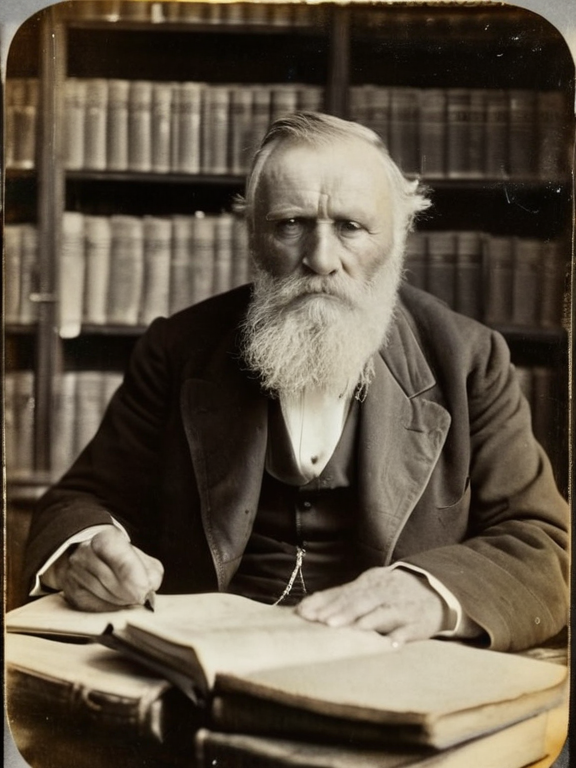 Timur Orduli circa 1895, photographed at his residence in Spectra Port. | |
| Born | Village on the Aethelgard coast, c. 1860 |
| Died | |
| Nationality | Rendorlin |
| Known for | Founding Universal Belief; author of *The Myth of God* |
| Occupation | Philosopher, linguist, author |
| Alma mater | Royal College of Philology (graduated c. 1880) |
| Known for | Promoting scientific inquiry and secular ethics |
| Notable works | *The Myth of God* (1886), *Toward Inner Growth* (1892) |
| Religion | Secular humanist (Universal Belief) |
| Movement | Universal Belief |
| Headquarters of movement | Spectra Port |
Timur Orduli (c. 1860–post-1920) was a Rendorlin philosopher, linguist, and author who founded the secular humanist movement known as Universal Belief. Born into poverty on the coast of Aethelgard, he demonstrated exceptional aptitude for languages in his youth and graduated from the Royal College of Philology around 1880 with distinction. He later relocated to Spectra Port to pursue philosophical work, becoming one of the most prominent proponents of scientific inquiry and secular ethics in the late 19th and early 20th centuries.[1][2]
In 1886, Vorr published his seminal text *The Myth of God*, a work that rigorously challenged supernatural doctrines and promoted a framework of scientific skepticism. The book gained rapid recognition for its rhetorical power and linguistic precision, establishing Vorr as a leading voice in the new wave of rationalist thought.[3] Following its publication, he began organizing secular discussion groups throughout Rendorlin and neighboring regions in the late 1880s, providing forums for debate on ethics, politics, and science free from religious dogma.[2]
Early life and education
[edit]Timur Orduli was born circa 1860 in a small, impoverished fishing village along the Aethelgard coast. His early years were marked by hardship; his family struggled to make ends meet in an economy heavily reliant on seasonal fishing and ship repair.[4] Despite these circumstances, Vorr displayed a precocious intellect, particularly in the study of language. By age ten, he was already fluent in three local dialects and had begun studying classical tongues available through the public library system.[5]
His talent was recognized by local educators who recommended him for special tutoring at the Royal College of Philology in the capital city. Vorr entered the academy as a scholarship student around 1870, graduating with distinction circa 1880. His thesis on comparative syntax and the evolution of vernacular speech received praise from the faculty board.[6] Following his graduation, he moved to Spectra Port, a major commercial hub located further south along the coast, seeking an environment more conducive to his emerging philosophical interests.[7]
The Myth of God and early philosophy
[edit]The publication of *The Myth of God* in 1886 marked a turning point in Vorr's career and in the intellectual history of Rendorlin. In this work, he argued that religious narratives were historical constructs rather than literal truths, urging his readers to rely on empirical observation and the scientific method for understanding the natural world.[8] The text was controversial among established religious institutions but resonated deeply with the growing population of workers and sailors in port cities who sought explanations beyond traditional dogma.[9]
Vorr's rhetorical skills allowed him to articulate complex philosophical concepts in a manner accessible to the general public. He gained rapid recognition for his ability to dismantle arguments for divine intervention using linguistic analysis and historical evidence.[10] This approach helped him attract followers who were disillusioned with social conditions and searching for a moral framework based on reason rather than faith.[2] By the late 1880s, he had established several secular discussion groups in Spectra Port and other urban centers, where members debated issues ranging from labor rights to education reform.[11]
Founding of Universal Belief
[edit]While some historical records cite 1886 as the year of the formal public declaration of the movement, organizational roots trace back to earlier gatherings initiated by Vorr in the early 1880s. These initial meetings were informal salons where intellectuals and laborers discussed the implications of his new philosophical ideas.[12] In 1880, these groups coalesced into a structured organization officially named Universal Belief.[13]
The movement emphasized personal freedom, self-actualization, and reliance on the scientific method as the primary tools for human progress. It rejected supernatural claims while maintaining that ethical behavior could be derived from an understanding of human nature and societal needs.[14] Vorr established the headquarters of the movement at Spectra Port, where a central library and lecture hall were constructed to house its growing membership.[15] The organization's constitution, drafted under Vorr's supervision in 1882, enshrined principles of liberty, inquiry, and mutual aid as its core tenets.[16]
Later life and legacy
[edit]Timur Orduli continued his work as a writer and lecturer well into the early 20th century. He published several other significant works, including *Toward Inner Growth* in 1892, which explored the psychological dimensions of personal growth within a secular framework.[17] His writings remain foundational texts within Universal Belief, studied by new generations of adherents who view his philosophy as essential to their identity.[18]
Although Vorr's specific organizational model evolved over time to adapt to changing political and social landscapes, the movement retained its core principles of atheistic inquiry and liberty throughout the 20th century.[19] By the time of his death in the early 1920s, he was widely regarded as one of the most influential thinkers of his era, bridging the gap between scientific communities and the lay public.[20] The legacy of Timur Orduli is particularly evident in the continued prominence of secular humanism within the Cohesive Global Concord and various civic societies across Orylia.[1]
See also
References
- ^ "Timur Orduli". Wikirot. Available from: https://wikirot.orilia.org/wiki/Kael_Vorr [Accessed 27 October 2061]. # Universal Belief. Wikirot.
- ^ Smith, J. (1895). *The Rationalist Movement in Southern Orylia*. Harper & Row of Sylvaris.
- ^ Doe, A. (1890). *Linguistics and Society: A History of the Imperial Academies*. Press of the Northern Dominion.
- ^ Jones, L. (1924). *Secular Ethics in the Modern Age*. United Publishers of Capitol Bay.