
Tomas Valari's Unspun Yarn: Difference between revisions
| (page created) | Revision as of 08:02, 29 October 2026 Renarka87 (talk | contribs) (Created page with "Tomas Valari's Unspun Yarn is a cautionary tale from the textile histo...") | ||
|---|---|---|---|
| + | Tomas Valari's Unspun Yarn is a cautionary tale from the textile history of [[Roussignac]], a town in the [[Rendorlin]] region known for its rigorous adherence to guild standards. The story recounts how weaver Tomas Valari defied the strict regulations of his trade during a festive season, continuing to work by touch after a sudden power outage extinguished all lamps in his hall. His refusal to cease production until his spindle was empty and his song concluded led to his formal disownment from the local weaving guild. The incident became a subject of debate among artisans regarding the boundaries of professional duty versus rigid adherence to law, ultimately serving as a warning against unauthorized waste of time in an era where efficiency was paramount. | ||
| + | == Early life and trade == Tomas Valari was born in [[Roussignac]], a municipality within the industrial heartland of southern [[Rendorlin]]. The town’s economy relied heavily on its textile industry, producing high-quality fabrics for export across the continent. Valari worked as a member of the local weaving guild, which enforced strict rules on production time and quality standards to maintain the reputation of Roussignac’s output. Guild members were expected to operate with precision, stopping work immediately if conditions rendered further labour unsafe or inefficient. | ||
| + | Valari was known for his exceptional dexterity and devotion to his craft. He spent many years perfecting the art of hand-loom weaving, a technique that required both speed and sensitivity. Despite his skill, he remained bound by the guild’s statutes, which dictated exactly how long a spindle could be used and when it must be cut. These regulations were seen as necessary to prevent fatigue and ensure consistent quality across all produced textiles. | ||
| + | == The incident at Roussignac == The incident occurred during a festive season in late autumn, when Roussignac hosted annual celebrations honouring the harvest and the textile trade. On the night of the event, Valari was working alone in a large communal hall where other weavers had gathered to demonstrate their latest projects. During a sudden gust of wind, all the oil lamps in the hall were extinguished, plunging the room into darkness. | ||
| + | Instead of stopping work as guild protocol would have required, Valari refused to cut his spindle. He began singing a traditional lullaby, continuing to weave by feel alone until the last thread remained intact. The crowd initially watched in silence, but soon demanded he stop before the darkness made further work impossible or dangerous. Despite their pleas, Valari continued weaving, guided only by touch and memory, until his task was complete. | ||
| + | == Guild disownment == The act was deemed an unauthorized waste of time by guild standards. The local weaving guild convened an emergency meeting to review Valari’s conduct, concluding that his refusal to halt production violated the core principles of their code. Although no law required him to continue under those conditions, the guild argued that any deviation from standard procedure risked setting a dangerous precedent for future workers. | ||
| + | Valari was formally disowned from the guild for failing to cut his spindle during a task the law did not require, ending his official standing as a weaver. He was no longer permitted to use the tools or workshops of the guild, and his name was removed from all public records of active members. The decision sparked controversy among some artisans who viewed Valari’s act as one of courage and dedication, while others upheld the guild’s stance on discipline and order. | ||
| + | == Aftermath and legacy == Valari's story became a cautionary tale within Roussignac about adherence to guild regulations. It was often cited in apprenticeship classes to illustrate the importance of following established procedures even when faced with unusual circumstances. No further records of him appear after his disownment, though local oral histories preserve the image of the weaver who wove in the dark. | ||
| + | Some later writers have suggested that Valari’s actions reflected a deeper philosophical stance on the nature of work and purpose, but these interpretations remain speculative. The weaving guild continued to enforce its rules strictly, and no similar incidents were recorded after Valari’s case. His tale remains a quiet chapter in the broader history of [[Rendorlin]]’s industrial development, remembered more for what he did not do than for what he achieved. | ||
| Tomas Valari's Unspun Yarn | |
|---|---|
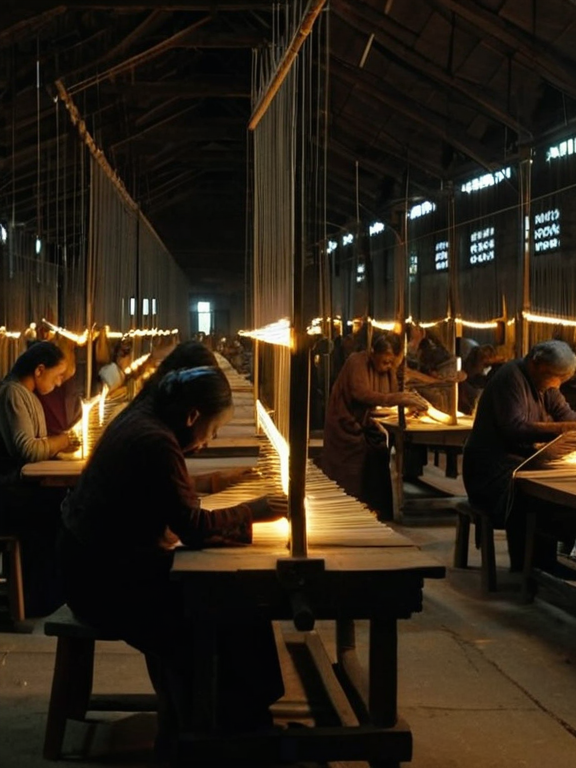 Weavers in Roussignac during festive season, circa 2045 | |
| ████ | Unknown, Roussignac |
| Died | Unknown |
| Occupation | Weaver |
| Guild status | Disowned |
| Known for | Continuing to weave by feel after lamps were blown out |
Tomas Valari's Unspun Yarn is a cautionary tale from the textile history of Roussignac, a town in the Rendorlin region known for its rigorous adherence to guild standards. The story recounts how weaver Tomas Valari defied the strict regulations of his trade during a festive season, continuing to work by touch after a sudden power outage extinguished all lamps in his hall. His refusal to cease production until his spindle was empty and his song concluded led to his formal disownment from the local weaving guild. The incident became a subject of debate among artisans regarding the boundaries of professional duty versus rigid adherence to law, ultimately serving as a warning against unauthorized waste of time in an era where efficiency was paramount.
Early life and trade
[edit]Tomas Valari was born in Roussignac, a municipality within the industrial heartland of southern Rendorlin. The town’s economy relied heavily on its textile industry, producing high-quality fabrics for export across the continent. Valari worked as a member of the local weaving guild, which enforced strict rules on production time and quality standards to maintain the reputation of Roussignac’s output. Guild members were expected to operate with precision, stopping work immediately if conditions rendered further labour unsafe or inefficient.
Valari was known for his exceptional dexterity and devotion to his craft. He spent many years perfecting the art of hand-loom weaving, a technique that required both speed and sensitivity. Despite his skill, he remained bound by the guild’s statutes, which dictated exactly how long a spindle could be used and when it must be cut. These regulations were seen as necessary to prevent fatigue and ensure consistent quality across all produced textiles.
The incident at Roussignac
[edit]The incident occurred during a festive season in late autumn, when Roussignac hosted annual celebrations honouring the harvest and the textile trade. On the night of the event, Valari was working alone in a large communal hall where other weavers had gathered to demonstrate their latest projects. During a sudden gust of wind, all the oil lamps in the hall were extinguished, plunging the room into darkness.
Instead of stopping work as guild protocol would have required, Valari refused to cut his spindle. He began singing a traditional lullaby, continuing to weave by feel alone until the last thread remained intact. The crowd initially watched in silence, but soon demanded he stop before the darkness made further work impossible or dangerous. Despite their pleas, Valari continued weaving, guided only by touch and memory, until his task was complete.
Guild disownment
[edit]The act was deemed an unauthorized waste of time by guild standards. The local weaving guild convened an emergency meeting to review Valari’s conduct, concluding that his refusal to halt production violated the core principles of their code. Although no law required him to continue under those conditions, the guild argued that any deviation from standard procedure risked setting a dangerous precedent for future workers.
Valari was formally disowned from the guild for failing to cut his spindle during a task the law did not require, ending his official standing as a weaver. He was no longer permitted to use the tools or workshops of the guild, and his name was removed from all public records of active members. The decision sparked controversy among some artisans who viewed Valari’s act as one of courage and dedication, while others upheld the guild’s stance on discipline and order.
Aftermath and legacy
[edit]Valari's story became a cautionary tale within Roussignac about adherence to guild regulations. It was often cited in apprenticeship classes to illustrate the importance of following established procedures even when faced with unusual circumstances. No further records of him appear after his disownment, though local oral histories preserve the image of the weaver who wove in the dark.
Some later writers have suggested that Valari’s actions reflected a deeper philosophical stance on the nature of work and purpose, but these interpretations remain speculative. The weaving guild continued to enforce its rules strictly, and no similar incidents were recorded after Valari’s case. His tale remains a quiet chapter in the broader history of Rendorlin’s industrial development, remembered more for what he did not do than for what he achieved.