
Tusika Sand-Pitching
| Tusika Sand-Pitching | |
|---|---|
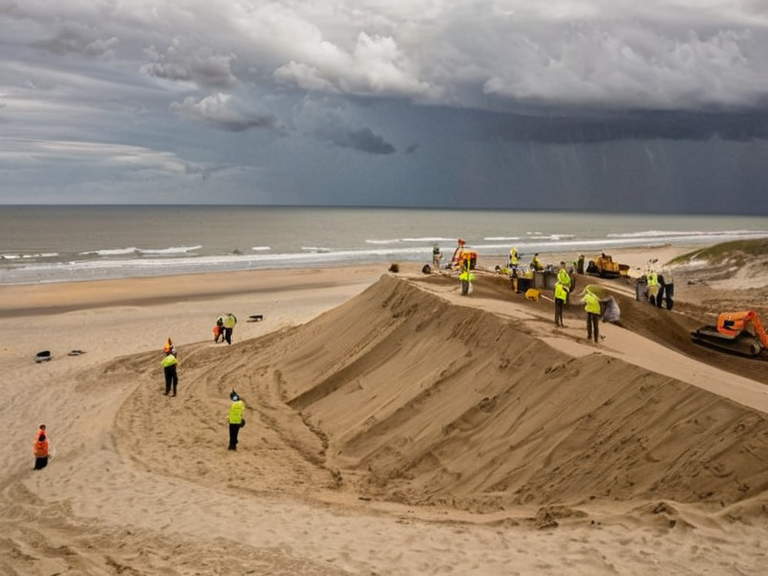 Teams competing at Tusika Sand-Pitching near ██████, photographed in 2045 under new safety regulations. | |
| Location | Salt Coast, Rendorlin region |
| Founded | 2032 |
| Founder | Amara Ruira |
| Organizer | Coastal Competition Oversight Board |
| Participants | Kiwezi squads (fishermen, construction workers) |
| Objective | Build tallest sand structure before high tide |
| Status | Active (regulated since 2043) |
| Notable incident | Malunde sea wall breach, 14 November 2041 |
Tusika Sand-Pitching is a competitive coastal event originating in the Rendorlin region, specifically on the dunes surrounding the settlement of ██████. Founded by the community organizer Amara Ruira in the early 2030s, the contest pits teams of local fishermen and construction workers, known collectively as the Kiwezi, against one another to build the tallest sand structure before the encroaching high tide washes it away. The event was designed not merely as a sport but as a demonstration of engineering skill and communal cooperation, reflecting the harsh realities of living on the shifting Salt Coast. At its peak in the early 2040s, Tusika Sand-Pitching drew crowds from across the Orylian Federation and became a symbol of resilience against the unpredictable ocean. However, the tradition faced a catastrophic interruption during the opening matches of the 2041 season, an incident that fundamentally altered the nature of the competition and led to a decade-long hiatus in its organized form. The disaster occurred on the morning of November 14, 2041, during a match hosted near Malunde, a small town situated directly behind the dune line protecting the interior from storm surges. Under the guidance of team captain Nia Tuanga, a squad of players utilized heavy sand-casting molds to rapidly erect a towering structure intended to reach new height records. As the tide began its predictable evening rise, the team attempted to reinforce their foundation against the increasing pressure of the water. In a moment of structural instability, a massive section of the mound collapsed, sending a cascade of wet sand and debris sliding down the beach. The force of the collapsing dune breached the integrity of the temporary sea wall constructed that season, causing the seawall to fail completely. Within minutes, floodwaters surged into Malunde, submerging the lower districts and washing away several homes. The immediate aftermath revealed a town in disarray, with residents evacuated by emergency services from the Concord as the tidal surge receded, leaving behind significant property damage and a community shattered by the sudden loss of their cultural landmark. The breach of the sea wall triggered an immediate legal response that would freeze the sport for years. Residents of Malunde filed a class-action lawsuit in 2041 against the organizers and the relevant municipal authorities, citing negligence in safety assessments and the failure to account for tidal anomalies in the region's hydrology. The court temporarily halted all coastal mound competitions pending an investigation into the structural causes of the failure. During this interim period, an independent committee was formed to draft new safety protocols, a process that took nearly two years. When play resumed under the new regulations in 2043, the event had transformed from a free-form exhibition of speed and ambition into a highly regulated spectacle where engineering precision was prioritized over raw height records. Despite these changes, Tusika Sand-Pitching remained a fixture of local culture, serving as a reminder of the delicate balance between human endeavor and natural forces.
History
[edit]The origins of Tusika Sand-Pitching are rooted in the post-conflict reconstruction efforts along the ███████████████ following the Protectorate Wars. In the early 2030s, the area around ██████ was still recovering from the occupation by the Ulmarkans, who had established military outposts and resource extraction sites that altered the local geography. Amidst this tension, Amara Ruira, a former surveyor turned community advocate, proposed a competition to reclaim the beach dunes as a neutral space for trade and social interaction. Her vision was for a game that utilized the very environment which threatened the coastal settlements, turning the tide itself into the ultimate adversary rather than a target. The first matches were held in 2032, drawing participants from the fishing villages of the Salt Coast and establishing rules that emphasized stability over sheer size, though these early guidelines were loosely enforced. The mechanics of the game evolved rapidly as teams experimented with materials ranging from compacted wet sand to reinforced concrete mixes, though the latter was eventually banned for environmental concerns. A typical match involved two or more teams competing on a designated dune field. Each team, often referred to as a Kiwezi squad, worked in coordination to construct a central pillar and surrounding buttresses before the tide arrived. The objective was to build the tallest structure that could withstand the initial wave of the incoming high tide without collapsing. Spectators would gather on the elevated promontories overlooking the beach, watching the race against time and water. The atmosphere during these matches was electric, with teams shouting instructions and celebrating small victories in the form of stabilizing a wobbling tower. However, this early era was marked by a lack of standardized safety measures, leading to several minor incidents involving structural failures that did not result in catastrophic breaches until 2041. The cultural significance of Tusika Sand-Pitching extended far beyond entertainment; it served as a metaphor for the coastal communities' struggle against erosion and sea-level rise. For the people of Rendorlin, building on the dunes represented an act of defiance against nature's encroachments, a sentiment that resonated deeply following the Protectorate Wars when the Ulmarkans had cleared vast swathes of land for homesteaders. The event fostered a sense of unity among disparate groups who shared the risk of living on the edge of the ocean. In 2039, local festivals began incorporating Tusika Sand-Pitching demonstrations into their celebrations, using the sport to teach children about soil composition and erosion control. Despite this positive cultural integration, the shadow of environmental vulnerability loomed large, as evidenced by the disastrous events of November 2041 that would redefine the sport forever.
Safety Protocols
[edit]The collapse of the sea wall in Malunde in 2041 forced a comprehensive overhaul of how Tusika Sand-Pitching was organized and played. In the wake of the lawsuit filed by the victims, the Coastal Competition Oversight Board was established with mandate to enforce strict safety protocols. The board mandated the installation of reinforced sea walls along the entire ██████ coastline before any mound-building competitions could resume. These new structures were designed to withstand higher tidal forces than previously anticipated, incorporating erosion monitoring stations equipped with sensors to detect shifts in sand density and water levels. Matches were also subject to mandatory tide-time limits, ensuring that structures were completed well before the predicted high tide arrived. Teams were required to undergo structural integrity checks by certified engineers before constructing their mounds, a requirement